Introduction:
India’s domestic security framework achieved a structural milestone on 31 March 2026, declaring the nation effectively free from the threat of Left-Wing Extremism (LWE) after nearly six decades of armed conflict with a comprehensive whole-of-government approach, national planning has successfully neutralized the asymmetric networks of Naxalism. This integrated strategy balances decisive counter-insurgency grids with aggressive Digital Public Infrastructure (DPI) expansion and targeted tribal welfare, shifting the Red Corridor from a zone of conflict into an active contributor to Viksit Bharat 2047.
Key Takeaways
-
- Geographic Consolidation: LWE-affected regions collapsed from 126 districts in 2014 to just 2 districts in 2026, while the number of “most affected districts” was reduced from 35 to an absolute zero.
- Decline in Violence Metrics: Annual Naxal-related incidents dropped from a historical peak of 1,936 in 2010 (resulting in 1,005 fatalities) to 234 incidents and 100 fatalities in 2025.
- The Intelligence & Operational Vacuum: Filled the security gap by constructing 597 Fortified Police Stations and establishing 408 Central Armed Police Force (CAPF) security camps across isolated forest zones.
- Macro Infrastructure Delivery: Constructed over 12,249 km of all-weather roads and deployed 9,600 mobile towers, bringing digital and physical connectivity to 96% of formerly isolated tribal villages.
Conceptual Evolution of Naxalism
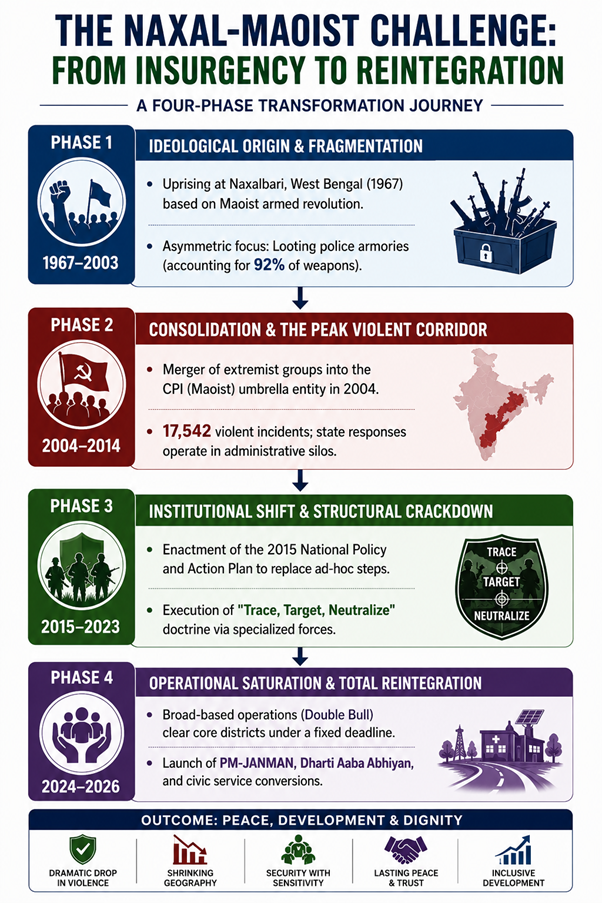
Background: The LWE challenge originated from the Naxalbari uprising in West Bengal in 1967, guided by Maoist political theory that advocated replacing democratic institutions with a totalitarian agrarian state through armed revolution. For decades, the structural core of this movement relied on tactical violence, asymmetric warfare, and weapon acquisition via targeted raids on state armories, which supplied 92% of the insurgent arsenal.
The threat matrix escalated significantly in 2004 with the merger of multiple extremist factions into the CPI (Maoist), creating a contiguous “Red Corridor” that disrupted local governance across central India. Between 2004 and 2014, this consolidated front conducted 17,542 violent incidents, resulting in 1,913 security force casualties and 5,019 civilian deaths. The geographic spread stretched federal resources, with state police forces operating in administrative isolation without an integrated counter-insurgency doctrine.
The Institutional Anti-LWE Framework: “Vishwaas, Nirman, and Jan Kalyan”
1. Vishwaas — Tactical Security Operations and Financial Choking:
The first pillar transformed the state’s security stance from passive containment to the proactive elimination of insurgent leadership:
-
- The Specialized Force Multiplier: Operations combined the jungle-warfare expertise of the CoBRA (Commando Battalion for Resolute Action) unit with the District Reserve Guard (DRG), Special Task Forces (STF), and Andhra Pradesh’s Greyhounds, creating an interoperable tactical force.
- Sustained Intelligence-Led Operations: Coordinated maneuvers—such as Operation Black Forest, Operation Octopus, and Operation Double Bull—cleared core insurgent strongholds in the Gumla, Lohardaga, and Latehar districts. This was supported by 68 night-landing helipads to facilitate rapid troop deployment and casualty evacuations.
- All-Agency Financial Disruption: A specialized vertical within the National Investigation Agency (NIA), working alongside the Enforcement Directorate (ED), targetted the economic support structures of LWE. This led to 112 formal prosecutions and the seizure of over ₹92 crore in laundered assets and extortion proceeds by June 2026.
- Red Carpet Rehabilitation: Operational pressure was balanced by an aggressive surrender framework, which provided immediate grants of up to ₹5 lakh, a monthly stipend of ₹10,000 for 36 months, and extra compensation for weapon deposits. This mechanism induced 3,927 insurgent surrenders between 2024 and March 2026.
2. Nirman — Expanding Physical and Digital Connectivity Infrastructure:
The second pillar looked to remove the geographic isolation of tribal pockets, replacing administrative vacuums with physical and digital infrastructure:
-
- The Logistics Spine: Capital allocations of ₹20,557 crore funded the construction of 12,249 km of durable roads in high-risk zones, giving state forces rapid transit capabilities while connecting local farmers to commercial markets.
- Digital Public Infrastructure (DPI) Penetration: The Department of Telecommunications placed over 9,600 mobile towers across the corridor, bringing cellular connectivity to 96% of formerly isolated villages (44,728 out of 46,592 locations).
- Financial and Educational Deepening: Between 2015 and 2026, the state established 1,804 new bank branches, 1,321 ATMs, and 6,025 rural post offices to formalize the local cash economy. This was supported by developing 179 Eklavya Model Residential Schools (EMRS) and 46 Industrial Training Institutes (ITIs) to provide vocational skills to over 90,000 tribal youth.
3. Jan Kalyan — Tribal Welfare, Local Governance, and Reintegration:
The final pillar focused on institutionalizing public dignity, converting security improvements into permanent democratic participation:
-
- Targeted Human-Centric Interventions: Welfare delivery scaled up by combining the Aspirational Districts Programme with the PM-JANMAN initiative, which prioritizes Particularly Vulnerable Tribal Groups (PVTGs) by guaranteeing secure housing under PMAY, clean drinking water, and diagnostic healthcare access.
- The Dharti Aaba Gram Utkarsh Mandate: This multi-ministerial initiative works to eliminate lingering infrastructure gaps in tribal villages, providing development grants to panchayats that remove extremist influence.
Challenges
-
- The Hindu (The Grey-Zone Cyber Recruitment and Ideological Remnants): While physical insurgent strongholds have been removed, security assessments indicate that remnants of LWE are shifting toward grey-zone cyber operations. These networks utilize encrypted social media channels to spread propaganda among urban youth and vulnerable student bodies, creating a decentralized radicalization threat.
- Indian Express (The Inter-State Border Border Friction and Tactical Relocation): The rapid consolidation of LWE down to just two districts creates a risk of tactical relocation across porous state lines. Insurgent remnants occasionally exploit differences in center-state police coordination to find temporary shelter in dense border forests.
- Observer Research Foundation (The Post-Conflict Land Rights and Corporate Trust Deficit): Sustaining long-term peace in the cleared tracts of Bastar requires careful management of tribal land alienation. If local populations feel that development initiatives favor large corporate mining interests over traditional community forest rights, it could renew historical grievances.
- PRS Legislative Research (The Statutory Void in Panchayats Extension to Scheduled Areas): The political integration of cleared zones faces hurdles due to the uneven implementation of PESA (Panchayats Extension to Scheduled Areas) rules across various states, limiting the transfer of real administrative power to local tribal assemblies.
- Government Audit Portals (The Last-Mile Maintenance Asset Drag): While the Nirman pillar deployed over 9,600 mobile towers and thousands of kilometers of rural roads, regional state budgets face a heavy fiscal maintenance drag. Local administrations often lack the operational funds to protect these assets from weather damage and logical wear.
Way Forward
-
- Enacting Uniform PESA Statutory Rules (PRS Approach): State legislatures should immediately pass standardized, comprehensive PESA rules to institutionalize local tribal autonomy, ensuring that local communities exercise direct control over minor forest produce and land alienation disputes.
- Deploying Joint Inter-State Border Command Centers (Indian Express Option): To prevent tactical relocation across state lines, the Ministry of Home Affairs should set up permanent Joint Border Command Centers run by unified police units to monitor porous forest borders in real time.
- Transitioning CAPF Camps into Shared Civic Action Nodes (Government Portal Goal): Accelerating the expansion of the Shaheed Veer Gunda Dhur Seva Dera model to convert remaining forward camps into integrated public service hubs, ensuring continuous delivery of banking, healthcare, and agricultural tools.
- Establishing Localized Infrastructure Maintenance Trust Funds (ORF Strategy): To address the long-term asset maintenance drag, the government should set up dedicated infrastructure trust funds using regional mining royalties, ensuring stable funding to maintain rural roads and mobile connectivity networks.
Conclusion:
India’s historic transition to an effectively Naxal-free state highlights a major achievement in internal security governance, moving from reactive containment to integrated pre-emption. Maintaining this momentum through synchronized inter-state border policing and community-led forest asset management will ensure that the former Red Corridor remains a secure foundation for a prosperous, inclusive Viksit Bharat @2047.
Spread the Word