Introduction:
India’s domestic security framework has transitioned from a reactive, containment-oriented posture into an integrated, preventive deterrence doctrine by combining severe statutory penalties, advanced cross-agency data links, and assertive tactical actions, national security planning has built a policy of zero tolerance against terrorism. This systematic restructuring eliminates the operating spaces of asymmetric threat networks, protecting national sovereignty while building the safe environment required to sustain economic development.
Key Takeaways
-
- The Legislative Anchor: The UAPA Amendment of 2019 updated counter-terror litigation by allowing the central government to designate individual actors as terrorists, blacklisting over 57 high-value operators to collapse decentralized cells.
- The Intelligence Fusion Grid: The Multi-Agency Centre (MAC) network received a ₹500 crore technological upgrade using advanced AI and Machine Learning tools, connecting 28 central and state organizations for real-time risk assessment.
- Doctrinal Strategic Shift: The execution of the 2016 Surgical Strikes, the 2019 Balakot Airstrike, and Operation Sindoor in 2025 established a new pattern of pre-emptive cost-imposition on cross-border terror hubs.
- The Unified Codification: The launch of PRAHAAR in February 2026 provides India’s first comprehensive National Counter-Terrorism Policy and Strategy, institutionalizing a whole-of-government blueprint across land, air, sea, and cyberspace.
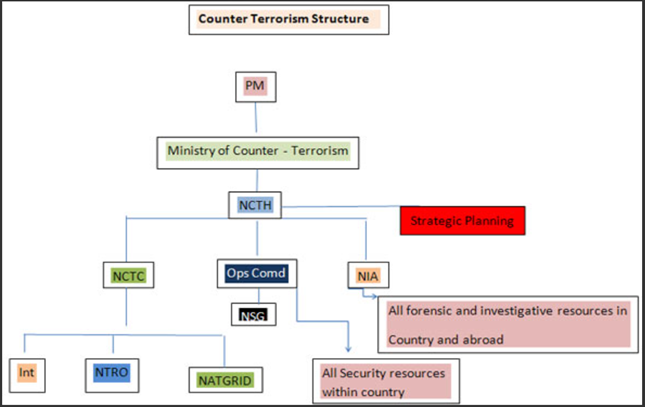
Institutional Matrix of India’s Internal Security Infrastructure. Source: IDSA
Step-by-Step Evolution of India’s Counter-Terror Ecosystem
Step 1: Confronting Systemic Vulnerabilities and Inherited Threats (2014–2015):
The initial phase of counter-terrorism reform focused on addressing a complex security environment shaped by fragmented command structures and high levels of local instability. The preceding decade (2004–2014) had recorded 7,217 terrorist incidents, with cross-border infiltration from networks like Lashkar-e-Taiba and Jaish-e-Mohammed constantly testing the internal security grid. This friction was intensified by Kashmir separatism and Over-Ground Worker (OGW) networks, which drove an average of 2,654 organized stone-pelting incidents annually between 2010 and 2014. At the same time, the emergence of international networks like ISIS introduced online radicalization through encrypted applications and dark-web channels, highlighting the urgent need to upgrade defensive capabilities.
Step 2: Doctrinal Reset and Core Legislative Re-Engineering (2016–2019):
The state executed a major strategic shift by moving away from historical restraint toward an assertive doctrine of pre-emptive deterrence and cost-imposition. This found expression in the 2016 precision Surgical Strikes and the 2019 Balakot Airstrike, establishing a precedent that cross-border provocations would face direct military consequences. This operational shift was matched by important legislative steps:
-
- The UAPA Amendment Act (2019): Granted the central government the power to designate individuals as terrorists, preventing financiers from hiding behind altered organization names. It also empowered NIA Inspectors to lead investigations and authorized the Director-General to directly seize assets linked to terror proceeds.
- The National Investigation Agency Amendment Act (2019): Granted the NIA extraterritorial jurisdiction to investigate crimes committed outside India against domestic interests, while expanding its scope to cover cyberterrorism and human trafficking.
- Global Sanctions Cooperation: This domestic legal expansion helped secure the UN Security Council designation of Masood Azhar as a global terrorist in May 2019, clearing international blocks on travel and assets.
Step 3: Institutional Scaling and AI Data-Grid Integration (2020–2024):
To process the high volume of real-time data required by modern security operations, the government systematically digitized its central enforcement systems:
-
- National Intelligence Grid (NATGRID): Deployed an analytical framework connecting 11 central user agencies with all 28 states and 8 Union Territories. It utilizes the GANDIVA multi-source analytics tool alongside the Organized Crime Network Database (OCND) to track finance trails instantly.
- CCTNS 2.0 Infrastructure: Launched an AI-powered system linking all 17,798 police stations across the country, removing old communication barriers between regional police headquarters.
- The ASUMP Police Modernization Fund: Supported by a ₹4,846 crore budget, this fund upgraded state police forces with advanced communication arrays, tactical gear, and counter-IED equipment.
- The Bharatiya Nyaya Sanhita (BNS), 2023: Replaced the legacy IPC to explicitly define and criminalize terrorist acts within standard penal law, introducing mandatory life sentences or the death penalty.
Step 4: Cyber Commands, Extraditions, and Policy Codification (2025–2026):
The final step involved creating specialized platforms to counter digital operations, managing high-value legal extraditions, and finalizing unified policy guidelines:
-
- The Cyber Multi-Agency Centre (CyMAC): Launched on 22 January 2025 as a specialized wing under the MAC platform to coordinate actions against cyber espionage, digital radicalization, and alternative payment threat vectors.
- The BHARATPOL Network: Deployed on 7 January 2025 to link the CBI directly with local law enforcement, helping accelerate the historic extradition of Mumbai attack plotter Tahawwur Rana from the United States.
- The PRAHAAR Policy Rollout: Released in February 2026, this strategy coordinates national resources to protect critical sectors like atomic energy, aerospace, and digital utilities. It establishes a clear, secular counter-terror model that separates threat networks from civil identities.
Comparative Analysis: A professional infographic summarizing these results would display the sharp downward trajectory of civilian casualties alongside the drop in stone-pelting incidents to illustrate the stabilization of local security environments. The long-term impact of these step-by-step institutional changes is shown in the definitive improvement across major conflict indicators:
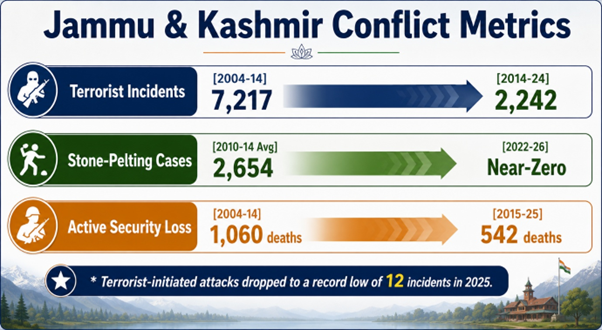
This stabilization supported local economic growth, leading to a record 2.3 crore tourist arrivals in 2024. Additionally, Jammu & Kashmir drew ₹18,000 crore in targeted new business investments between 2016 and 2026, outperforming the total capital inflows of the previous seven decades.
Challenges
-
- The Hindu (The Asymmetric Lone-Wolf and Digital Radicalization Layer): Analysis indicates that despite the deployment of CyMAC, tracking decentralized, peer-to-peer radicalization on end-to-end encrypted chat lines remains difficult, shifting risks toward unpredictable, lone-wolf actions.
- Indian Express (The Low-Altitude Drone Logistics Vulnerability): Ground reports show that cross-border actors are increasingly using low-altitude commercial drones to drop weapons, electronics, and fake currency, presenting a challenge for traditional air-defense radar networks.
- Observer Research Foundation (The Hybrid OGW Networks and Grey-Zone Finance): Intelligence files reveal that traditional terror models have evolved into loosely coupled Over-Ground Worker networks that utilize digital wallet transfers, making standard financial tracking less effective.
- PRS Legislative Research (State-Level Delays in Criminal Code Updates): The operational speed of the new BNS 2023 codes faces friction from slow administrative adaptations within regional police manuals, creating a gap in unified interstate law enforcement.
- Government Audit Portals (The Frontline Forensic Application Gap): While the ₹4,846 crore ASUMP fund supplies advanced diagnostic equipment, a gap persists between the complex software tools used by state labs and the baseline technical training of local police investigators.
Way Forward
-
- Passing a Statutory Interstate Data Synchronization Code (PRS Approach): Parliament should pass a comprehensive legal framework to make real-time data sharing between state networks and NATGRID mandatory, eliminating local processing delays.
- Deploying Layered Radio-Frequency Counter-Drone Webs (Indian Express Option): To secure border spaces, the Ministry of Home Affairs should place automated counter-drone systems along sensitive segments to intercept low-flying unmanned devices instantly.
- Implementing Graph-Analytics for Link-Analysis Mapping (ORF Strategy): To counter hybrid OGW cells, the NIA and state intelligence teams should use advanced graph-database analytics, tracking micro-transactions across digital wallets to flag grey-zone funding patterns.
- Deploying Autonomous District Cyber-Forensic Units: In line with the modernization targets set by government portals, establishing specialized forensic cells at the district level will accelerate evidence compilation and preserve the high conviction rates of the NIA.
- Standardizing the PRAHAAR Doctrine across Municipal Units: Incorporating the newly issued 2026 national strategy directly into local police training, ensuring uniform, tech-driven threat response and inter-agency coordination at the municipal level.
Conclusion:
India’s structural counter-terrorism evolution marks a successful transition from a reactive security setup to an integrated, data-driven framework of preventive pre-emption by matching strong legal tools like the BNS and UAPA with advanced real-time tracking networks and clear diplomatic strategies, the country has significantly lowered internal security risks.
Spread the Word