Introduction:
India’s space framework by combining high-gestation deep-space milestones with deep structural market liberalizations and single-window statutory clearances has institutionalized a policy of sovereign capacity building. This systematic approach lowers operational costs, builds resilient domestic supply chains, and establishes the physical infrastructure required to anchor the nation’s technological security for Viksit Bharat @2047.
Key Takeaways
-
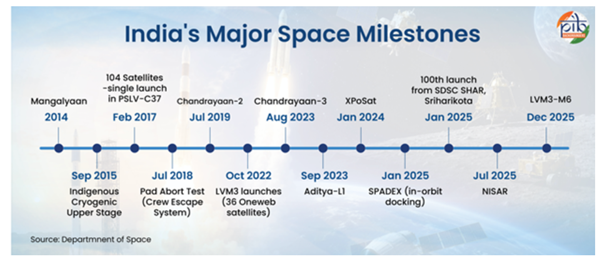
- Deep-Space Triumphs: Achieved a global milestone with Chandrayaan-3, becoming the first nation to soft-land a payload at the Moon’s lunar south pole ($69.3^\circ$ South latitude), alongside successfully positioning the Aditya-L1 solar observatory.
- Commercialization Scaling: Driven by NSIL and IN-SPACe single-window architectures, commercialization revenues increased multi-fold, supporting an ecosystem that expanded from one space startup in 2014 to over 400 by February 2026.
- Capital Account Deregulation: The updated Foreign Direct Investment (FDI) policy enforces a liberalized regime, permitting up to 74% automatic FDI for satellite operations and up to 49% for launch vehicles and spaceports.
- Launch Infrastructure Saturation: Approved a ₹3,984.86 crore Third Launch Pad at Sriharikota to support next-generation human spaceflight, while constructing a second spaceport at Kulasekarapattinam for small satellite launch vehicles.
Deep-Space Exploration and Human Spaceflight Pipeline:
The core column of India’s planetary exploration program focuses on building independent mission capabilities capable of executing complex interplanetary profiles:
-
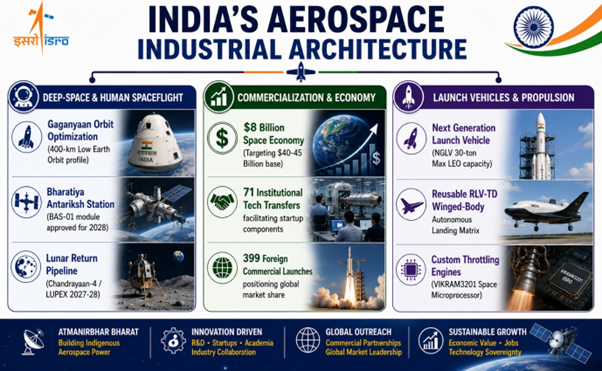
- The Lunar Sample-Return Matrix: Capitalizing on Chandrayaan-3’s direct in-situ discovery of lunar Sulphur, the upcoming Chandrayaan-4 (2027) introduces an advanced sample-return engineering architecture. This operates in parallel with the joint ISRO-JAXA Chandrayaan-5/LUPEX mission designed to drill for subsurface volatile ice deposits.
- Gaganyaan Operational Readiness: The final orbital phase of the Gaganyaan human spaceflight program is supported by data from the Axiom-4 mission (2025). During this mission, Indian astronauts conducted microgravity experiments aboard the International Space Station, establishing crew readiness for the five-module Bharatiya Antariksh Station (BAS) planned for 2028.
- Autonomous In-Orbit Assembly: The Space Docking Experiment (SPADEX) in January 2025 successfully validated autonomous docking, power transfer, and robotic microgravity manipulation, creating the foundational technology required to construct modular orbital space labs.
Reusable Launch Systems and Propulsion Engineering:
To lower the cost of access to low-Earth and geostationary orbits, India’s launch transport infrastructure has pivoted toward reusable, high-capacity engineering designs:
-
- The Next Generation Launch Vehicle (NGLV): To replace legacy single-use configurations, the government approved the development of the NGLV, providing a maximum payload capability of 30 tons to Low Earth Orbit (LEO), alongside a partially reusable 14-ton variant.
- The Winged-Body RLV-TD Framework: The Reusable Launch Vehicle Technology Demonstrator program has successfully validated autonomous navigation guidance codes and reusable thermal protection shields through three consecutive autonomous runway landing experiments.
- Propulsion and Avionics Indigenization: Major upgrades include Electric Propulsion Systems (EPS) for satellite life extension and Bootstrap Ignition Technology for multiple restarts of the CE20 cryogenic engine. This is secured by the VIKRAM3201, India’s first fully indigenous 32-bit space microprocessor developed with the Semiconductor Laboratory (SCL), Chandigarh.
Space-Based Public Goods and Data-Driven Governance:
Beyond exploration, satellite infrastructure functions as a critical public utility, embedding real-time geospatial intelligence directly into civil administration:
-
- The NavIC Geo-Spatial Grid: India’s indigenous satellite navigation system, NavIC, has deployed second-generation NVS-01 and NVS-02 satellites, providing continuous regional timing and positioning across a network now extending via international reference stations to South Africa.
- Emergency Response Infrastructure: High-resolution sensors run real-time tracking across the National Database for Emergency Management (NDEM 5.0), while coastal fishing fleets utilize indigenous Distress Alert Transmitters (DATs) alongside Potential Fishing Zone (PFZ) data to lower fuel consumption.
- Democratized Digital Access: Under the PM e-VIDYA framework, GSAT-15 and GSAT-9 satellites deliver 370 educational television channels directly to remote zones, matching the telemetry reach of 179 operational telemedicine nodes active across strategic high-altitude blocks like Siachen and Ladakh.
Challenges
-
- The Hindu (The Advanced GTO Payload Weight Bottleneck): While the current launch inventory successfully routes 4.2 tons to Geo-Synchronous Transfer Orbit (GTO) via LVM3, transitioning to heavy-weight commercial communication platforms above 5 tons remains constrained by delays in the final deployment of the Next Generation Launch Vehicle, leaving a structural payload gap.
- Indian Express (The High-Gestation Venture Funding Gap for Upstream Hardware): Despite the registration of over 400 space startups, private capital flows remain highly clustered around downstream software applications. Upstream deep-tech hardware startups face a steep cash-flow challenge due to the lack of long-term commercial venture equity for testing complex engine prototypes.
- Observer Research Foundation (The Global Space Debris Liability and Traffic Complexity): Expanding India’s commercial launch footprint to capture 8% of the global market by 2030 demands increased asset density. This expansion faces challenges from growing orbital traffic congestion and international space debris liability regimes, which complicate autonomous docking maneuvers like SPADEX.
- PRS Legislative Research (The Statutory Void in National Space Liability Law): The introduction of the Norms, Guidelines and Procedures (NGP) 2024 provides operational transparency, but the absence of an omnibus national space act leaves private launch operators exposed to unclear legal liability boundaries regarding international cross-border anomalies.
- Government Audit Portals (The Geographic Disconnect in Aerospace Labor Specialization): Advanced aerospace engineering skills remain heavily concentrated in elite national institutes, creating a talent absorption bottleneck for regional MSMEs looking to join the supply chain.
Way Forward
-
- Passing a Comprehensive National Space Act (PRS Approach): Parliament should pass an integrated legislative framework to clearly define third-party liability limits for private launch services, legalize commercial space mining guidelines, and protect domestic intellectual property rights.
- Establishing Sovereign Aerospace Venture Funds via GIFT City (ORF Strategy): To support upstream deep-tech hardware fabrication, the government should deploy specialized, tax-exempt venture credit windows within the GIFT International Financial Services Centre, de-risking private investments into experimental propulsion systems.
- Deploying Autonomous Space Traffic Coordination Desks (Indian Express Option): To safeguard upcoming assets like the Bharatiya Antariksh Station, ISRO should integrate real-time AI-led collision tracking codes with automated orbital debris detection arrays, optimizing the SPADEX docking framework.
- Scaling Up Private Sector Technology Transfers via IN-SPACe: Moving beyond the 71 initial technology transfers to systematically license advanced cryogenic engine blueprints and Small Satellite Launch Vehicle (SSLV) structures to domestic aerospace consortia, accelerating commercial manufacturing scales.
- Decentralizing Specialized VLSI and Propulsion Skilling: Utilizing the expanded public-private networks of the Indian Institutes of Skills (IIS) to deploy industry-aligned micro-credentials in mechatronics, satellite data processing, and composite alloy metallurgy across Tier-2 and Tier-3 educational hubs, closing the talent gap.
Conclusion:
The evolution of India’s space ecosystem over the past decade highlights a successful transition from a localized scientific program into a high-density, globally competitive space power by matching landmark deep-space triumphs like Chandrayaan-3 with aggressive institutional market liberalizations and single-window IN-SPACe clearances which has significantly enhanced its national economic sovereignty.
Spread the Word