Indian Polity & Governance
High-Level Committee on Demographic Change:
Context: The Centre has constituted a high-level committee to examine rapid demographic shifts, framing them as a challenge to national and internal security.
-
- Leadership: The high-level committee is chaired by retired Supreme Court Judge, Justice P.P. Naolekar.
- Nodal Ministry: The Ministry of Home Affairs (MHA) acts as the nodal agency for this panel’s setup and operations.
- Objective: To assess “abnormal shifts” among various religious and regional communities to study potential threats to internal security.
- Mandate Boundaries: Unlike a standard Census body, it focuses on analysing specific geopolitical borders and sensitive border districts experiencing rapid population changes.
- Core Concerns Raised: Experts flag that reliance heavily on documentation risks establishing a sizable stateless population.
- Human Rights Dynamic: Critiques focus on the possibility of structural profiling of minority populations under a purely securitized lens.
- Constitutional Link: Demographic management directly links to the Directive Principles of State Policy (DPSP) under Article 38 (promoting public welfare).
- Static Link (Preventive Laws): The committee’s data will heavily feed into regional security frameworks that often rely on preventive detentions.
- Static Link (The Seventh Schedule): While “Population control and family planning” sits in the Concurrent List (List III, Entry 20A), “Internal Security/Public Order” is a State List subject, making MHA coordination crucial.
- Static Link (Census vs Panels): Regular Census activities fall under the Union List (Entry 69) and are governed by the Census Act, 1948, whereas this specific committee is a non-statutory executive panel created for security policy inputs.
(TH)
International Relations
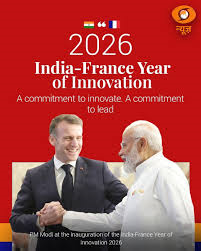
India-France Launch “Year of Innovation 2026”:
Context: Advancing their strategic partnership, India and France have officially activated the “India-France Year of Innovation 2026” during the G7 sidelines.
-
- Primary Event Launch: The initiative features the debut of the “Bharat Innovates” exhibition, showcasing Indian deep-tech solutions.
- Venues: Joint startup and technology summits are scheduled across Nice and Paris alongside Europe’s famous VivaTech Summit.
- Host Status: The bilateral push coincides with France holding the current Chair of the G7 for 2026.
- Summit Location: France is hosting the main 2026 G7 Summit in the resort town of Evian.
- Focus Sectors: Deep tech, green hydrogen storage, artificial intelligence ethics, and space-based maritime tracking systems form the core of the 2026 partnership.
- Africa Trilateral Target: The framework includes provisions for Franco-Indian co-development of technology solutions for West African nations, an area previously underutilized.
- Static Part (G7 Composition): The G7 is an informal bloc of advanced economies: US, UK, France, Germany, Italy, Canada, and Japan. The European Union is a non-enumerated member. India is not a member but is invited regularly as an outreach partner.
- Static Part (India-France Space ties): India and France share a deep space legacy via ISRO and CNES (e.g., TRISHNA satellite mission for thermal infrared imaging).
- Strategic Autonomy Alignment: Both nations share a foreign policy doctrine emphasizing “Strategic Autonomy,” avoiding rigid block alliances.
- Economic Footprint: France ranks among the top 10 Foreign Direct Investment (FDI) contributors to India, with major defense aerospace links (Rafale, Scorpene submarines).
(PIB)
Ecology & Environment and DM
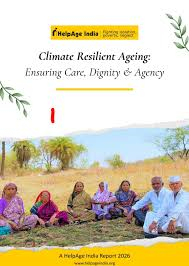
HelpAge India Report on Climate Risks to the Elderly:
Context: HelpAge India has released a study warning that accelerating climate change combined with increasing urban social isolation is creating an intersectional crisis for India’s elderly.
-
- Dual Threat Matrix: The report identifies that extreme weather (heatwaves, urban flooding) and expanding social isolation are compounding health risks for senior citizens.
- The Urban Heat Island (UHI) Target: Elderly populations in dense urban concrete pockets face disproportionately higher cardiovascular strain during prolonged heat waves.
- The Mobility Bottleneck: Sudden climate disasters (like flash floods) heavily impact the elderly due to lack of customized evacuation channels and single-person households.
- Economic Aspect: A high percentage of India’s elderly lack regular pension structures, making post-disaster livelihood or medical recovery difficult.
- Gendered Impact: Eldest women experience greater vulnerability due to longer life expectancy, lower asset ownership, and deep-seated nutritional imbalances.
- Static Part (Demographic Dividend Shift): India’s elderly population (aged 60 and above) is projected to double to over 20% of the total population by 2050, transitioning India toward an aging society.
- Static Part (Constitutional Mandate): Article 41 of the Constitution (DIPC) explicitly states that the State shall make effective provision for securing the right to public assistance in cases of old age, sickness, and disablement.
- Static Part (Legislative Framework): The Maintenance and Welfare of Parents and Senior Citizens Act, 2007 makes it a legal obligation for heirs to provide maintenance, and mandates senior citizen care cells.
- National Policy Link: The National Policy on Older Persons (NPOP) manages institutional health infrastructure, but lacks updated mandates integrating climate resilience models.
- SDG Target: Addressing this intersection is critical to achieving SDG 3 (Good Health and Well-being) and SDG 10 (Reduced Inequalities).
(TH)
Science & Technology
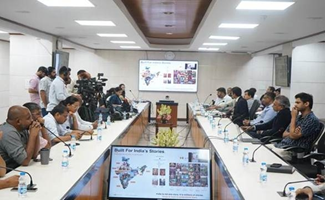
IndiaAI Mission-Backed Video Model “Varya” Launched:
Context: Underscoring India’s domestic deep-tech push, the Ministry of Electronics and Information Technology (MeitY) unveiled “Varya,” the nation’s first indigenous distilled video story-generating AI model.
-
- Developer: The model was built by an AI-native firm named Avataar.ai.
- Public Support Engine: The model’s development was funded and accelerated under the government’s flagship IndiaAI Mission.
- Technical Distinction: It is classified as an indigenous distilled video generative model, designed to run efficiently with lower computational overhead than Western counterparts.
- Infrastructure Base: Varya was trained using India’s sovereign national AI supercomputing infrastructure nodes.
- Sovereign Tech Goal: The launch reduces dependence on foreign foundational models (like OpenAI’s Sora) for content and simulation workflows.
- Static Part (IndiaAI Mission): This is a comprehensive statutory/executive umbrella initiative under MeitY with an outlay of over Rs 10,300 crore to build compute capacity, data centers, and native LLMs.
- Sovereign Compute Strategy: A key objective of the mission is establishing an AI computing infrastructure of at least 10,000 graphics processing units (GPUs) through public-private partnerships.
- Static Part (Distillation in AI): “Knowledge Distillation” is a machine learning process where a smaller, compact model (the student) is trained to reproduce the behavior and output of a massive, compute-heavy model (the teacher) without losing significant accuracy.
- Application Scope: Beyond entertainment, it targets generating spatial maps, educational models, and agricultural simulation videos in regional languages.
- Data Sovereignty Protection: By utilizing domestic compute infrastructures, the model keeps localized training datasets entirely within Indian legal jurisdiction.
(ET)
Defence
Historic First Batch of Women Cadets Commissioned from NDA:
Context: Marking a historic breakthrough in the armed forces, the first batch of 17 women cadets trained at the National Defence Academy (NDA) have been commissioned into active service.
-
- Distribution: The 17 women officers completed their secondary specialized pre-commission training across the three sister service academies.
- Army Allocation: 9 women officers were commissioned into the Indian Army at the Indian Military Academy (IMA), Dehradun.
- Air Force Allocation: 5 women officers were commissioned into the Indian Air Force at the Air Force Academy (AFA), Dundigal.
- Navy Allocation: 3 women officers joined the Indian Navy at the Indian Naval Academy (INA), Ezhimala.
- The Judicial Origin: This milestone is the direct outcome of a Landmark Supreme Court judgment that declared the exclusion of women from the NDA unconstitutional.
- Constitutional Violations Remedied: The apex court held that denying entry violated Article 14 (Equality before Law) and Article 16 (Equal Opportunity in Public Employment).
- Combat Employment Shift: This transitions Indian women military personnel from short-service support roles into permanent commission combat and combat-support pathways from the foundational training level.
- Static Part (NDA Command): The National Defence Academy (located at Khadakwasla, Pune) is the world’s first tri-service academy where cadets for the Army, Navy, and Air Force train together.
- Article 33 Exception: Article 33 allows Parliament to restrict fundamental rights for armed forces personnel to ensure discipline, but judicial review still monitors institutional discrimination.
- Strategic Impact: Aligns India with global military powers (like the US and UK) regarding modern gender parity standards in command tracks.
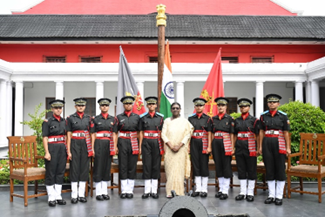
(PIB)
Spread the Word