Introduction
India’s maternal healthcare landscape was heavily burdened by localized data gaps and delayed risk detection, resulting in an MMR of 130 per lakh live births. To achieve the UN Sustainable Development Goal (SDG) Target 3.1—which mandates reducing global MMR to below 70 by 2030—the government unveiled the Pradhan Mantri Surakshit Matritva Abhiyaan (PMSMA) in 2016. It converts standard welfare checkups into an integrated, diagnostic screening grid designed to secure health equity for every mother.
Fundamental Concepts
-
- Maternal Mortality Ratio (MMR): Calculated as the total number of maternal deaths per 1 lakh live births during a specified period. It covers deaths during pregnancy or within 42 days of termination due to causes related to or aggravated by pregnancy management.
- The Fixed-Day Diagnostic Concept: On the 9th of every month, designated public health facilities (District Hospitals, Community Health Centres, and First Referral Units) host dedicated specialist clinics. This ensures that women in their second and third trimesters get free, standardized clinical evaluations irrespective of geographical constraints.
The 4-Color Sticker Triage System
To prevent diagnostic tracking gaps at the village level, a visual, color-coded sticker system is affixed directly onto the user’s Mother and Child Protection (MCP) card after evaluation:
-
- 🟢 Green Sticker: Assigned to women displaying completely normal clinical indicators with zero risk flags.
- 🔴 Red Sticker: Mandated for cases matching any of the 25 High-Risk Pregnancy (HRP) parameters (e.g., severe anemia, gestational diabetes, HIV, severe hypertension, previous C-sections). These are instantly mapped to the nearest First Referral Unit (FRU).
- 🔵 Blue Sticker: Affixed to identify women diagnosed with underlying pregnancy-induced hypertension conditions.
- 🟡 Yellow Sticker: Designated for mothers diagnosed with complex co-morbid health factors like hypothyroidism, malaria, or tuberculosis.
Public-Private Voluntarism
A unique component of the scheme is its crowdsourced public-private partnership model. The Doctor Volunteer System invites private sector OB-GYNs, radiologists, and multi-specialty clinicians to pledge 12 days a year to manage sovereign public clinics on the 9th of each month. Managed via an online portal and recognized through the IPledgeFor9 Achievers Awards, this setup infuses private sector diagnostic expertise into the public health delivery track.
The Extended PMSMA Strategy
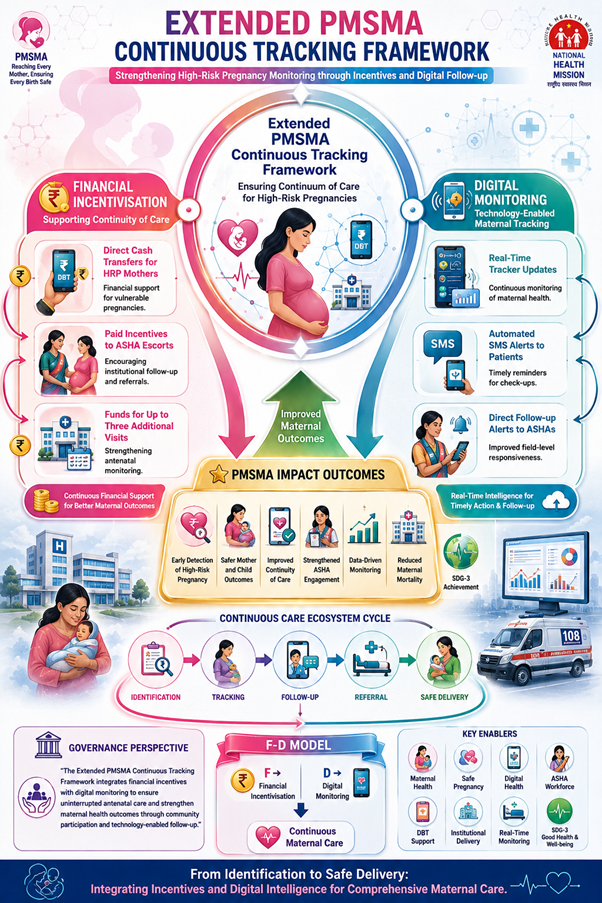
Recognizing that risk mapping without continuous clinical tracking limits field outcomes, the government rolled out the Extended PMSMA Strategy in January 2022.
-
- Financial Incentivisation: Grants cash incentives to the beneficiary and the accompanying Accredited Social Health Activist (ASHA) worker to cover transport and logistics for up to three additional follow-up checks.
- Digital Monitoring: Links tracking data with automated mobile SMS systems to push registration alerts and follow-up prompts to the HRP patient and their assigned ASHA companion, ensuring continuous medical monitoring until a safe delivery is logged.
Convergence
PMSMA operates in close alignment with a broader network of national social security and healthcare initiatives:
-
- Janani Suraksha Yojana (JSY): Direct cash transfer incentive system that has driven 11.96 crore institutional deliveries since 2014.
- Janani Shishu Suraksha Karyakram (JSSK): Provides zero-cost zero-expense diagnostic, medical, and transport facilities for over 18.05 crore pregnant women and sick infants.
- Surakshit Matritva Aashwasan (SUMAN): Assures zero-tolerance for service denial across a network of 99,290 public health clinics.
- LaQshya & PMMVY: Connects labor-room quality upgrades (LaQshya) with prenatal nutrition cash installments under the Pradhan Mantri Matru Vandana Yojana.
Challenges
-
- Editorial reviews in The Hindu highlight that while the iPledgeFor9 award model creates initial enthusiasm, voluntary private sector doctor registrations remain heavily skewed toward urban and semi-urban hubs. Extreme shortages of OB-GYNs and radiologists persist in remote tribal and blocks on the 9th, requiring state administrations to rely heavily on overburdened government doctors.
-
- Critiques in the Indian Express point out that while the color-coded triage system successfully flags high-risk pregnancies, the downstream referral chain faces issues. Limited first-mile ambulance logistics and under-equipped First Referral Units (FRUs) often lead to delayed emergency response times when an HRP mother enters active labor.
- Policy briefs from the Observer Research Foundation (ORF) emphasize that while the digital tracking under Extended PMSMA generates valuable field data, it increases the administrative workload on local ASHA workers. Frontline workers often spend excessive time logging data onto multiple digital apps instead of focusing on direct home-based nutrition tracking and counseling.
Way Forward
-
- Connecting PMSMA Datasets to the ULI Framework: Exploring ways to leverage data public infrastructure to let rural families access fast-track, interest-subsidized emergency medical credit line options seamlessly if a high-risk factor is flagged.
- Upgrading Ayushman Arogya Mandirs for Frontline Diagnostics: Using the Decadal Shivirs model to fully equip 1.8 lakh Ayushman Arogya Mandirs with automated urine analyzers and blood pressure monitors to stabilize continuous care.
- Mandating Volumetric Tele-OBGYN Circuits via BHASHINI: Deployed voice-based tele-consultation channels integrated with Banking BHASHINI style translation tech to let rural practitioners consult urban specialists instantly in local dialects.
- Cluster-Based FRU Retrofitting under PM-ABHIM: Channeling the infrastructure funds under the Health Infrastructure Mission to upgrade every rural FRU with operational blood banks and C-section theaters.
Conclusion
The decadal journey of the Pradhan Mantri Surakshit Matritva Abhiyaan highlights India’s transition from passive maternal welfare support to high-efficiency, risk-sensitive healthcare delivery. By balancing a unique color-coded triage framework with digital public tracking systems, the country has significantly lower its national MMR.
Spread the Word