
Introduction:
Rapid urban-industrial clustering demands a structural shift toward dedicated High-Speed Rail (HSR) corridors, defined globally as systems operating above 250 kmph, HSR decouples inter-city transit from conventional freight-clogged networks. The Mumbai–Ahmedabad High-Speed Rail (MAHSR) project, initiated with Japanese collaboration, functions as the baseline for a domestic high-speed rail ecosystem.
Architecture and Technology : The MAHSR project is being developed using Japanese Shinkansen technology and operational standards. The core system design consists of several components:
-
- J-Slab Ballastless Track Infrastructure: Deployed for the first time in India, this precast concrete slab track setup reduces maintenance downtime, provides extreme structural stability under 320 kmph loads, and ensures high riding comfort.
- Advanced Traction Power Distribution: Powered by a 2×25 kV overhead traction system using Shinkansen-spec OHE cantilevers, backed by 12 core traction substations and 16 automated distribution substations.
- Full Span Launching Method (FSLM): To build the 90% elevated viaduct structure, heavy 40-meter full-span box girders are cast and launched continuously. This technique operates ten times faster than conventional segmental construction methods.
Engineering Feats: The MAHSR corridor passes through complex geological terrain and active river basins, requiring advanced engineering solutions:
1. Structural River and Steel Crossings
The alignment integrates 25 major river bridges (21 in Gujarat, 4 in Maharashtra). Substructure and well-foundation works have been completed across major systems like the Sabarmati, Mahi, and Tapi rivers, alongside the structural erection of 28 heavy steel truss bridges crossing operational highways and existing railway lines.
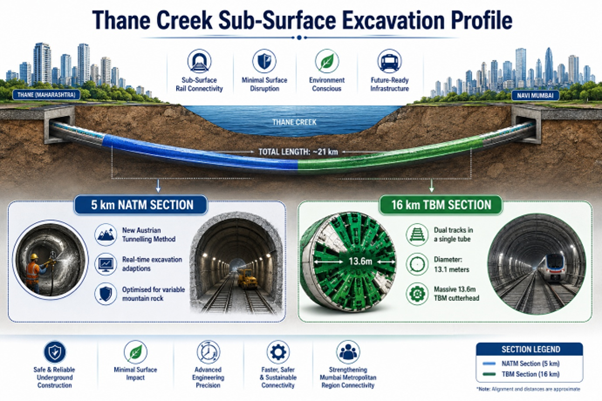
2. The Thane Creek Undersea Rail Tunnel
In Maharashtra, the bullet train routes through a 21 km continuous tunnel tube. This contains India’s first undersea rail section, a 7 km stretch excavated beneath Thane Creek.
Real-Time Safety and Tri-System Automation: To achieve high operational reliability, the Operation Control Centre (OCC) integrates three distinct real-time automated safety systems:
-
- Early Earthquake Detection System: Deploys 28 high-sensitivity seismometers (22 along the track, 6 in active seismic zones). The system detects primary (P) waves ahead of destructive secondary (S) waves, automatically shutting down the traction power grid to trigger emergency braking before ground shaking begins.
- Wind Speed Monitoring System: Features 14 specialized anemometer stations across coastal segments. Real-time velocity data (0–252 kmph) is routed to the OCC; if wind speeds cross the 72 kmph threshold, train operations are automatically regulated.
- Automated Rainfall Monitoring System: Uses 6 instrumented rain gauge networks to calculate hourly and 24-hour cumulative precipitation. This enables real-time stability modeling for tunnel portals, earth embankments, and natural slopes.
Progress Timeline Milestones: Civil and structural works have maintained steady momentum, logging several key breakthroughs in the first half of 2026:
| Milestone Event Date | Engineering Achievement Logged | Project Impact |
|---|---|---|
| 29 January 2026 | Completed a 100-meter 'Make in India' steel bridge section in Ahmedabad. | Advances indigenous heavy metallurgy. |
| 03 February 2026 | Second major mountain tunnel breakthrough achieved in Palghar, Maharashtra. | Clears structural bottlenecks. |
| 08 April 2026 | Heaviest portal beam launched over operational railway tracks. | Minimizes conventional rail traffic delays. |
| 17 May 2026 | Lowered a 350-tonne TBM cutterhead at the Vikhroli shaft node. | Commences the primary undersea drive. |
| 02 June 2026 | Third mountain tunnel breakthrough achieved in the Palghar district. | Finalizes North-Maharashtra sub-surface links. |
Budgetary Roadmap: Building on the technical experience gained from the MAHSR project, the Union Budget 2026–27 announced seven new high-speed rail growth corridors. Spanning nearly 4,000 kilometers with a projected investment of ₹16 lakh crore, these routes aim to connect major metropolitan areas:
-
- Delhi–Varanasi: Redefining northern transit corridors to a 3 hr 50 min travel time.
- Varanasi–Patna–Siliguri: Connecting eastern economic hubs in 2 hr 55 min.
- Chennai–Bengaluru–Hyderabad Diagonal: Dropping Chennai-Bengaluru transit to 1 hr 13 min, and Bengaluru-Hyderabad to 2 hours.
- Mumbai–Pune–Hyderabad Axis: Lowering the Mumbai-Pune mountain transit to 48 minutes.
Challenges:
-
- The Hindu editorial analysis highlights that while civil works in Gujarat progressed rapidly, the Maharashtra leg faced complex delays. Delays were driven by high land acquisition costs in urban zones, forest clearance approvals in the Palghar eco-sensitive tribal belts, and the intense engineering demands of the Thane Creek undersea tunnel.
- Critiques in the Indian Express note that while Shinkansen technology transfer is highly advanced, long-term self-reliance requires localizing the production of high-precision components. Manufacturing components like the active electronic signaling systems and advanced aerodynamic rolling stock domestically remains a challenge for Indian heavy industries.
- Policy papers from the Observer Research Foundation (ORF) emphasize that HSR corridors have very high initial capital costs. With the seven newly proposed lines requiring ₹16 lakh crore, relying on long-term international soft loans (like Japan’s JICA funding) demands careful fiscal management. This is necessary to avoid exposing state budgets to global exchange rate fluctuations and long debt-servicing timelines.
Way Forward
-
- Exploring ways to leverage data public infrastructure to let small businesses and regional FPOs along the Vapi-Surat-Mumbai belt use the Unified Lending Interface (ULI) to access fast-track credit lines, using automated transit and invoice records.
- Executing comprehensive multi-modal hubs like the Sabarmati Multimodal Hub, which directly links bullet train platforms with regional metros, BRTS networks, and conventional rail lines.
- Using the Make in India mandate to incentivize domestic steel giants (like SAIL and Tata Steel) to supply the structural components for the newly announced 4,000 km expansion grid.
- Expanding the academic scope of the institute to train a specialized workforce, preparing them for the rollout of the seven upcoming corridors.
Conclusion:
The Mumbai–Ahmedabad High-Speed Rail project marks a fundamental shift in India’s transport infrastructure, transitioning the country from conventional rail operations to advanced, high-velocity mass transit. By successfully pairing Japanese Shinkansen technical standards with domestic manufacturing milestones—such as the Palghar tunnel breakthroughs and the Sabarmati multi-modal integration.
Spread the Word