
Indian Polity & Governance
Federal Structure & Executive Transitions:
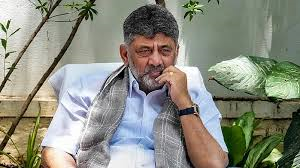
Context: D.K. Shivakumar sworn in as the 34th Chief Minister of Karnataka at the Lok Bhavan, concluding a structural power-sharing transition from Siddaramaiah.
-
- Constitutional Appointment: The Chief Minister is appointed by the Governor under Article 164 of the Constitution of India.
- Principle of Responsibility: Article 164(2) states that the Council of Ministers is collectively responsible to the Legislative Assembly of the State.
- Oath Administration: The oath of office and secrecy to the Chief Minister and their cabinet is administered by the Governor of the respective state.
- Term of Office: The Chief Minister does not hold a fixed constitutional tenure; they hold office “during the pleasure of the Governor.” However, the Governor cannot dismiss them as long as they command a majority in the Legislative Assembly.
- Size of Cabinet Constraint: Under the 91st Constitutional Amendment Act, 2003, the total number of ministers, including the CM, in a state’s Council of Ministers cannot exceed 15% of the total strength of that state’s Legislative Assembly (minimum cap is 12).
- Discretionary Powers of Governor: If no single party wins an absolute majority, the Governor exercises personal discretion to invite a leader to form the government, subject to proving a majority on the floor of the house (S.R. Bommai case guidelines).
- Eligibility Criteria: The CM must be a member of either house of the State Legislature. If not a member at the time of appointment, they must secure a seat within six consecutive months, failing which they cease to be the CM.
- The Role of Lok Bhavan/Raj Bhavan: Official state swearing-in ceremonies are traditionally organized at the Raj/Lok Bhavan, representing the constitutional seat of executive power.
- Salary Determinations: The salary and allowances of the Chief Minister are determined from time to time by the respective State Legislature, not by the Parliament.
- Relationship with the Governor: Article 167 specifies the duties of the Chief Minister regarding the furnishing of information to the Governor concerning administration and legislative proposals.
(TH)
Indian Society & Social Justice
Maternal and Child Health Indicators:
Context: The latest localized segment releases of the family health survey indicated a worrying rise in teenage pregnancies alongside a dip in crucial child nutrition indicators across parts of Rajasthan.
-
- Survey Authority: Micro-level health trends are gathered under the structural umbrella of the National Family Health Survey (NFHS), coordinated by the International Institute for Population Sciences (IIPS), Mumbai, acting as the nodal agency.
- Key Metric (Teenage Pregnancy): An increase in teenage pregnancies indicates gaps in early reproductive health education, low female secondary education retention, and persistent early marriage trends.
- Malnutrition Indicators: Child nutrition status is measured using three global metrics: Stunting (low height-for-age), Wasting (low weight-for-height), and Underweight (low weight-for-age).
- Stunting vs. Wasting: Stunting reflects chronic, long-term undernutrition and socio-economic deprivation, whereas wasting is a sign of acute, immediate nutritional deficits or recent disease.
- The “Intergenerational Cycle” of Malnutrition: Anaemic, undernourished adolescent girls who become pregnant early frequently give birth to low-birth-weight babies, perpetuating a cycle of stunting.
- Government Interventions (POSHAN Abhiyaan): POSHAN Abhiyaan (Prime Minister’s Overarching Scheme for Holistic Nourishment) targets a reduction in stunting, undernutrition, and low birth weight in young children.
- Legal Age Safeguards: The Prohibition of Child Marriage Act, 2006, provides the primary legal framework to curb marriages of girls below 18 years of age.
- Anemia Mukt Bharat: A targeted health strategy under the National Health Mission designed to lower the prevalence of anemia among adolescents, pregnant women, and lactating mothers through prophylactic iron-folic acid (IFA) supplementation.
- Sustainable Development Goals (SDG) Target: These indicators directly map to SDG 2 (Zero Hunger), which aims to end all forms of malnutrition by 2030, and SDG 3 (Good Health and Well-being).
- Role of Anganwadi Centers: Integrated Child Development Services (ICDS) rely on Anganwadi workers to deliver hot cooked meals, take-home rations, and regular growth-monitoring for children aged 0 to 6 years.
(IE)
International Relations
India-Latin America Diplomacy:
Context: Venezuela’s Acting President, Delcy Rodríguez, arrived on an official high-profile bilateral visit to India to hold bilateral talks with PM Modi.

-
- Strategic Intent: The visit centers around reviving bilateral energy ties, exploring non-dollar trade settlement mechanisms, and enhancing pharmaceutical exchanges.
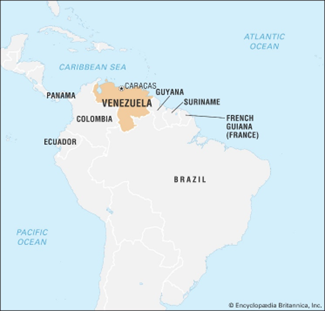
- Geographical Profile: Venezuela is located on the northern coast of South America, bordered by Colombia to the west, Guyana to the east, and Brazil to the south.
-
- Resource Endowment: Venezuela possesses the world’s largest proven crude oil reserves (exceeding 300 billion barrels), primarily concentrated in the Orinoco Oil Belt.
- India’s Energy Security Pivot: Historically, Venezuela was one of India’s top three suppliers of crude oil. Geopolitical disruptions and sanctions forced India to shift its import portfolio toward the Middle East and Russia.
- Type of Crude: Venezuelan crude is primarily heavy and extra-heavy sour crude, which requires advanced, highly complex refining systems such as those operated by Indian private refiners in Jamnagar.
- OPEC Membership: Venezuela is a founding member of the Organization of the Petroleum Exporting Countries (OPEC), established at the Baghdad Conference in 1960.
- Multilateral Forums: Both nations share membership in the Non-Aligned Movement (NAM), Group of 77 (G-77), and are both signatories to the Paris Agreement on Climate Change.
- International Solar Alliance (ISA): Venezuela has ratified the framework agreement of the India-led ISA to diversify its domestic domestic energy mix toward renewables.
- Major Export-Import Basket: India’s primary exports to Venezuela consist of pharmaceuticals, chemicals, textiles, and machinery, while imports are dominated by crude oil and mineral fuels.
- Geopolitical Challenge (Sanctions Framework): Bilateral trade remains deeply contingent upon the status of U.S. OFAC (Office of Foreign Assets Control) sanctions relief mechanisms extended to Venezuela’s state-owned oil firm, PDVSA.
(IE)
Border Mechanisms & Bilateral Diplomacy:
Context: The Ministry of External Affairs (MEA) firmly rejected assertions made by Nepal’s leadership regarding international intervention in border disputes, stating there is “no role for any third party” in bilateral issues.
-
- The Dispute Context: The statement came in response to Nepal’s Prime Minister Balendra Shah suggesting third-party intervention (like the U.K. or China) to resolve complex boundary issues.
- Bilateral Mechanism Stand: India maintains that institutional border management and resolution must strictly occur via existing bilateral diplomatic channels and joint technical committees.
- The Historical Boundary Treaty: The formal boundary between India and Nepal was established under the Treaty of Sugauli in 1816 signed between the Kingdom of Nepal and the British East India Company.
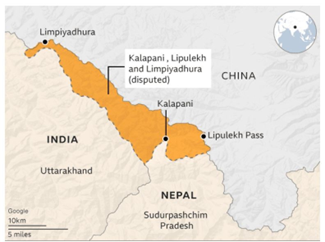
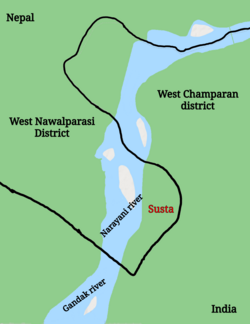
- Key Disputed Sectors: The primary territorial disputes center around the Kalapani, Limpiyadhura, and Lipulekh tri-junction area (Uttarakhand) and the Susta region (Bihar).
-
- The Kalapani River Core: The dispute in Kalapani stems from differing interpretations of the source of the Kali River (Mahakali), which the 1816 treaty designated as the western border of Nepal.
- Susta Dispute Origin: The Susta dispute is driven by the shifting course of the Gandak River (known as Narayani in Nepal), which has altered the physical boundary over decades due to flooding.
-
- Border Nature: India and Nepal share an open border stretching over 1,850 km, cutting across five Indian states: Uttarakhand, Uttar Pradesh, Bihar, West Bengal, and Sikkim.
- Security Management: The Sashastra Seema Bal (SSB) is the dedicated Central Armed Police Force (CAPF) responsible for guarding the open India-Nepal border.
- Treaty of Peace and Friendship (1950): This foundational treaty provides national treatment to citizens of both countries regarding residence, property, employment, and movement across the border without passports or visas.
- Strategic Mechanism: India and Nepal operate a Joint Border Working Group (BWG) established to construct, repair, and restore missing boundary pillars.
(TH+IE)
Economy
Forex Reserves & Gold Auditing:
Context: The RBI clarified that India’s physical gold holdings have remained entirely stable, standing at 880.52 metric tonnes as of late May 2026.
-
- Rising Share in Reserves: Instead of a drop, the share of gold within India’s total Foreign Exchange (Forex) Reserves grew from 13.92% (September 2025) to 16.70% (March 31, 2026), and further to 16.85% by May 2026.
- Valuation Dynamic: The total valuation of gold held by the RBI spiked significantly to $120.24 billion. This escalation reflects unprecedented global gold price surges rather than a change in stock physical volumes.
- Components of Forex Reserves: India’s Forex reserves consist of four structural assets: Foreign Currency Assets (FCAs), Gold Reserves, Special Drawing Rights (SDRs), and the Reserve Position in the International Monetary Fund (IMF).
- Total Forex Metric: As of the latest official audited cycle highlighted by the bulletin, India’s total Foreign Exchange Reserves hover strongly at $698.49 billion.
- Custodian of Reserves: Under Section 40 of the Reserve Bank of India Act, 1934, the RBI acts as the sole custodian and manager of the nation’s foreign exchange assets.
- Legal Framework for Gold Purchase: The RBI is legally permitted to buy and sell gold under Section 17 of the RBI Act, 1934, to balance its portfolio and mitigate currency volatility risks.
- The “Gold Mobilization” Myth: Central banks often reallocate geographical custody of gold (e.g., bringing gold back from the Bank of England to domestic vaults) for security, which speculative reports sometimes misinterpret as market sales.
- Why Central Banks Accumulate Gold: Gold serves as an ultimate “safe-haven asset,” acting as a hedge against inflation, global geopolitical friction, and the depreciation of weaponized reserve currencies (like the US Dollar).
- Data Transparency: Official reporting on gold and foreign exchange dynamics is periodically updated via the RBI Monthly Bulletin and the Weekly Statistical Supplement (WSS).
(TH)
Geography
Cloudburst Dynamics:
Context: Sudden, intense cloudbursts hit two districts of Jammu and Kashmir, causing severe flash floods, mudslides, and putting local administrations on high alert.
-
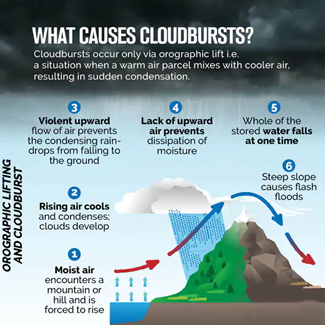
- IMD Definition of a Cloudburst: The India Meteorological Department (IMD) defines a cloudburst as an extreme precipitation event where 100 mm (10 cm) or more of rainfall occurs within one hour over a localized geographical area of roughly 20 times 30 sq km.
- Meteorological Mechanism: It occurs when highly moist air ascends rapidly up a mountain slope, forming a dense Cumulonimbus cloud. Strong updrafts prevent the condensing rain from falling immediately, causing a massive accumulation of water inside the cloud that eventually collapses under its own weight.
-
- Topographical Vulnerability: Mountainous landscapes, particularly the rugged terrains of the Himalayas and Western Ghats, are highly prone to cloudbursts due to their steep orographic lifting profiles.
- The Flash Flood Trigger: Due to the steep terrain gradient, the sudden torrent of water cannot drain out naturally, resulting in instantaneous Flash Floods carrying heavy debris and boulders down the slopes.
- Associated Hazard (Orographic Mudflows): The saturated topsoil on hill slopes loses its shear strength, triggering cascading mudslides and landslides that block narrow river channels, creating volatile artificial dams.
- Climate Change Multiplier: Rising global surface temperatures increase the moisture-holding capacity of the atmosphere, making localized, short-duration convective storms far more frequent and intense.
- Predictive Challenges: Due to their small spatial footprint and short lifespans, cloudbursts are incredibly difficult to predict accurately using conventional satellite imagery. They require dense networks of Doppler Weather Radars (DWR).
- Early Warning Radar Bands: India deploys X-band and S-band Doppler Radars across the Himalayan arc to track convective cloud developments in real-time.
- Disaster Management Framework: Emergency relief operations are coordinated under the Disaster Management Act, 2005, overseen by the National Disaster Response Force (NDRF) and its state counterpart (SDRF).
- Mitigation Strategy: Key structural mitigation steps include mapping landslide hazards, restricting constructions along natural drainage channels, and building step-terraced retention walls.
(IE)
Ecology & Environment and DM
Judicial Review & Conservation:
Context: The Supreme Court of India appointed a high-powered panel to comprehensively review the ecological definition and boundary demarcations of the Aravalli Range.
-
- The Issue: The apex court intervened to review an Aravalli definition report to resolve overlapping ambiguities between commercial construction zones and protected forest lands.
- Geological Fact: The Aravallis are one of the world’s oldest fold mountain systems, tracing back to the Proterozoic era (Pre-Cambrian assembly).
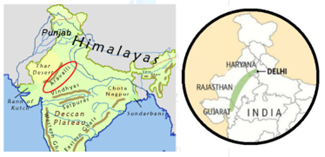
- Geographical Stretch: The range runs approximately 692 km in a south-west to north-east direction, cutting across four states/UTs: Gujarat, Rajasthan, Haryana, and Delhi.
-
- Highest Peak: The highest point of the Aravalli range is Guru Shikhar located on Mount Abu, rising to an altitude of 1,722 meters.
- Ecological Role (Green Wall): It acts as a critical climate barrier, preventing the eastern expansion of the Thar Desert into the fertile Indo-Gangetic plains.
- Hydrological Significance: The range serves as a water divide between the Indus and Ganga river basins. Major rivers originating here include the Banas, Luni, Sakhi, and Sabarmati.
- Legal Mandate (TN Godavarman Case Link): The Supreme Court leverages the landmark T.N. Godavarman Thirumulpad v. Union of India (1996) case, which expands the definition of “forest” to its dictionary meaning regardless of ownership.
- Environmental Stressors: The range faces severe degradation due to illegal mining of minor minerals, rapid urbanization, unchecked real estate expansions, and the absolute flattening of its protective low-lying hills.
- The “Desertification” Consequence: The destruction of hills has broken down natural gaps, creating geological pathways for dust-storms to travel deeper into the National Capital Region (NCR).
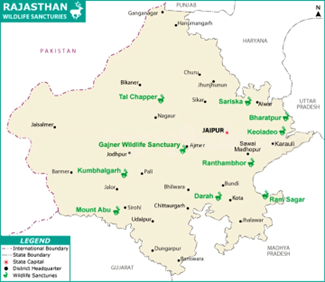
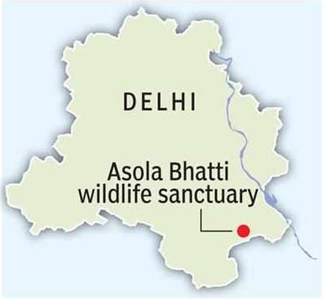
- Key Wildlife Corridors: Aravalli ranges contain vital ecological corridors like the Sariska Tiger Reserve and the Asola Bhatti Wildlife Sanctuary, which facilitate wildlife movement across state borders.
(IE)
Tiger Conservation & Genetic Diversity:
Context: Wildlife biologists and forest officials reported that cubs from a “runaway” tigress could potentially reverse the critical genetic isolation threatening the big cat population of Similipal Tiger Reserve.
-
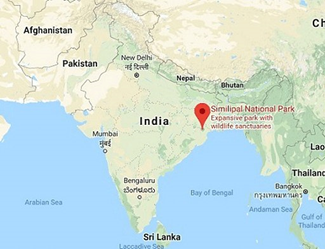
- Location: Similipal Tiger Reserve is located in the Mayurbhanj district of Odisha.
-
- Phenotypic Uniqueness (Melanistic Tigers): Similipal is globally renowned as the only wild habitat in the world that houses a population of melanistic (black) tigers, characterized by thick, fused black stripes caused by a rare genetic mutation.
- The Genetic Issue (Inbreeding): Due to strict geographical isolation from other major tiger landscapes (like Central India or the Western Ghats), Similipal’s tigers suffer from low genetic diversity and high inbreeding depression.
- Pseudo-melanism Cause: Research shows that pseudo-melanism is driven by a single nucleotide polymorphism (mutation) in the Taqpep gene.
- Similipal Biosphere Reserve Status: It was declared a Biosphere Reserve by the Government of India in 1994 and has been a part of the UNESCO World Network of Biosphere Reserves since 2009.
- Project Tiger Association: Similipal was among the first nine tiger reserves chosen during the initial launch of Project Tiger in 1973.
- River Networks: The reserve serves as a vital catchment area. Major rivers flowing through it include the Budhabalanga, Baitarani, and Subarnarekha.
- Vegetation Profile: The forest cover is a rich mix of Northern Tropical Semi-Evergreen Forests, Northern Tropical Moist Deciduous Forests, and vast swathes of Sal (Shorea robusta) trees.
- Indigenous Tribes: Similipal is home to prominent vulnerable tribal groups (PVTGs) and Scheduled Tribes, including the Erenga Kharias and the Mankirdias.
- The “Runaway” Inflow Benefit: The introduction of fresh genetic lineages via wild migrant tigers prevents local extinctions caused by accumulated harmful genetic mutations.
(IE)
Science & Technology
Indigenous Defence Capabilities – RudraM-II:
Context: The Defence Research and Development Organisation (DRDO) and the Indian Air Force (IAF) successfully conducted flight-tests of the indigenous RudraM-II air-to-surface missile.

-
- Classification: RudraM-II is an indigenously developed, technologically advanced air-to-surface, anti-radiation missile.
- Primary Objective: Designed to suppress the enemy’s air defence systems (SEAD) by targeting radar installations, communication stations, and radio frequencies.
- Development Agency: It has been completely designed and developed by the Defence Research and Development Organisation (DRDO) along with domestic public and private production partners.
- Integration Platform: The missile is designed for seamless integration and deployment from the frontline fighter aircraft of the Indian Air Force (IAF), specifically the Sukhoi Su-30MKI.
- Propulsion System: It relies on a solid-propellant motor that provides high hypersonic/supersonic speeds to evade modern interception networks.
- Guidance and Navigation: Features an advanced inertial navigation system (INS) coupled with GPS/NavIC satellite guidance for mid-course corrections, complemented by a passive radar seeker for terminal homing.
- The RudraM Lineage: The series includes RudraM-I (New Generation Anti-Radiation Missile – NGARM), RudraM-II, and the under-development RudraM-III, expanding India’s stand-off range striking spectrum.
- Operational Range: RudraM-II is built to offer a substantial stand-off range (~150-300 km), allowing fighter jets to neutralize threats well outside the engagement envelope of enemy surface-to-air missiles (SAMs).
- Strategic Significance: Attaining successful operational parameters marks a massive milestone towards Aatmanirbharta (self-reliance) in precision strike technology, diminishing historical dependencies on Russian Kh-31 or Western anti-radiation missiles.
- (Anti-Radiation Missile): “Radiation” in this military context does not mean nuclear radiation; it refers to radio frequency waves/electromagnetic emissions originating from enemy surveillance radars.
(TH)
Government Schemes & Initiatives
Groundwater Management:
Context: Union Minister C.R. Patil announced that over 1.5 crore artificial groundwater recharge and storage structures have been created under the Jal Sanchay Jan Bhagidari (JSJB) initiative.
-
- Core Ideology of JSJB: The Jal Sanchay Jan Bhagidari program focuses on community-driven water conservation, leveraging public participation (Jan Bhagidari) to combat groundwater depletion.
-
- Administrative Ministry: The initiative is steered by the Ministry of Jal Shakti, which consolidates all water-related governance bodies.
- Technological Framework: The creation of these 1.5 crore structures involves low-cost, decentralized techniques such as check dams, farm ponds, recharge shafts, and rainwater harvesting injection wells.
- Groundwater Over-exploitation: India is the largest user of groundwater in the world, extracting more than the US and China combined, primarily driven by agricultural tube-well irrigation.
- The Concept of “Artificial Recharge”: It is the engineered process by which surface water is directed into the ground to replenish subsurface aquifers, bypassing slow, natural percolation processes.
- NITI Aayog CWMI Index Connection: As per NITI Aayog’s Composite Water Management Index, a vast majority of India’s groundwater resources face critical depletion threats, making artificial interventions urgent.
- Convergence with Other Schemes: JSJB works in close convergence with the Mahatma Gandhi National Rural Employment Guarantee Scheme (MGNREGS) and the Atal Bhujal Yojana.
- Atal Bhujal Yojana Specifics: Unlike infrastructure-only initiatives, Atal Bhujal Yojana is a Central Sector Scheme funded partly by the World Bank, focusing on behavioral change and community water budgeting in select water-stressed states.
- Geological Constraint (Aquifer Mapping): The efficacy of artificial recharge structures depends heavily on National Aquifer Mapping and Management (NAQUIM) data, which identifies hydrogeological formations.
- Constitutional Division of Water: Under the Seventh Schedule of the Indian Constitution, ‘Water’ is primarily a State Subject (Entry 17 of the State List), but the Union exercises regulatory influence via environmental laws and central assistance programs.
(IE)
Spread the Word