
Indian Polity & Governance
Telangana Statehood Day & Article 3 Constitutional Framework:
Context: On June 2, 2026, the PM and national leaders extended official greetings to the people of Telangana on the occasion of its 12th Statehood Day, commemorating its formal creation in 2014.
-
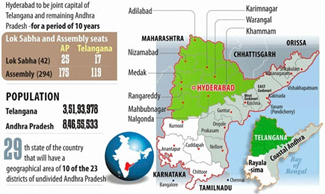
- Historical Timeline: Telangana was officially carved out of the northwestern region of Andhra Pradesh on June 2, 2014, becoming the 29th state of the Indian Union at that specific time.
- The Srikrishna Committee: The structural blueprint and assessment for the bifurcation of the state were guided by the high-level N. Srikrishna Committee, appointed by the Ministry of Home Affairs.
- The Legislative Tool: The state was created under the provisions of the Andhra Pradesh Reorganisation Act, 2014, passed by the Indian Parliament.
- Static Polity – Article 3 Mandate: The reorganization of any state is governed by Article 3 of the Indian Constitution, which empowers Parliament to form new states, alter areas, boundaries, or names of existing states.
- Nature of the Bill: A bill for reorganizing states under Article 3 can be introduced in either House of Parliament only on the prior recommendation of the President of India.
- State Legislature’s Role: Before recommending the bill, the President must refer it to the concerned State Legislature for expressing its views within a specified period. However, Parliament is not bound by the views of the state legislature.
- Simple Majority Requirement: A law passed under Article 3 is carried through by a simple majority in Parliament, following standard legislative processes.
- Exclusion from Article 368: Article 4 explicitly states that any laws made under Article 2 or Article 3 for the amendment of the First and Fourth Schedules shall not be deemed to be an amendment of the Constitution under Article 368.
- Geographical Boundaries: Telangana is a completely landlocked state, bounded by Maharashtra to the north, Chhattisgarh to the northeast, Karnataka to the west, and Andhra Pradesh to the east and south.
- The Capital Allocation: Under the initial 2014 reorganisation framework, Hyderabad was designated as the joint capital for both states for a transitional period not exceeding 10 years, which concluded in 2024.
(PIB)
International Developments
Escalating Strategic Geopolitical Risk in the Russia-Ukraine War:
Context: A devastating wave of Russian ballistic missiles and drone strikes rocked Kyiv, Dnipro, and Kharkiv overnight, killing several civilians and triggering urgent international diplomacy as the war entered its fifth continuous year.
-
- The Tactical Incident: Russian forces deployed a concentrated barrage of ballistic missiles targeted at Ukraine’s capital city, Kyiv, disrupting municipal power grids and disabling key civil infrastructure.
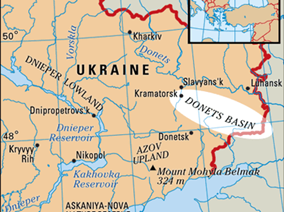
- The Geographical Hotspots: The strikes targeted three main urban industrial zones: Kyiv (North-Central), Dnipro (East-Central on the Dnieper River), and Kharkiv (Northeast, close to the Russian border).
-
- The Dnieper River Strategic Value: The city of Dnipro sits directly on the Dnieper River, which is a vital European river system dividing Ukraine into eastern and western spheres, serving as a critical navigation and hydroelectric resource.
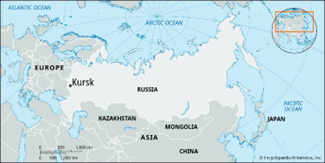
- The Kursk Counter-Strike: In tandem with the air raids, Ukrainian forces launched drone retaliations into Russia’s Kursk region, a sensitive border oblast that has been a focal zone of direct cross-border fighting.
-
- Patriot Missile Diplomacy: President Volodymyr Zelenskyy intensified direct diplomatic appeals to the United States for the expedited financing and supply of Patriot Missile Defense Systems, which are advanced surface-to-air missile (SAM) arrays designed to intercept incoming tactical ballistic missiles.
- Stalled Global Mediation: The implementation of peace frameworks has decelerated significantly due to the major shift in global diplomatic attention and resources toward the concurrent military crisis in West Asia.
- Black Sea Security Dynamics: The escalation continues to pressure maritime security across the Black Sea, affecting global grain shipments and impacting the maritime trade routes linking the Danube River to the Mediterranean.
- Static Geo: Bordering Nations of Ukraine: Ukraine is bordered by Russia to the east and northeast, Belarus to the north, Poland, Slovakia, and Hungary to the west, and Romania and Moldova to the southwest.
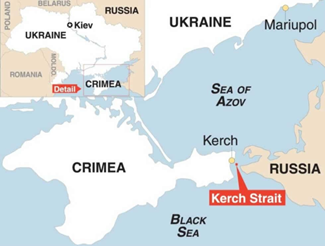
- Sea of Azov Status: The Sea of Azov, connected to the Black Sea by the narrow Kerch Strait, is currently under complete Russian naval dominance, heavily impacting Ukraine’s eastern port access (like Mariupol).
-
- Asymmetric Drone Warfare: The 2026 strikes underscore the high operational density of loitering munitions (kamikaze drones) and ballistic weapons systems, which bypass conventional legacy anti-aircraft radar nets.
(TH)
International Relations
The India-Oman Comprehensive Economic Partnership Agreement (CEPA) Takes Effect:
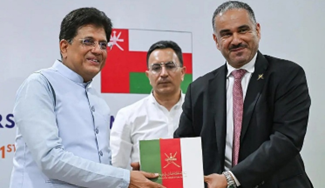
Context: Bilateral trade dynamics entered a new phase on June 1-2, 2026, as the India-Oman Comprehensive Economic Partnership Agreement (CEPA) officially took effect, eliminating duties on over 98% of tariff lines.
-
- The CEPA Operationalization: The comprehensive trade pact signed between New Delhi and Muscat became active on June 1, 2026, opening immediate duty-free windows for mutual market access.
- Immediate Duty Eliminations: Under the agreement, Oman is extending immediate duty-free access to 98% of Indian export products by volume and value, significantly boosting export competitiveness.
- Primary Beneficiary Sectors: The key domestic sectors benefiting from this immediate zero-duty window include Textiles, Pharmaceuticals, Engineering Goods, Chemicals, and MSME manufactured goods.
- The Strategic West Asian Footprint: Oman is the second country in the Gulf Cooperation Council (GCC) bloc to operationalize a comprehensive trade agreement with India, following the India-UAE CEPA enacted in 2022.
- Static Geo – The Strait of Hormuz Guard: Oman occupies a highly critical geopolitical position along the Strait of Hormuz and the Gulf of Oman, making it India’s vital strategic maritime partner in the western Indian Ocean.
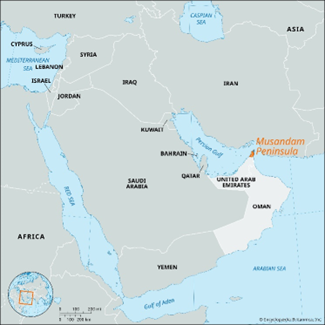
- The Musandam Peninsula Exclave: For geographical mapping, Oman possesses an exclave on the tip of the Musandam Peninsula, which projects directly into the narrowest point of the Strait of Hormuz.
-
- Difference Between CEPA and CECA: A Comprehensive Economic Partnership Agreement (CEPA) is broader than a Comprehensive Economic Cooperation Agreement (CECA). CEPA covers a wider range of services, investments, and intellectual property rights, involving a deeper degree of regulatory alignment.
- Rules of Origin (RoO) Safeguards: To prevent third-party countries (like China) from routing cheap goods through Oman into India, the CEPA incorporates strict Rules of Origin clauses requiring a minimum percentage of local value addition in Oman.
- Energy Cooperation Framework: Beyond standard merchandise trade, the operationalized CEPA lays down a legal architecture for cross-border investments in Green Hydrogen production facilities within Oman.
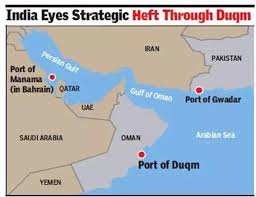
- The Duqm Port Access: The trade deal runs parallel to defense agreements allowing the Indian Navy operational and logistics access to Oman’s strategic Duqm Port, which overlooks the Arabian Sea and shipping lanes coming out of the Red Sea.
(PIB)
Economy
Gross GST Revenue Collections for May 2026 Cross ₹1.94 Lakh Crore:
Context: Official economic data released on June 1-2, 2026, revealed that India’s gross Goods and Services Tax (GST) revenues for May 2026 topped ₹1.94 lakh crore, registering a steady 3.2% Year-on-Year (YoY) growth.
-
- The Core Data Fact: The actual gross GST revenue collected in May 2026 stood at ₹1,94,220 crore (approximately ₹1.94 lakh crore), reflecting domestic transactions from the preceding month (April).
- Growth Trajectory: This collection represents a 2% year-on-year growth compared to May 2025 collections, driven heavily by resilient domestic manufacturing and an expansion in services.
- Component Distribution: The gross collections are split into four structural pillars: Central GST (CGST), State GST (SGST), Integrated GST (IGST – on inter-state trade and imports), and the dedicated Compensation Cess.
- E-Way Bill High-Frequency Indicator: Reflecting robust logistics and trade volumes, cumulative e-way bill volumes reported a stark growth of 21% YoY, indicating tight compliance and reduced tax leakage.
- Static Economy – Destination-Based Tax: The GST is a destination-based consumption tax, meaning the tax revenue accrues to the state where the goods or services are ultimately consumed, rather than the state where they were produced.
- The Constitutional Core: GST was introduced via the 101st Constitutional Amendment Act, 2016, which inserted Article 246A granting concurrent taxing powers to both Parliament and State Legislatures.
- The GST Council (Article 279A): The constitutional body responsible for modifying slabs and rules is the GST Council. It is chaired by the Union Finance Minister, with Union Ministers of State for Revenue and Finance Ministers of all states as members.
- Voting Power Asymmetry: In the GST Council, the Central Government possesses one-third (33.33%) of the total voting power, while all State Governments combined hold two-thirds (66.67%). Every decision requires a three-fourths (75%) majority.
- Automated Refund Ecosystem: The revenue stability in 2026 is attributed to the newly upgraded digital enforcement systems, featuring automated export refunds and algorithmic tracking of inverted duty structures (IDS).
- Impact on Nominal GDP: Consistent collections above the ₹1.9 lakh crore threshold indicate healthy tax buoyancy, closely aligning with India’s nominal GDP projections.
(IE)
Index of Industrial Production (IIP) Base-Year Transition and 4.9% Growth:
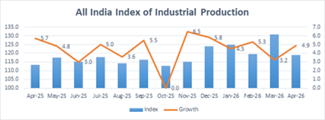
Context: Industry leaders on June 1-2, 2026, lauded the steady performance of the newly revised Index of Industrial Production (IIP), which registered a 4.9% year-on-year growth for the initial monthly tracking block under its new base year.
-
- The New Base Year Transition: India has officially transitioned its All India Index of Industrial Production (IIP) series to the new base year of 2022-23, replacing the old 2011-12 base to capture modern industrial dynamics.
- Recent Growth Metric: The newly aligned IIP recorded a stable growth rate of 9%, indicating robust industrial expansion despite external geopolitical shocks and high global input costs.
- Compiling and Releasing Agency: The IIP is compiled and published every month by the National Statistical Office (NSO), which operates under the Ministry of Statistics and Programme Implementation (MoSPI).
- The Three Broad Sectors: The IIP measures production volume changes across three universally classified sectors with specific weightages: Manufacturing, Mining, and Electricity.
- Manufacturing Dominance: Within the sectoral classification, the Manufacturing sector holds the highest weightage, acting as the primary driver of the index’s movements.
- Use-Based Classification: The IIP is also mapped into a use-based framework consisting of: Primary Goods, Capital Goods, Intermediate Goods, Infrastructure/Construction Goods, Consumer Durables, and Consumer Non-durables.
- The Core Industry Overlap: The IIP relies heavily on the Index of Eight Core Industries (ICI), which acts as a proxy indicator and constitutes 27% of the total weight of items included in the overall IIP.
- Purpose of Base Year Revision: Base year updates are systematically executed to eliminate structural obsolescence, introduce modern consumer commodities (like smartphones, electronics, new-age chemicals), and drop outdated items.
- Difference from WPI/CPI: Unlike the Wholesale Price Index (WPI) or Consumer Price Index (CPI) which track monetary inflation/price changes, the IIP strictly measures the physical volume of production in factories and utilities.
- Policy Utility: The IIP is a vital macroeconomic input utilized by the Reserve Bank of India (RBI) for its Monetary Policy reviews and by the Ministry of Finance for tracking formal quarterly GDP calculations.

(IE+PIB)
Index of Eight Core Industries (ICI) Performance for April 2026:
Context: The final reviews of the Index of Eight Core Industries (ICI) for April 2026 were compiled on June 2, 2026, showing a provisional 1.7% increase in production capacity compared to the corresponding period of the previous year.
-
- The growth percentage: The provisional growth rate of the Index of Eight Core Industries for April 2026 stood at 7%, down from the final growth rate of 1.2% validated for March 2026.
- Releasing authority: The ICI is prepared and released monthly by the Office of the Economic Adviser (OEA), which operates under the Department for Promotion of Industry and Internal Trade (DPIIT), Ministry of Commerce and Industry.
- The eight core sectors: The index maps eight specific infrastructure sectors: Coal, Crude Oil, Natural Gas, Refinery Products, Fertilizers, Steel, Cement, and Electricity.
- Exact weightage hierarchy: The descending order of the weightages of these eight industries is a critical Prelims standard: Refinery Products > Electricity > Steel > Coal > Crude Oil > Natural Gas > Cement > Fertilizers
- Highest and Lowest Weights: Petroleum Refinery Products holds the highest individual weightage (~28.04%), while Fertilizers holds the lowest weightage (~2.63%).
- Proportion in IIP: These eight core industries collectively comprise exactly 27% of the total weight of items included in the comprehensive Index of Industrial Production (IIP).
- Current base year: The index currently operates on the base year of 2011-12=100, though it is scheduled for a synchronous realign with the broader IIP base changes.
- Economic significance: Because these eight sectors produce basic and intermediate goods, their performance acts as an early leading indicator of structural bottlenecks or expansions within the broader Indian economy.
- Refinery products characterization: Refinery products represent the output from India’s crude processing facilities (like diesel, petrol, kerosene), reflecting domestic transport and freight intensity.
- Fertilizer linkage: The performance of the fertilizer segment is highly seasonal, acting as a direct indicator of rural agricultural demand patterns ahead of the Kharif sowing cycle.
(PIB)
Ecology & Environment and DM
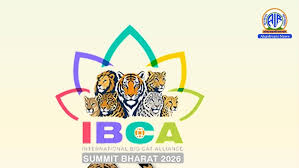
The 1st International Big Cat Alliance (IBCA) Summit 2026:
Context: The landmark 1st International Big Cat Alliance (IBCA) Summit concluded its high-level sessions in New Delhi (held across June 1–2, 2026), bringing together 95 range countries to secure global frameworks for apex predators.
-
- Origin of IBCA: The International Big Cat Alliance was officially launched by the PM of India in April 2023 during the commemoration of the 50th anniversary of Project Tiger.
- Seven targeted species: The alliance focuses exclusively on the conservation of seven big cats: Tiger, Lion, Leopard, Snow Leopard, Cheetah, Jaguar, and Puma.
- India’s unique global status: India is the only country in the world to host five of these seven big cats in the wild (Tiger, Lion, Leopard, Snow Leopard, and Cheetah). It lacks the Jaguar (native to the Americas) and the Puma (native to the Americas).
- Summit Theme 2026: The inaugural summit was guided by the central multi-sectoral theme: “Save Big Cats, Save Humanity, Save Ecosystem”.
- Geographical horizon: The summit brought together a global coalition representing 95 range countries spread across three continents: Asia, Africa, and the Americas.
- Headquarters & status: The IBCA is established as an inter-governmental international organization with its permanent headquarters located in India.
- Funding framework: The Government of India has committed a dedicated budgetary support of ₹150 crore over a five-year period (2023-24 to 2027-28) to establish the structural capacity of the alliance.
- Static Eco-Linkage (Apex Species): In ecological science, big cats serve as umbrella species. Protecting them automatically ensures the preservation of vast tracts of water catchments, dense forests, and associated biodiversity.
- South-south cooperation: The alliance acts as a institutional channel for South-South cooperation, facilitating technology transfers, standardized census techniques (like M-STrIPES equivalents), and anti-poaching intelligence sharing.
- Governance structure: The IBCA organizational setup includes a General Assembly (the supreme body), a Council, and a dedicated Secretariat.
(PIB)
Science & Technology
Near-Universal 5G Saturation and Infrastructure Expansion in India:
Context: The Ministry of Communications confirmed on June 2, 2026, that India’s 5G rollout has achieved a near-universal saturation milestone, with active high-speed mobile networks deployed across 99.9% of all districts.
-
- The saturation stat: Telecom Service Providers (TSPs) have successfully operationalized 5G infrastructure in 9% of Indian districts, covering all States and Union Territories.
- Base Transceiver Stations (BTS): As per verified data logs, India has deployed over 08 lakh dedicated 5G BTSs across rural and urban terrains, pushing the country’s total pan-India (2G/3G/4G/5G) BTS footprint past 31 lakh units.
- The 4G Saturation Scheme: To prevent a digital divide, the government is running a concurrent 4G Saturation Scheme funded via the Digital Bharat Nidhi (formerly USOF) to ensure that completely uncovered remote pockets receive baseline connectivity before upgrading.
- The GatiShakti Sanchar Portal: The rapid expansion of towers is driven by the state-led GatiShakti Sanchar Portal, which acts as a single-window digital clearinghouse for central, state, and local Right of Way (RoW) clearances.
- Street furniture deployment: Updated Right of Way (RoW) rules permit the use of street furniture (such as lamp posts, traffic lights, and bus shelters) for mounting small cells and laying low-profile fiber cables, bypassing slow construction permits.
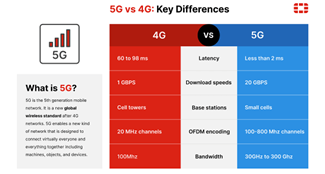
- Static Tech – 5G Spectrum Bands: 5G in India utilizes three distinct spectrum bands: Low Band (under 1 GHz for wide coverage), Mid Band (3.3-3.6 GHz for balancing speed and coverage), and High Band / Millimeter Wave (26 GHz for ultra-high speed over short distances).
- Latent technical advantage: 5G technology offers peak data transfer speeds up to 20 Gbps, ultra-low latency (reducing lag down to under 1 millisecond), and a massive connection density capable of supporting 1 million devices per square kilometer.
- Network slicing capability: A key feature of 5G is Network Slicing, which allows operators to create multiple virtual networks over a single physical 5G infrastructure to prioritize critical services like telemedicine or autonomous transport.
- The Digital Bharat Nidhi: The financial backbone for rural connectivity expansion comes from the fund established under the Telecommunications Act 2023, which replaced the legacy Universal Service Obligation Fund (USOF).
- The BharatNet Integration: The 5G ecosystem is integrated with the BharatNet project, which aims to connect all Gram Panchayats with high-speed optical fiber backhaul networks.
(PIB)
Launch of the Google Cloud AI Hub in Visakhapatnam:
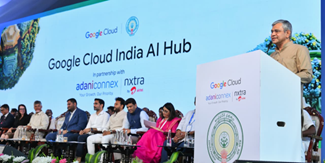
Context: In an important public-private infrastructure push, the Union Ministry of Electronics and Information Technology (MeitY) along with state leaders launched the multi-billion dollar Google Cloud AI Hub in Visakhapatnam.
-
- Project Value & Footprint: The initiative centers around a massive $15 billion technology infrastructure layout designed to position the eastern seaboard as a premier Artificial Intelligence cluster.
- Data center capacity: The core facility features a 1 Gigawatt (GW) capacity data center spanning nearly 600 acres, intended to provide high-performance computing (HPC) for AI training and deployment.
- Strategic corporate partnership: The project is a tripartite commercial collaboration involving Google Cloud, AdaniConneX, and Airtel Nxtra, ensuring a blend of cloud software, local infrastructure, and high-speed fiber backhaul.
- Completion timeline: The central stakeholders have been issued a strict directive to achieve full operationalization of the full-stack AI ecosystem by September 2028.
- Static S&T – What is a 1 GW Data Center?: A one-gigawatt facility represents hyperscale computing capacity capable of powering millions of AI tensor processing units (TPUs) simultaneously, requiring dedicated green energy baseload infrastructure.
- Full-Stack AI Ecosystem: This implies the local presence of all three layers of AI development: Infrastructure (compute/GPUs/TPUs), Platforms (foundational large language models and APIs), and Applications (software solutions for health, governance, and agriculture).
- The Sovereign AI Push: This hub complements the objectives of India’s IndiaAI Mission, which seeks to secure sovereign computing capacity and lower costs for Indian startups and researchers.
- The visakhapatnam geographical choice: Visakhapatnam’s coastal location is highly strategic due to its proximity to international undersea submarine fiber cable landing stations, which drastically minimizes international data latency.
- Energy sourcing: Due to the immense power requirements of a 1 GW datacenter, the facility is designed to draw power from dedicated renewable energy corridors, aligning with India’s net-zero targets.
- Edge computing integration: The data architecture will leverage Airtel’s domestic network edge nodes, allowing real-time AI inference processing across Indian smart cities and automated industrial zones.
(IE)
Organisations in news
The JEE (Advanced) 2026 Academic Framework & JoSAA Governance:
Context: Following the formal release of the competitive JEE (Advanced) 2026 results, candidate registration and centralized institutional choice filling officially commenced on June 2, 2026, under the JoSAA platform.
-
- The JoSAA Mandate: The Joint Seat Allocation Authority (JoSAA) is the statutory centralized administrative engine constituted by the Ministry of Education to manage and regulate seat allocation across premier national technical institutes.
- Institutional footprint: JoSAA systematically processes admissions for 121 premier central institutions, including 23 Indian Institutes of Technology (IITs), 31 National Institutes of Technology (NITs), 26 Indian Institutes of Information Technology (IIITs), and 41 other Government Funded Technical Institutes (GFTIs).
- Organizing institute 2026: For the 2026 academic cycle, IIT Roorkee was designated as the nodal authority responsible for organizing the JEE Advanced exam and initializing the JoSAA technological platform.
- Dual merit criteria: The allocation process utilizes a dual matrix: admissions to IITs are determined strictly by JEE Advanced ranks, while seats in NITs, IIITs, and GFTIs are processed using JEE Main
- Status of Institutes: Every institute governed under the JoSAA umbrella holds the legislative status of an Institute of National Importance (INI), an official designation awarded via specific acts of Parliament.
- Supernumerary female seats: To rectify historical gender imbalances in engineering, JoSAA enforces a mandatory quota of female supernumerary seats, ensuring a minimum baseline percentage of women in each technical department.
- The single-window policy: JoSAA was structurally designed to replace separate institutional counseling processes, functioning as a single-window portal to prevent seat duplication and reduce vacancy rates.
- Automated locking architecture: The portal uses a digital auto-lock mechanism where choices filled by candidates are systematically frozen at a specified deadline, preventing manual or corrupt administrative interventions in the merit list.
- The Architecture Aptitude Test (AAT): Alongside standard allocations, JoSAA manages the registration for AAT, a specialized exam mandatory only for candidates seeking admission to the Bachelor of Architecture (B.Arch) programs offered within the IIT ecosystem.
- Central reservation execution: JoSAA is the primary enforcement mechanism for the precise application of central reservation percentages, processing seat allocations for Scheduled Castes (SC), Scheduled Tribes (ST), Other Backward Classes (OBC-NCL), and Economically Weaker Sections (EWS).

(IE)
Spread the Word