Introduction
The introduction of the IBC in 2016 marked a milestone shift from a “debtor-controlled” to a “creditor-driven” system, introducing a unified, strictly time-bound framework focused on asset value maximization rather than pure liquidation. The subsequent rollout of the IBC (Amendment) Act, 2026, represents the next evolutionary phase, optimizing speed, clarity, and ease of doing business across the industrial value chain.
Evolution of IBC
Before the enactment of the Insolvency and Bankruptcy Code (IBC) in 2016, India’s corporate restructuring landscape was fragmented across multiple overlapping legal frameworks, including SICA, the Companies Act, and the SARFAESI mechanism.
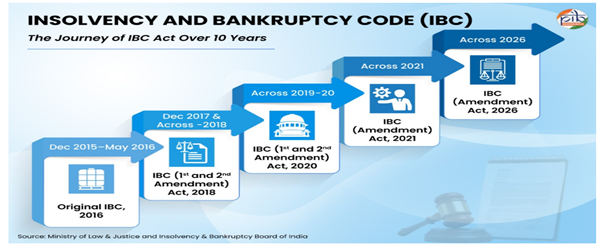
Proceedings spanned multiple uncoordinated forums, allowing distressed assets to deteriorate indefinitely while eroding investor confidence. The statutory progression of the Code reflects a dynamic response to macroeconomic challenges:
-
- 2018 Amendment: Streamlined voting majorities in the CoC and barred unscrupulous promoters from bidding for their own distressed assets under Section 29A.
- 2019 Amendment: Enforced the mandatory aggregate timeline of 330 days.
- 2020 Amendment: Extended statutory immunity to new buyers against past criminal liabilities of corporate debtors.
- 2021 Amendment: Unveiled the Pre-packaged Insolvency Resolution Process (PPIRP) specifically tailored for MSMEs to ensure a lower-cost “debtor-in-possession” restructuring model.
Institutional Architecture of the IBC Ecosystem
The functionality of India’s insolvency resolution stack relies on a closely regulated four-pillar institutional framework:
1. Insolvency and Bankruptcy Board of India (IBBI): The apex regulatory body responsible for supervising insolvency processes, registering service providers, and setting code enforcement standards.
2. Adjudicating Authorities (NCLT & NCLAT): The National Company Law Tribunal (NCLT) serves as the quasi-judicial anchor for corporate admissions, while appeals are processed by the National Company Law Appellate Tribunal (NCLAT).
3. Insolvency Professionals (IPs): Independent statutory administrators who take control of the distressed corporate debtor, preserve asset value, and manage daily operations during proceedings.
4. Committee of Creditors (CoC): The commercial core of the process, composed of financial creditors who collectively vote on the approval or rejection of resolution plans.
Corporate Insolvency Resolution Process (CIRP)
The principal operational route under the IBC is the CIRP, designed to address default distress in a structured manner:
-
- The Statutory Timeline: The Code prescribes that the CIRP must be concluded within an initial 180-day window, which can be extended up to a hard ceiling of 330 days, inclusive of all legal delays and litigations.
- The Resolution Outcome: If a viable resolution plan is vetted by the CoC and approved by the NCLT, the firm undergoes a capital and operational reset. If no consensus is built within the 330-day parameter, the corporate entity auto-enters mandatory liquidation.
Structural Transformations under the IBC (Amendment) Act, 2026
The 2026 Amendment updates the principal act by closing regulatory gaps, standardizing definitions, and minimizing delays:
1. Explicit and Harmonized Definitions
-
- Service Providers: Formally expands the legal term to include IPs, information utilities, and professional agencies registered under the IBBI.
- Security Interest: Clarified to mean only interests arising out of express bilateral agreements or contractual arrangements; liens created purely by operation of law are excluded.
- Avoidance & Fraudulent Transactions: Codifies strict actions against transactions that unfairly favor specific creditors, transfer assets undervalued, or carry out fraudulent trading under Section 66.
2. Procedural Speed and Admission Accountability
To counter long admission lags, the amendment mandates that the Adjudicating Authority must decide on applications within 14 days. Any failure to meet this timeline requires the judicial officers to formally record written reasons, introducing administrative accountability.
3. Disciplinary Restrictions on Case Withdrawals
To prevent tactical maneuvering, applications cannot be withdrawn before the formal constitution of the CoC or once resolution plans have been officially invited.
4. Deepening the Role of Creditors and Asset Scopes
-
- Liquidation Control: Extends the CoC’s authority into the liquidation phase, empowering financial creditors to supervise liquidation tracks and replace liquidators if operational targets are missed.
- Guarantor Integration: Widens the asset base by allowing the assets of corporate guarantors to be bundled into the resolution plan under specific creditor approvals.
- Moratorium Uniformity: Clarifies that the moratorium shield explicitly extends to cross-border or indirect guarantee parallel routes, protecting the debtor from multi-forum litigation.
5. Equity for Dissenting Creditors & Pre-Liquidation Flexibility
The law establishes that dissenting creditors must receive at least the lower of the liquidation value or the priority waterfall distribution under Section 53. Furthermore, it introduces a one-time restoration window allowing viable firms to return to the CIRP track right before final liquidation orders are signed.
Challenges
-
- The Hindu reports that despite the 14-day admission mandate under the 2026 Act, massive vacancy rates across NCLT benches nationwide continue to push the actual average admission period beyond 90 days, clogging the entry gate.
- ORF analytical briefs note that while creditors realized over ₹4.32 lakh crore, aggregate recovery rates hover between 32% and 36% of total admitted claims, meaning financial institutions take significant “haircuts” on aging assets.
- PRS Legislative highlights that the lack of full legislative adoption of the UNCITRAL Model Law on Cross-Border Insolvency hinders rapid resolution when a distressed enterprise holds significant manufacturing infrastructure or holding assets in foreign jurisdictions.
Way Forward
-
- Fully implementing an AI-driven, centralized case management system to automate notice deliveries, claim tracking, and document submissions to the NCLT.
- Extending the pre-packaged debtor-in-possession resolution framework from MSMEs to larger mid-corporate sectors to reduce the legal load on standard CIRP tracks.
- Promptly filling member vacancies across NCLT and NCLAT benches to ensure compliance with the 2026 statutory timelines.
- Framing a structured framework to address the simultaneous distress of interconnected corporate holding structures and subsidiaries as a single economic unit.
Conclusion
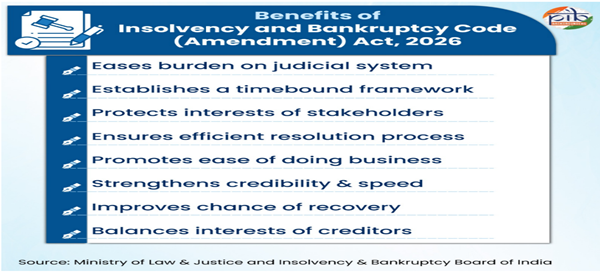
The Insolvency and Bankruptcy Code (Amendment) Act, 2026, represents a milestone in the evolution of India’s corporate resolution framework by balancing strict timeline compliance with strategic flexibilities like guarantor asset integration and pre-liquidation restoration, the framework improves both exit efficiency and capital reallocation.
Spread the Word