Introduction:
India’s green pathway centers on the principle that environmental protection and economic development are mutually reinforcing pillars of national progress. Globally, India has emerged as a credible voice for climate justice and equity, demonstrating that prosperity and planetary protection can advance together.
Biodiversity Conservation and Ecosystem Restoration
India is one of 17 mega-biodiverse countries, accounting for approximately 8% of recorded species worldwide despite occupying only 2.4% of global land area.
1. National Biodiversity Strategy (NBSAP) 2024–2030
Launched at COP16 in 2024, this roadmap aims to halt and reverse biodiversity loss by 2030, with a long-term vision of living in harmony with nature by 2050. It involves 23 ministries and focuses on species recovery, wetland conservation, and strengthened governance.
2. Protected Areas and Wildlife Programs
The Protected Area network expanded from 745 in 2014 to 1,134 in 2025.
-
- Project Tiger: Reserves increased to 58 in 2025, with a recorded population of 3,167 tigers in 2022.
- Project Elephant: 33 Reserves and 150 corridors across 15 states now protect elephant habitats.
- Project Cheetah: As of December 2025, the population reached 30, including 19 cubs born in India.
- Project Snow Leopard: The first nationwide assessment estimated a population of 718, with the highest concentration in Ladakh (477).
- Project Dolphin: Nationwide surveys (2021–2023) estimated 6,327 riverine dolphins.
Ecosystem Restoration: Forests, Wetlands, and Coasts
India employs a multi-layered strategy for habitat recovery across terrestrial and aquatic ecosystems.
-
- Forests: 18 Biosphere Reserves cover 91,425 sq. km, with 13 recognized under UNESCO. The “Ek Ped Maa Ke Naam” campaign saw 262.4 crore saplings planted by the end of 2025.
- Wetlands: India now has 98 Ramsar Sites as of January 2026, the highest in Asia. Udaipur and Indore are India’s first accredited Wetland Cities.
- Mangroves (MISHTI): Restored 4,536 hectares in 2025, with 22,560 hectares identified for future restoration.
- Coastal Resilience: 18 beaches achieved Blue Flag Certification by the 2025–26 season for maintaining international sustainability standards.
Strategic Climate Policy and Clean Energy
India’s climate action combines risk preparedness with proactive mitigation through renewable energy and low-carbon technology.
1. Key Frameworks
-
- NDC (2022): Targets a 45% reduction in emissions intensity by 2030 and 50% electric power capacity from non-fossil sources.
- Net Zero: Outlines a pathway toward net-zero emissions by 2070.
- Mission LiFE: Encourages climate-conscious lifestyles; over six crore people participated in events by December 2025.
2. Structural Energy Transition
In 2025, India achieved over 50% installed electricity capacity from non-fossil sources, five years ahead of the 2030 target.
-
- Global Standing: India ranks 3rd in Solar Power, 4th in Wind Power, and 4th in total Renewable Energy capacity globally as of late 2024.
- Innovation: Modhera (Gujarat) is India’s first 24×7 solar-powered village. The Omkareshwar Floating Solar Park is one of Asia’s largest.
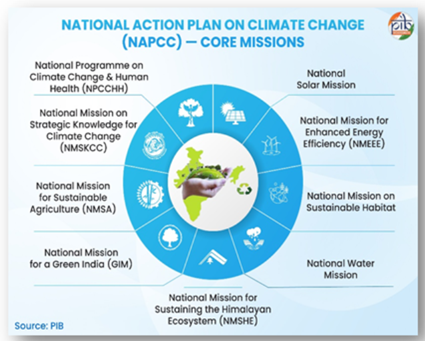
Pollution Control and Circular Economy
The National Clean Air Programme (NCAP) aims to improve air quality in 130 cities; 103 cities showed improved PM10 concentrations in 2024–25.
-
- Fly Ash Management: In 2024–25, India utilized 332.63 million tonnes of fly ash (approx. 98% generation) in construction and cement.
- Extended Producer Responsibility (EPR): Registered over 71,000 producers and 4,400 recyclers, facilitating the recycling of 375.11 lakh tonnes of waste by December 2025.
- Recycling Infrastructure: Waste recycling plants increased from 829 in 2019–20 to 3,036 in 2024–25.
Sustainable Development Goals (SDG) Progress
Coordinated by NITI Aayog, India’s composite SDG score improved to 71 in 2023–24 from 57 in 2018.
-
- SDG 7 (Clean Energy): Renewable energy reached 51.55% of installed capacity by November 2025.
- Efficiency: Emissions intensity of the power sector per unit of GDP dropped from 61.45 to 40.52 tonnes per ₹ crore between 2016 and 2023.
Challenges
-
- Climate Displacement & Compensation: The Hindu reports that while Project Tiger expands, human-wildlife conflict hotspots are increasing due to fragmented corridors, necessitating more robust ex-gratia systems.
- Financing the Transition: ORF notes that India requires approximately $10 trillion to reach net-zero by 2070; current international climate finance flows remain significantly below the required implementation scale.
- Intermittency and Storage: PRS Legislative highlights that as renewable share crosses 50%, the grid faces stability challenges, requiring urgent investment in Battery Energy Storage Systems (BESS) and pumped hydro.
- Regulatory Compliance: While EPR frameworks exist, monitoring the recycling of 375 lakh tonnes of waste across thousands of small-scale recyclers remains an administrative bottleneck.
Way Forward
-
- Scaling CCUS: Utilizing the ₹20,000 crore budget allocation to deploy Carbon Capture, Utilisation, and Storage in hard-to-abate sectors like steel and cement.
- Deepening Carbon Markets: Operationalizing the Carbon Credit Trading Scheme to incentivize private sector participation in emission reductions.
- Mainstreaming Traditional Knowledge: Integrating Indian Knowledge Systems (as seen in the updated NBSAP) into modern environmental governance to ensure community-led conservation.
- Strengthening Coastal Resilience: Expanding the National Coastal Mission (2025–31) to protect the 7,500 km coastline against sea-level rise.
Conclusion:
India’s vision of harmony with nature by 2050 is supported by measurable actions spanning carbon markets, species recovery, and renewable expansion. By aligning global responsibility with national execution, India continues to secure ecological stability for future generations.
Spread the Word