
Indian Polity & Governance
Governor’s Role in State Legislation:
CONTEXT: Governor’s discretionary powers, especially assent to Bills.
-
- Governor acts as constitutional head, not parallel authority.
- Withholding assent indefinitely raises constitutional concerns.
- Governor’s discretion is limited and situational.
- Federalism requires respect for elected state governments.
- Supreme Court has emphasised constitutional morality.
- Reservation of Bills for President is not routine.
- Delay in assent can affect governance outcomes.
- The issue tests Centre–State relations.
(IE)
International Relations
India–Africa Development Partnership & Lines of Credit:
Context: India’s renewed focus on development partnerships with African nations, including Lines of Credit (LoCs), capacity building and infrastructure cooperation.
-
- India’s Africa engagement focuses on South-South cooperation.
- Lines of Credit are extended through EXIM Bank of India.
- Projects span power, railways, agriculture and health.
- Unlike aid, LoCs promote mutual economic benefit.
- Africa is central to India’s Global South diplomacy.
- India’s model emphasises local capacity building, not resource extraction.
- LoCs are sovereign-backed financial instruments.
- India competes with other development partners like China, EU.
- Development diplomacy strengthens political goodwill and strategic presence.
(IE+PIB)
Economy
India’s Fiscal Consolidation Path & FRBM:
Context: India’s fiscal consolidation roadmap, especially in the backdrop of post-Budget borrowing, FRBM targets, and debt sustainability concerns.
-
- Fiscal consolidation refers to reducing fiscal deficit and public debt over time.
- India follows the FRBM Act framework, though targets are often revised due to shocks.
- Post-pandemic borrowing has significantly increased Centre’s debt-GDP ratio.
- Interest payments now form a large component of revenue expenditure.
- Capital expenditure is being prioritised despite consolidation pressures.
- Fiscal consolidation impacts inflation control, credit ratings and investor confidence.
- States’ borrowing limits are linked to Centre’s fiscal stance.
- Consolidation must balance growth, welfare expenditure and macro-stability.
- FRBM is a rules-based framework, not an austerity mandate.
(ET)
Geography, Mapping, Ecology & Environment and DM
National Green Hydrogen Mission:
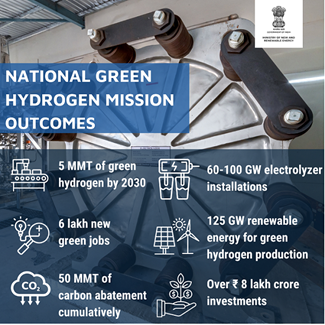
CONTEXT: Progress under the National Green Hydrogen Mission, especially industrial pilots and export-oriented hubs.
-
- Green hydrogen is produced via electrolysis using renewable energy, not fossil fuels.
- It is different from blue hydrogen, which still relies on fossil fuels with CCS.
- India’s mission targets decarbonisation of hard-to-abate sectors like steel and fertilisers.
- Hydrogen is an energy carrier, not a primary energy source.
- Storage and transportation remain key techno-economic challenges.
- Green hydrogen supports India’s net-zero by 2070 commitment.
- Mission links energy security with industrial competitiveness.
- Export ambitions depend on cost parity with fossil-based hydrogen.
- Renewable capacity expansion is a prerequisite for green hydrogen scale-up.
(PIB)
Global Stocktake under Paris Agreement:
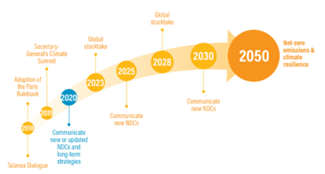
CONTEXT: Implications of the Global Stocktake (GST) under the Paris Agreement.
-
- Global Stocktake assesses collective progress, not individual country compliance.
- It occurs every five years under the Paris framework.
- Outcomes are non-binding but norm-setting.
- It influences future NDC ambition cycles.
- Equity and common but differentiated responsibilities (CBDR) remain central.
- Adaptation and finance are assessed alongside mitigation.
- Developing countries stress climate finance gaps.
- GST strengthens transparency but does not impose penalties.
(IE)
Heat Action Plans (HAPs):
CONTEXT: Urban Heat Action Plans ahead of summer season.
-
- Heat waves are increasing due to climate change.
- HAPs focus on early warning systems.
- Vulnerable populations are primary targets.
- Emphasis on urban resilience.
- Cooling strategies include green cover and shelters.
- Inter-agency coordination is essential.
- HAPs are adaptation, not mitigation tools.
(IE)
Science & Technology
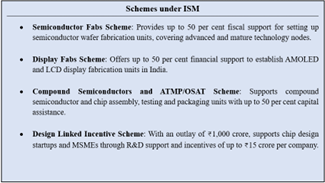
Semiconductor Mission:
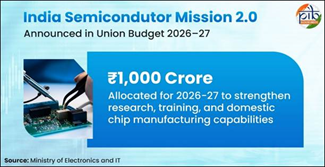
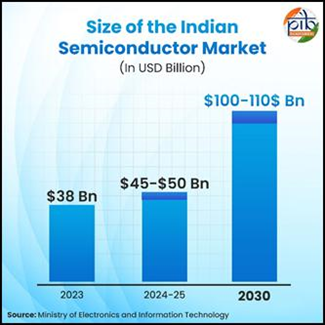
CONTEXT: Progress under India Semiconductor Mission and ecosystem development.
-
- Semiconductors are foundational to modern digital economy.
- Supply chains are geopolitically sensitive.
- Fabrication requires high capital and water-intensive processes.
- India focuses on ecosystem creation, not just fabs.
- Design, packaging, testing are equally important.
- Strategic autonomy is a key driver.
- Skilled workforce is a constraint.
- Semiconductor policy aligns with national security concerns.
(PIB)
Miscellaneous
India-WFP MoU on Rice Supply:
Context: Food Corporation of India (FCI) signed a five-year Memorandum of Understanding with the World Food Programme (WFP) to supply rice for humanitarian operations aimed at combating global hunger.
-
- Humanitarian Rice Supply Agreement: India agreed to supply 200,000 metric tonnes of rice to support WFP operations globally, demonstrating India’s commitment to global hunger alleviation.
- Five-Year Validity: The agreement is for five years, extendable by mutual consent, pointing to sustained engagement not just ad hoc relief.
- Global Food Security Leadership: India positions itself as a responsible global food security partner, complementing its role as a major agricultural producer.
- WFP Mandate: The WFP, established by the UN General Assembly, leads emergency food relief and long-term food security efforts globally. (static background)
- Zero Hunger Goal: This partnership aligns with SDG 2: Zero Hunger, reflecting global commitments.
- Export vs Aid: Rice supplied is intended for humanitarian missions, not commercial exports, impacting India’s soft power.
- International Cooperation: Strengthens India–UN institutional cooperation frameworks.
- Agriculture Diplomacy: Highlights agriculture diplomacy as a key element of foreign policy.
- Policy Implications: May incentivise improvements in domestic food grain stock management and storage protocols to meet international commitments.

(PIB)
Spread the Word