TOPIC-1: Indian Parliamentary Delegation to the 153rd IPU Assembly in Tanzania
-
- UPSC Relevance: GS Paper 2 (Parliament and State Legislatures — Structure, Functioning, and Conduct of Business; Parliamentary Diplomacy, International Forums, Good Governance, and Multilateral Engagements).
Introduction: An Indian Parliamentary Delegation led by Shri Harivansh, Hon’ble Deputy Chairman of the Rajya Sabha, departed for Arusha, United Republic of Tanzania to participate in the 153rd Assembly of the Inter-Parliamentary Union (IPU) held from October 5 to 9, 2026. The assembly convenes global parliamentarians under the overarching theme: “Enhancing good governance and empowering communities through inclusivity, trust and opportunities for all.”
About the Inter-Parliamentary Union (IPU):
-
- Inter-Parliamentary Union (IPU) was established in 1889, is the global organization of national parliaments aimed at promoting democratic governance, peace, accountability, and international cooperation.
- IPU holds permanent observer status at the United Nations while Headquartered in Geneva, Switzerland.
- Participation in the IPU provides India with a platform for Parliamentary Diplomacy, enabling lawmakers to articulate national positions, build multilateral legislative consensus, and share governance best practices with foreign counterparts.
Key Highlights:
-
- Delegation Composition: A multi-party delegation comprising Rajya Sabha Deputy Chairman Shri Harivansh alongside MPs including Shri Anurag Singh Thakur, Smt. Aparajita Sarangi, Dr. Sasmit Patra, Dr. Sanjay Jaiswal, Shri N. K. Premachandran, and others.
- Core Plenary Engagements: Leader of the Delegation, Shri Harivansh, represents India in the IPU Governing Council, the General Debate, discussions on emergency agenda items, and the candidate hearing for the IPU Presidency.
- Focus Areas in Multilateral Debates:
- Security & Peace: Counter-terrorism frameworks, maritime security, and peacebuilding.
- Technology & Future of Work: Artificial Intelligence (AI) regulation, ethical tech deployment, and critical minerals security.
- Environmental Governance: Climate change mitigation, preservation of ocean/mountain ecosystems, and sustainable development goals (SDGs).
- Social Inclusivity: Women’s political participation, public health, and community empowerment.
UPSC Quick Reference Table
| Feature | Detailed Specification |
| Global Body | Inter-Parliamentary Union (IPU) (Established 1889; HQ: Geneva) |
| Event & Location | 153rd IPU Assembly (Arusha, United Republic of Tanzania | Oct 5–9, 2026) |
| Assembly Theme | “Enhancing good governance and empowering communities through inclusivity, trust and opportunities for all” |
| Delegation Leader | Shri Harivansh (Hon’ble Deputy Chairman, Rajya Sabha) |
| Constituent House | Cross-party delegation representing both Lok Sabha and Rajya Sabha |
| Strategic Significance | Strategic deployment of Parliamentary Diplomacy and multilateral legislative engagement |
Conclusion:
India’s active participation in the 153rd IPU Assembly underlines the significance of parliamentary diplomacy in shaping global governance frameworks. Presenting perspectives on AI regulation, climate action, and democratic accountability helps strengthen democratic values, build multilateral trust, and position India’s legislative experience on the international stage.
TOPIC-2: India’s First 5.56 km Free-Space Quantum Key Distribution (QKD) Link
-
- UPSC Relevance: GS Paper 3 (Science & Technology — Developments and Applications in Quantum Technology, National Quantum Mission [NQM], Cyber Security, Defence & Space Communication, and Deep-Tech Start-ups).
Introduction: India achieved a breakthrough in quantum-secure communication by successfully demonstrating its first 5.56 km free-space Quantum Key Distribution (QKD) link. Executed through a collaboration between Bengaluru-based deep-tech startup QNu Labs, BISAG-N (under MeitY) and IIT Gandhinagar. The field trial established an unhackable optical quantum link across the open atmosphere between BISAG-N and IIT Gandhinagar.
Technology Framework:
-
- Quantum Key Distribution (QKD) relies on the fundamental principles of quantum mechanics (specifically Heisenberg’s Uncertainty Principle and Quantum Entanglement) to secure communication channels.
- Unlike classical encryption, any attempt by an eavesdropper to intercept or measure quantum states instantly alters the photon properties, immediately alerting the system.
- While fiber-optic QKD suffers from signal attenuation over long distances, free-space QKD transmits optical quantum signals directly through air, serving as a stepping stone for ground-to-satellite quantum communication.
Key Highlights:
-
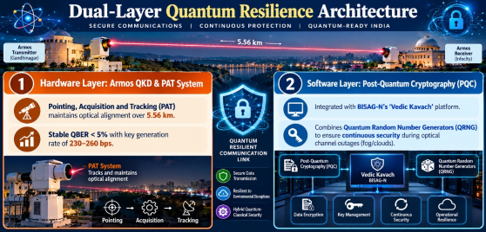
- High-Precision Optical Alignment: Used QNu Labs’ indigenous Pointing, Acquisition and Tracking (PAT) system to maintain precise laser collimation across 5.56 km of open-air atmospheric turbulence.
- Operational Performance: Maintained a stable Quantum Bit Error Rate (QBER) under 5% while continuously outputting symmetric quantum keys at 230–260 bits per second (bps).
- Hybrid Defense-in-Depth Architecture: Integrated hardware-level QKD (Armos) with software-level Post-Quantum Cryptography (Vedic Kavach). This dual-layer setup guarantees encryption integrity even if atmospheric conditions (e.g., fog or dust) temporarily disrupt the line-of-sight laser link.
- Triple-Helix Innovation Model: Showcases successful integration between academic research (IIT Gandhinagar), private deep-tech enterprise (QNu Labs), and government R&D institutions (BISAG-N / MeitY).
UPSC Quick Reference Table
| Feature | Detailed Specification |
| Nodal Ministry / Agency | Ministry of Electronics & Information Technology (MeitY) / BISAG-N |
| Collaborating Entities | QNu Labs (Deep-tech startup), BISAG-N, & IIT Gandhinagar |
| Field Trial Distance | 5.56 km (Free-Space / Open-Air Transmission) |
| Key Metrics | QBER < 5% | Key Rate: 230–260 bps |
| Core Hardware System | Armos QKD with Pointing, Acquisition & Tracking (PAT) sub-systems |
| Software Security Platform | Vedic Kavach (Post-Quantum Cryptography with QRNG) |
| Strategic Goal | Precursor for satellite-based QKD networks & National Quantum Mission (NQM) targets |
Conclusion:
Demonstrating India’s first 5.56 km free-space QKD link advances the national strategic roadmap for quantum-secure communication. Combining indigenous hardware with post-quantum software systems strengthens defense and strategic data security against quantum-era cyber threats while building the foundation for satellite-assisted quantum communication under the National Quantum Mission.
Spread the Word