TOPIC-1: 7th Session of the India–Morocco Bilateral Trade Partnerships
-
- GS Paper 2 (Bilateral, Regional, and Global Groupings and Agreements involving India and/or affecting India’s Interests)
- GS Paper 3 (Indian Economy — Foreign Trade, Preferential Trade Agreements, Food Safety Standards, and Energy/Fertiliser Supply Chain Security).
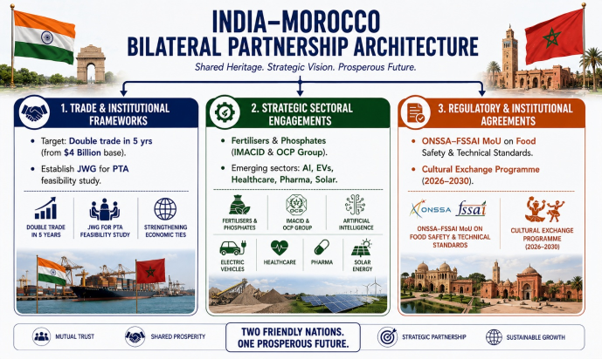
Introduction: Both nations agreed to double bilateral trade in five years (from ~$4 billion in 2025) & to establish a Joint Working Group (JWG) to explore a Preferential Trade Agreement (PTA). Also sign key MoUs on food safety and cultural exchange, and prepare for the 70th anniversary of diplomatic relations in 2027.
Key Highlights
-
- Both sides agreed to double bilateral trade over the next five years from the 2025 baseline of USD 4 billion.
- Formed an India–Morocco Joint Working Group (JWG) to examine tariff/non-tariff barriers and assess the feasibility of a bilateral Preferential Trade Agreement (PTA).
- Reviewed the joint venture manufacturing facility of India-Maroc Phosphore (IMACID), a partnership involving Morocco’s OCP Group, Paradeep Phosphates Limited and Indian partners.
- Reaffirmed commitment from OCP Group for stable, long-term supplies of phosphates and raw fertiliser materials to secure India’s agricultural supply chains.
Regulatory Cooperation:
-
- Food Safety MoU: Signed between Morocco’s National Office of Food Safety (ONSSA) and the Food Safety and Standards Authority of India (FSSAI) to align technical expertise, testing laboratories, packaging, and sampling standards.
- Pharma Market Access: Agreed to streamline market authorization procedures and approval timelines for Indian pharmaceutical exports to Morocco.
- Cultural Exchange Programme (2026–2030): Signed to promote institutional links between museums, libraries, archives, and heritage conservation bodies ahead of the 70th anniversary of diplomatic relations in 2027.
UPSC Quick Reference Table
| Feature | Detailed Specification |
| Nodal Ministries | Ministry of Commerce and Industry (India) & Ministry of Industry and Trade (Morocco) |
| Co-Chairs of 7th JCM | Shri Jitin Prasada (MoS India) & H.E. Mr. Omar Hejira (Secretary of State, Morocco) |
| Bilateral Trade Target | Double trade in 5 years (2025 Base: ~USD 4 Billion) |
| Key Mechanism Formed | India–Morocco Joint Working Group (JWG) for PTA Feasibility |
| Key Standard MoU | ONSSA (Morocco) – FSSAI (India) MoU on Food Safety |
| Key Cultural Agreement | Cultural Exchange Programme (2026–2030) |
| Diplomatic Milestone | 70th Anniversary of Diplomatic Relations (2027) — 8th JCM to be held in New Delhi |
Conclusion:
The 7th Session of the India–Morocco Joint Commission strengthens bilateral economic ties across trade, agriculture, and energy security. Setting up a Joint Working Group for a Preferential Trade Agreement, addressing pharmaceutical regulatory barriers and securing raw phosphate supplies reinforce India’s trade engagement and supply chain resilience in North Africa.
TOPIC-2: India Calls for Community-Led Restoration of Rangelands at UNCCD COP17
-
- GS Paper 3 (Environment & Ecology — Biodiversity Conservation, Land Degradation Neutrality [LDN], Climate Resilience, Sustainable Land Management [SLM], and Community Rights under FRA).
Context: Addressing the Ministerial Dialogue on “Restoration of Rangelands and the Well-being of Pastoralist Communities” at the 17th Conference of Parties (COP17) to the UN Convention to Combat Desertification (UNCCD) in Ulaanbaatar, Mongolia, Union Environment Minister Shri Bhupender Yadav outlined India’s strategy for restoring rangelands and grasslands. Emphasizing that “successful restoration begins with pastoralists as custodians, not merely beneficiaries,” India advocated for combining traditional community knowledge with science, secure land tenure, and dedicated global financing.
Key features:
-
- Re-anchors ecosystem management around local pastoralist communities rather than treating them as passive beneficiaries.
-
- Combines traditional ecological knowledge with contemporary spatial planning to foster socially inclusive and economically viable restoration.
- Sacred Groves (Orans): Highlighted Rajasthan’s Orans and India’s ~25,000 community-protected sacred groves (covering ~0.6 million hectares).
- Biodiversity Anchors: These sacred groves protect critical habitats for endangered species like the Great Indian Bustard (GIB) while securing local pastoral livelihoods.
- Encompasses diverse biomes—including Himalayan pastures, Central Indian savannas, Thar/Kachchh arid zones, and Southern sholas.
- Integrates large-scale wildlife conservation programs, such as the reintroduction of the Cheetah and its planned expansion into open grassland biomes like Banni in Gujarat.
- Promotes deep-rooted indigenous grasses to increase soil organic carbon (SOC), improve surface water infiltration, and accelerate groundwater recharge.
- Called for accessible, dedicated international financing for rangeland restoration to support developing nations in achieving Land Degradation Neutrality (LDN).
UPSC Quick Reference Table
| Feature | Detailed Specification |
| Nodal Forum | Ministerial Dialogue, UNCCD COP17 (Ulaanbaatar, Mongolia) |
| Key Indian Representative | Shri Bhupender Yadav (Union Minister for MoEF&CC) |
| Core Theme | Restoration of Rangelands and Well-being of Pastoralist Communities |
| Traditional Systems | Orans (Sacred Groves) & Gauchars (~0.6M hectares across ~25,000 sites) |
| Scientific Tool | ISRO/SAC Satellite-based Desertification & Land Degradation Atlases |
| Key Grassland Hubs | Banni Grasslands (Gujarat), Thar Desert, Himalayan pastures, Deccan savannas |
| Global Alignment | International Year of Rangelands and Pastoralists (IYRP) & UNCCD LDN Targets |
Conclusion:
India’s intervention at UNCCD COP17 underscores the importance of community-led stewardship in ecological restoration. Integrating pastoral rights, traditional knowledge systems like Orans, spatial mapping, and deep-rooted grassland management provides a model for achieving Land Degradation Neutrality while safeguarding pastoral livelihoods.
TOPIC-3: India and Seychelles High-Level Bilateral Meeting on Fisheries
-
- GS Paper 2 (Bilateral, Regional, and Global Groupings involving India; SAGAR Vision and Indian Ocean Diplomacy)
- GS Paper 3 (Indian Economy — Marine Fisheries, Mariculture, Blue Economy, Seafood Exports, and Technological Integration).
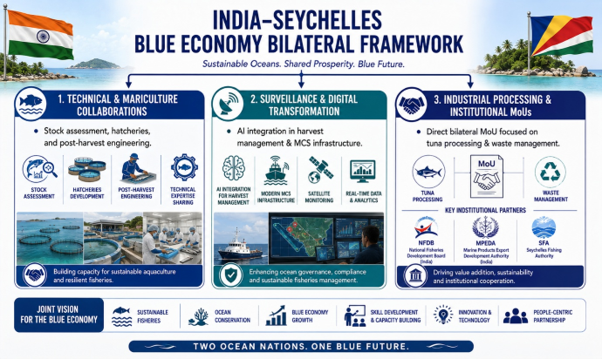
Context: The Department of Fisheries, Ministry of Fisheries, Animal Husbandry and Dairying (MoFAH&D) hosted a high-level bilateral meeting with a delegation from the Republic of Seychelles in New Delhi. The meeting reviewed existing frameworks and established a roadmap for sustainable marine resource management, tuna processing, and digital fisheries surveillance.
Key Highlights
-
- Alignment with Indian Ocean Diplomacy (SAGAR Vision):
- Reaffirmed commitment to deepening maritime ties, supporting food and nutritional security, and advancing socio-economic stability across the Indian Ocean Region (IOR).
- Highlighted India’s landmark achievements in fisheries, noting national fish production reaching 19.7 million tonnes and annual seafood exports valued at USD 8.46 billion.
- Digital Transformation & Maritime Surveillance:
- Explored joint deployment of Artificial Intelligence (AI) for harvest management and stock assessment.
- Focused on building integrated Monitoring, Control, and Surveillance (MCS) infrastructure and modernized fisheries data management platforms to combat Illegal, Unreported, and Unregulated (IUU) fishing.
- Industrial Value Chain & Market Development:
- Emphasized value-chain optimization specifically targeted at tuna fisheries, modern hatchery setup, product diversification, and sustainable fish waste management.
- Agreed on reciprocal laboratory access, cross-leveraging national Centres of Excellence, and organizing mutual exposure visits for scientific experts.
- Institutional Governance & Formal Bilateral MoU:
- Seychelles proposed accelerating the execution of a dedicated bilateral Memorandum of Understanding (MoU) focused exclusively on fisheries and aquaculture.
- Agreed to institute a structured annual work plan to oversee regulatory alignment, joint scientific research commercialization, and pilot project execution.
- Alignment with Indian Ocean Diplomacy (SAGAR Vision):
UPSC Quick Reference Table
| Feature | Detailed Specification |
| Nodal Department | Department of Fisheries, Ministry of Fisheries, Animal Husbandry and Dairying |
| Partner Nation | Republic of Seychelles |
| Indian Co-Chair | Dr. Abhilaksh Likhi (Secretary, Dept. of Fisheries) |
| Seychelles Co-Chair | H.E. Mr. Wallace Cosgrow (Minister of Fisheries, Agriculture & Blue Economy) |
| India Sector Metrics | Fish Production: 19.7 Million Tonnes; Seafood Exports: USD 8.46 Billion |
| Key Priority Species | Tuna (Optimization, processing, and post-harvest value addition) |
| Institutional Outcome | Dedicated Bilateral MoU & Annual Work Plan on Fisheries & Aquaculture |
Conclusion:
The high-level bilateral meeting between India and Seychelles advances strategic and economic ties in the Indian Ocean Region. Leveraging technology-driven monitoring systems, mariculture R&D and tuna processing partnerships supports sustainable ocean governance under India’s broader Security and Growth for All in the Region (SAGAR) framework.
TOPIC-4: DAANVEER — Computer Crowdsourcing Initiative for Gram Panchayats
-
- GS Paper 2 (Government Policies & Interventions for Development; E-Governance Applications, Transparency, and Accountability; Local Self-Governance & Panchayati Raj)
- GS Paper 3 (Digital Public Infrastructure [DPI], ONDC, and Grassroots Infrastructure Development).
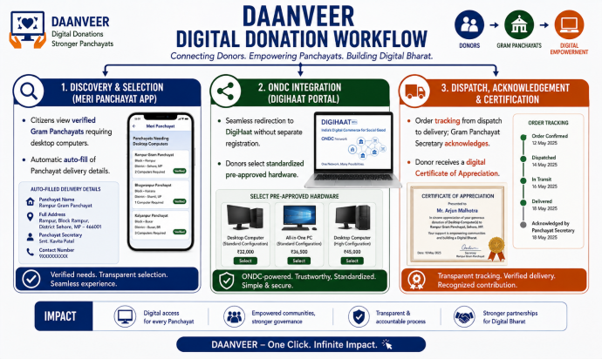
Introduction: The Ministry of Panchayati Raj invited public participation for DAANVEER. It is a people-led computer crowdsourcing initiative designed to strengthen digital infrastructure in Gram Panchayats accessible via the Meri Panchayat App. The initiative enables individuals, CSR partners, non-resident Indians (NRIs), and philanthropic organizations to donate desktop computers directly to verified Gram Panchayats using a transparent and technology-enabled mechanism.
Key Highlights
-
- Digital Transformation:
- Complements government infrastructure schemes such as the Rashtriya Gram Swaraj Abhiyan (RGSA) to equip Gram Panchayats for digital service delivery, financial management, record-keeping, and local planning.
- Establishes a transparent model of participatory governance, enabling citizens, philanthropic institutions, and the Indian diaspora to contribute directly to rural digital infrastructure.
- Operates through the Meri Panchayat App, securely redirecting donors to DigiHaat, an Open Network for Digital Commerce (ONDC)-enabled digital marketplace.
- End-to-End Transparency & Verification:
- Features real-time order tracking from confirmation and dispatch to delivery and installation.
- Requires formal acknowledgement by the Gram Panchayat Secretary upon receipt, which triggers a digitally generated Certificate of Appreciation for the donor.
- Allows the public to view the donation status of Gram Panchayats, ensuring complete transparency.
- Digital Transformation:
UPSC Quick Reference Table
| Feature | Detailed Specification |
| Nodal Ministry | Ministry of Panchayati Raj, Government of India |
| Initiative Name | DAANVEER (Computer Crowdsourcing Initiative) |
| Primary Platform | Meri Panchayat App |
| E-Commerce Backend | DigiHaat (ONDC-enabled digital marketplace) |
| Complementary Scheme | Rashtriya Gram Swaraj Abhiyan (RGSA) |
| Target Donors | Citizens, Philanthropists, CSR Partners, and Indian Diaspora |
| Verification & Impact | Receipt acknowledgement by Panchayat Secretary & digital Certificate of Appreciation |
Conclusion:
The DAANVEER initiative demonstrates the role of participatory digital infrastructure in empowering rural governance. Integrating the Meri Panchayat App with ONDC-enabled marketplaces like DigiHaat provides a transparent avenue for voluntary public contributions. Thus, helping equip Gram Panchayats to deliver efficient, technology-driven public services at the grassroots.
Spread the Word