
THEME: SCIENCE, SCIENTIFIC TEMPER, RATIONALITY, REASONING, KNOWLEDGE, WISDOM AND TRUTH
| THEMES | TOPICS |
|---|---|
| Science, Scientific temper, Rationality, Reasoning, Knowledge, Wisdom, Truth | • Truth knows no colour(2025). • Thought finds a world and creates one also(2025). • The doubter is a true man of science. (2024) • Visionary decision-making happens at the intersection of intuition and logic. (2023) • Mathematics is the music of reason. (2023) • The real is rational and the rational is real. (2021) • What is research, but a blind date with knowledge! (2021) • Wisdom finds truth (2019) • Reality does not conform to the ideal, but confirms it (2018) • Words are Sharper than the two-edged sword. (2014) • Science and Mysticism: Are they compatible? (2012) |
MEANING OF THE THEMES
Science
-
- Meaning: The systematic enterprise that builds and organizes knowledge in the form of testable explanations and predictions about the universe. It relies on the scientific method—observation, experimentation, measurement, and formulation of hypotheses.
- Core Idea: A structured, empirical method to test how the physical world works.
Scientific Temper
-
- Meaning: An individual and societal attitude defined by a lifelong spirit of inquiry, critical thinking, and intellectual flexibility. It involves the refusal to accept assertions without evidence, a commitment to trial and testing, and crucially, the humility to change one’s mind when confronted with new facts.
- Core Idea: Science applied as a lifestyle and a mindset, not just a subject.
Reasoning
-
- Meaning: The cognitive process of looking for reasons, beliefs, conclusions, or actions. It is the logical mechanism the human mind uses to connect pieces of information, make sense of things, and establish facts.
- Core Idea: The mental engine that processes “If A, then B.”
Rationality
-
- Meaning: The quality of being guided by or based on logic, reason, and evidence rather than emotion, tradition, or superstition. Rationality means aligning your beliefs with reality (epistemic rationality) and acting in a way that effectively achieves your goals based on those beliefs (instrumental rationality).
- Core Idea: Choosing logic over dogma; the discipline to remain objective.
Knowledge
-
- Meaning: The accumulation of facts, information, skills, and data acquired through education, experience, or theoretical understanding. In philosophy, it is traditionally defined as “justified true belief.”
- Core Idea: The “what” — the inventory of data and facts we have verified.
Wisdom
-
- Meaning: The ability to discern, judge, and apply knowledge, experience, and deep understanding to make sound decisions and live a meaningful life. While knowledge is knowing that a door is open, wisdom is knowing when to walk through it. It introduces ethics, long-term consequences, and empathy into knowledge.
- Core Idea: The “how” and “why” — knowing how to use knowledge for the greater good.
Truth
-
- Meaning: The property of being in accord with fact or reality. In a philosophical and scientific sense, truth is that which corresponds to the actual state of the world, independent of human opinions, wishes, or beliefs.
- Core Idea: The ultimate destination; objective reality.
THE THEMATIC POPULAR QUOTES
| Theme | Quote | Author | Essay Application / Key Takeaway |
|---|---|---|---|
| Science & Scientific Temper | Science is a way of thinking much more than it is a body of knowledge. | Carl Sagan | Introductions: Argues that science is an active process and mindset, not just a static textbook of facts. |
| The good thing about science is that it's true whether or not you believe in it. | Neil deGrasse Tyson | Objectivity: Perfect for discussing the objective reality of empirical facts versus subjective belief. | |
| What is called a 'scientific temper' is an attitude of mind which comprises search for truth and new knowledge, refusal to accept anything without testing and trial, a capacity to change previous conclusions in the face of new evidence. | Jawaharlal Nehru | Socio-Political/Education: Essential for tracking the societal need for logical inquiry and rejecting dogma. | |
| Rationality & Reasoning | ...provide the framework; reasoning builds the structure. | Paraphrased from Classical Philosophy | Structural Argument: Useful for illustrating how logic builds upon foundational premises. |
| The intellect has sharp eyes for methods and tools, but is blind to ends and values. | Albert Einstein | Ethics in Logic: Use this to critique "pure rationality" or technocracy devoid of human empathy and ethics. | |
| Reasoning is the slow and tortuous method by which an illiterate mankind discovers how things work. | Ambrose Bierce | Progress Narrative: A witty, cynical option to highlight how human progress relies on grinding logic over sudden revelation. | |
| Fix reason firmly in her seat, and call to her tribunal every fact, every opinion. | Thomas Jefferson | Skepticism: Excellent for advocating the rigorous questioning of authority, tradition, or popular opinion. | |
| Knowledge vs. Wisdom | Knowledge is proud that he has learned so much; Wisdom is humble that he knows no more. | William Cowper | Intellectual Humility: The gold standard for contrasting the ego of information accumulation with true understanding. |
| Knowledge is talking. Wisdom is listening. | Jimi Hendrix | Communication: A punchy, modern quote ideal for transitions or conclusions on learning and perspective. | |
| To know is not enough; we must apply. Willing is not enough; we must do. | Johann Wolfgang von Goethe | Action & Ethics: Perfect for essays dealing with actionable knowledge, policy-making, or moral responsibility. | |
| The only true wisdom is in knowing you know nothing. | Socrates | Philosophical Foundation: Explores intellectual humility as the absolute prerequisite for genuine learning. | |
| Truth | The truth is rarely pure and never simple. | Oscar Wilde | Complexity: Excellent for analysing nuanced scientific discoveries or the messy realities of human history. |
| In a time of deceit telling the truth is a revolutionary act. | George Orwell | Political/Sociological: A powerful addition for body paragraphs regarding censorship, institutional accountability, and misinformation. | |
| Truth resides in every human heart... But no one has a right to coerce others to act according to his own view of truth. | Mahatma Gandhi | Pluralism & Morality: Ideal for discussing the intersection of personal truth, morality, and social tolerance. | |
| If you would be a real seeker after truth, it is necessary that at least once in your life you doubt, as far as possible, all things. | René Descartes | Philosophical Inquiry: Connects truth directly back to skepticism and rationality; a great thesis-stage quote. |
SCIENTIFIC TEMPER
Philosophical Roots
-
- Francis Bacon: Empirical method; “Knowledge is power.”
- Karl Popper: Scientific method is falsifiable, not dogmatic.
- Gandhi: Though spiritual, supported rational experiments in social reform (“My life is my message” as experimentation).
- J.S. Mill: Freedom of thought, debate, and rational inquiry as basis of progress.
- Indian Traditions: Carvaka materialism, Buddhist rationality, Nyaya logic schools.
Ethical Framework
-
- Promotes objectivity, fairness, justice in governance.
- Counters superstition, communalism, obscurantism.
- Links to probity in public life: decisions based on evidence, not bias.
- Encourages scientific innovation aligned with sustainability and ethics.
Scientific Temper and Evolution of Society
Stages of Evolution of Society
(a) Primitive Societies – Myth & Superstition
-
- Early humans explained natural events (thunder, eclipse, disease) through myths.
- Social practices rooted in fear and rituals.
- Little space for inquiry.
(b) Ancient Civilizations – Early Rationality
-
- India: Ayurveda, Charaka, Susruta, Aryabhata.
- Greece: Aristotle, Archimedes.
- China: Confucian rational ethics.
- Scientific temper started influencing governance (e.g., irrigation systems, calendars).
(c) Medieval Era – Dogma & Resistance
-
- Dominance of religion often suppressed inquiry (e.g., Galileo vs. Church).
- In India: caste practices & superstition overshadowed rationality.
(d) Renaissance & Enlightenment – Reason as Driver
-
- Scientific Revolution (Copernicus, Newton).
- Rational philosophy (Descartes, Locke, Kant).
- Birth of modern democratic ideals, human rights, secularism.
(e) Industrial & Modern Era – Science Transforms Society
-
- Industrial Revolution: steam, electricity, vaccines.
- Rise of democratic governance, welfare states.
- Indian National Movement: Nehru, Ambedkar, Tagore linked rationality to social reform.
(f) Contemporary Society – Challenges & New Frontiers
-
- Digital revolution, AI, biotechnology, space exploration.
- BUT: resurgence of fake news, climate denial, pseudoscience, religious extremism.
- Need to balance scientific temper with ethics and sustainability.
GALILEO VS. THE CHURCH – CLASH OF DOGMA AND INQUIRY
Background
-
- Galileo Galilei (1564–1642), Italian astronomer and physicist.
- Advocated heliocentrism (Earth revolves around the Sun), based on telescopic observations.
- This supported Copernicus’ theory, challenging the Church’s geocentric view (Earth at center).
Church’s Reaction
-
- The Catholic Church saw heliocentrism as contradicting scriptural authority.
- Galileo was summoned before the Roman Inquisition (1633).
- He was tried for heresy, forced to recant, and spent his final years under house arrest.
Philosophical/Ethical Angle
-
- This incident symbolizes the conflict between authority (dogma) and reason (inquiry).
- It highlights the ethical dilemma: truth vs. conformity, freedom of thought vs. institutional power.
Legacy for Scientific Temper
-
- Demonstrates that suppression of rational inquiry delays social evolution.
- Later, the Enlightenment drew lessons: science must be free from religious/political dogma.
- Pope John Paul II (1992) formally acknowledged the Church’s error, rehabilitating Galileo’s reputation — a symbolic victory for scientific temper.
Wider Implication
-
- Similar clashes occurred elsewhere:
- Giordano Bruno burned for cosmological ideas.
- In India, social reformers (Raja Ram Mohan Roy, Periyar, Phule) faced opposition from orthodoxy when questioning rituals.
- Shows that dominance of religion or tradition, without openness to reason, slows societal progress.
- Similar clashes occurred elsewhere:
Galileo vs. Church as a metaphor:
“When society silences inquiry in the name of authority, it halts its own evolution. But when it nurtures scientific temper, it moves towards justice, liberty, and progress.”
KARL POPPER & SCIENTIFIC TEMPER
-
- Problem with older view (Verificationism): Earlier thinkers (like the Logical Positivists) believed a statement is scientific only if it can be verified. But Popper argued that no matter how many times you verify, certainty is never achieved. Example: seeing a thousand white swans doesn’t prove all swans are white.
- Popper’s Solution – Falsifiability: A theory is scientific if it can, in principle, be falsified by evidence.
- If a theory makes risky predictions that could be wrong, it’s scientific.
- If it’s framed in such a way that nothing can disprove it, it’s dogma, not science.
- Examples:
- Einstein’s General Relativity → predicted bending of light around stars. It could be tested (Eddington’s 1919 eclipse experiment). Hence, scientific.
- Astrology → claims are so vague they can’t be disproved. Hence, not scientific.
- Connection to Scientific Temper in India:
- Encourages a mindset of questioning, testing, rejecting false claims.
- Guards against pseudo-science, superstition, political dogma.
Popper
-
- “A theory which is not refutable by any conceivable event is non-scientific.”
- “Science must begin with myths, and with the criticism of myths.”
SCIENTIFIC TEMPER IN INDIAN SOCIETY
-
- Social Reform: Abolition of Sati (Raja Ram Mohan Roy), Widow Remarriage, caste reforms.
- Public Health: Vaccination, sanitation, eradication of polio.
- Economic Growth: White Revolution, IT Revolution, Digital India.
- Democracy: Rational debates, informed citizenry.
- Justice & Equality: Breaking myths of untouchability, witch-hunting, gender taboos.
Jawaharlal Nehru in The Discovery of India (1946) popularized the term. It refers not only to knowledge of science but to a way of thinking that is rational, evidence-based, questioning, and progressive. It is about cultivating reason over superstition, inquiry over dogma, and objectivity over prejudice.
Constitutional & Legal Framework
-
- Article 51A(h), Fundamental Duties: “It shall be the duty of every citizen of India to develop the scientific temper, humanism and the spirit of inquiry and reform.”
- National Policy on Education (1986, 1992, NEP 2020): stresses scientific temper in learning.
- Indian Science Congress and National Science Day (28 Feb) are platforms to promote it.
Court Observations:
-
- Royappa v. State of Tamil Nadu (1974)– SC emphasized reasonableness and rationality as hallmarks of governance.
- Ismail Faruqui v. Union of India (1994)– separation of faith and reason in public matters.
- Sabrimala Case 2018: Giving preference to constitutional morality orver. Social morality.
Positive Examples
-
- White Revolution (Verghese Kurien) – science applied to solve food scarcity.
- ISRO – evidence-based, frugal innovation.
- Eradication of Polio – mass vaccination driven by scientific temper.
- Right to Information Act (2005) – promotes rational, transparent governance.
EXAMPLES ANTI-THETICAL TO SCIENTIFIC TEMPER
-
- Opposition to Vaccination (Polio & COVID-19): During polio eradication drives (1990s–2000s) and COVID vaccination (2020–21), rumours spread about infertility, conspiracy, or side effects.
- GM Crops Controversy (Bt Brinjal, GM Mustard): Despite years of trials by scientists, strong opposition came from activists, farmer groups, and political lobbies. Bt Brinjal placed under indefinite moratorium (2010).
- Opposition to Rationalists and Science Communicators: Rationalists like Narendra Dabholkar (2013), Govind Pansare (2015), M.M. Kalburgi (2015), Gauri Lankesh (2017)were assassinated for promoting critical thinking, exposing superstitions, and questioning blind faith.
- Digital Misinformation & Health Myths: During COVID, false cures (cow urine, steam inhalation, herbal “immunity boosters”) spread widely on WhatsApp and social media. Evidence-based medicine often side-lined by viral misinformation.
Relevance Today
-
- Essential for democracy: citizens need rational debate.
- Crucial for sustainable development: evidence-based policy making.
- Necessary for social justice: ending regressive practices like witch-hunting, untouchability.
- Important for global challenges: AI ethics, climate change, genetic engineering.
Scientific temper is not about rejecting faith, but about refusing blind belief. It is the ethical and rational foundation of a modern, democratic, and progressive society.
Mind Map
Scientific Temper → Rationality → Inquiry → Humanism → Reform
Historical Roots
-
- Ancient India: Carvaka (materialism), Buddha (logic, causality), Aryabhata (astronomy).
- European Enlightenment: Bacon (empiricism), Descartes (reason), Popper (falsifiability).
- Indian National Movement: Nehru, Tagore, Ambedkar emphasized rational social reform.
Conclusion
Scientific temper is the engine of social evolution — it shifts society from fear to freedom, from blind faith to reason, from stagnation to progress. For India, cultivating it is not only a constitutional duty but the pathway to becoming a just, modern, and sustainable democracy.
Quotes
-
- Nehru: “Scientific temper is neither a discipline nor a subject but an attitude of mind.”
- Carl Sagan: “Science is a way of thinking much more than it is a body of knowledge.”
- Bertrand Russell: “In all affairs it’s a healthy thing now and then to hang a question mark on the things you have long taken for granted.”
CRITICAL THINKING
Critical thinking is the disciplined art of analysing, questioning, and evaluating information or beliefs before forming judgments. It involves logic, evidence, and reflection rather than blind acceptance.
-
- It is not mere criticism, but a constructive, rational inquiry.
- Core skills: analysis, evaluation, inference, explanation, self-regulation.
Philosophical Foundations
-
- Socrates (469–399 BCE): Father of critical thinking. His Socratic Method (asking probing questions) challenged assumptions and cultivated reasoning.
- “The unexamined life is not worth living.”
- Aristotle: Emphasized logic as the foundation of clear reasoning. His syllogisms were early tools of structured thinking.
- Descartes: Advocated radical doubt — accept nothing as true unless it is proven through reason.
- “Cogito, ergo sum” (I think, therefore I am).
- Kant: Critical thinking as enlightenment — having the courage to use one’s own understanding without external guidance.
- “Sapere Aude” (Dare to know).
- John Stuart Mill: Defended free speech as necessary for critical thinking; only through contesting ideas can truth emerge.
- Contemporary: Jürgen Habermas emphasized communicative rationality — critical reasoning in dialogue sustains democracy.
- Socrates (469–399 BCE): Father of critical thinking. His Socratic Method (asking probing questions) challenged assumptions and cultivated reasoning.
Importance & Relevance
-
- Personal Sphere: Helps distinguish between belief and knowledge; prevents manipulation by superstition or propaganda.
- Democracy & Governance: Citizens with critical thinking resist authoritarianism and misinformation.
- Example: Critical public discourse shaped Indian independence under Gandhi and Nehru.
- Science & Innovation: Critical questioning of old paradigms leads to breakthroughs.
- Example: Einstein questioned Newtonian absolutes, leading to relativity.
- Administration: A civil servant must critically evaluate policies, not just implement them blindly.
Quotes
-
- “Education is not the learning of facts, but the training of the mind to think.” – Albert Einstein
- “Doubt is the origin of wisdom.” – Augustine of Hippo
- “The essence of the independent mind lies not in what it thinks, but in how it thinks.” – Christopher Hitchens
RATIONALITY
Rationality is the quality of being guided by reason, logic, and evidence in thought and action. It is the capacity to weigh facts, avoid contradictions, and make judgments consistent with goals and values.
Distinction:
-
-
- Theoretical Rationality → Concerned with belief (what is true).
- Practical Rationality → Concerned with action (what should be done).
-
Philosophical Foundations
-
- Socrates & Plato: Truth emerges from dialectical reasoning. Rationality is the soul’s guide to justice.
- Aristotle: Man is a zoon logikon (rational animal). Rationality distinguishes humans from other beings.
- Descartes: Rational doubt as the foundation of knowledge (“I think, therefore I am”).
- Kant: Rationality as the basis of morality — act only on maxims that can be universal laws (Categorical Imperative).
- Hegel: Reality itself is rational (“What is rational is real, and what is real is rational”).
- J.S. Mill: Rational discourse is vital for liberty — only free debate sharpens truth.
- Modern thinkers:
- Amartya Sen → Rationality as reasoning about justice and choice (e.g., capability approach).
- Herbert Simon → Bounded rationality — humans are rational, but limited by information and cognitive capacity.
Types of Rationality
1. Instrumental Rationality– Choosing best means to achieve given ends (efficiency-driven).
2. Value Rationality– Acting based on principles or ethical commitments, even against self-interest.
3. Communicative Rationality (Habermas)– Rationality rooted in dialogue, consensus, and truth-seeking.
Importance
-
- Individual level: Helps distinguish belief from superstition, fosters scientific temper.
- Governance: Evidence-based policy making, rational budgeting, checks on arbitrary rule.
- Democracy: Informed citizenry resists populism and authoritarianism.
- Science & Progress: All breakthroughs—from Copernicus to AI—are built on rational questioning of dogma.
- Ethics: Rationality prevents moral relativism by demanding reasons for moral claims.
Facts & Contemporary Relevance
-
- UNESCO (2021) emphasized rationality and critical thinking as essential 21st-century skills.
- IPCC reports on climate change illustrate the power of rational science in policy framing.
- COVID-19 pandemic showed contrast between rational, science-based responses (South Korea, New Zealand) vs irrational denialism (Brazil, US initially).
Quotes
-
- “Reason is, and ought only to be the slave of the passions.” – David Hume (warning against overestimating reason)
- “Man is not a rational animal, he is a rationalizing animal.” – Robert A. Heinlein
- “The advancement and diffusion of knowledge is the only guardian of true liberty.” – James Madison
RELATIONSHIP OF CRITICAL THINKING, RATIONALITY, LOGIC, REASONING, AND REALITY
Conceptual Meanings
-
- Critical Thinking: The art of questioning assumptions, analysing arguments, and evaluating evidence before forming judgments.
- Rationality: The quality of acting or thinking based on reason, consistency, and evidence.
- Logic: The formal structure of valid arguments (rules of inference, avoiding fallacies).
- Reasoning: The process of drawing conclusions from premises, facts, or evidence.
- Reality: The state of things as they actually exist, independent of perception or belief.
Philosophical Foundations
-
- Socrates: Initiated critical thinking through questioning, leading to rational clarity.
- Aristotle: Developed logic (syllogism) as the foundation of reasoning; called humans “rational animals.”
- Descartes: Used radical doubt (critical thinking) to arrive at certainty of existence (rationality aligned with reality).
- Kant: Distinguished phenomena (reality as experienced) from noumena (reality in itself) — showing limits of reasoning.
- Hegel: Saw reason and reality as intertwined — rational structures underlie the real world.
- Habermas – Communicative rationality: reasoning together reveals truth.
- Karl Popper – Critical rationalism: knowledge progresses by testing reality through falsification.
Comparative Examples
-
- Science:
- Logic → Mathematical proofs.
- Reasoning → Hypothesis testing.
- Rationality → Theory of relativity replacing Newtonian physics based on evidence.
- Critical Thinking → Questioning long-held assumptions.
- Reality → Experiments confirm relativity’s predictions.
- Governance:
- Logic → Rule of law.
- Reasoning → Policy design based on data.
- Rationality → Evidence-based governance (e.g., Aadhaar + DBT reducing leakages).
- Critical Thinking → Civil servants questioning impractical schemes.
- Reality → Outcomes measured by actual poverty reduction.
- Ethics:
- Logic → Universal moral maxims (Kant’s imperative).
- Reasoning → Debating right vs wrong in dilemmas.
- Rationality → Justifying decisions with ethical consistency.
- Critical Thinking → Challenging moral dogmas (abolition of slavery).
- Reality → Human dignity improves when rational ethics are practiced.
- Science:
Tensions & Balance
-
- Rationality without empathy → cold calculation (e.g., nuclear bombing justified as “rational choice”).
- Logic without reality → sterile formalism (e.g., Zeno’s paradoxes).
- Critical thinking without structure → endless skepticism.
- Reality without rational inquiry → superstition and blind belief.
Human progress thrives when critical thinking questions, logic structures, reasoning connects, rationality justifies, and reality validates.
“Science is organized common sense where many a beautiful theory was killed by an ugly fact.” – Thomas Huxley
| Concept | Meaning | Philosophical Roots | Example (Practical) | Limitation |
|---|---|---|---|---|
| Critical Thinking | Attitude of questioning, analyzing, and reflecting before accepting claims | Socrates (Socratic method), Mill (free debate), Habermas (deliberative dialogue) | A civil servant challenging an impractical policy before implementation | Can slip into endless skepticism if not anchored |
| Rationality | Thinking/acting with consistency, logic, evidence, and ethical justification | Aristotle (rational animal), Kant (categorical imperative), Amartya Sen (reasoned choice) | Abolition of Sati based on rational critique of blind custom | May become cold and utilitarian if detached from values |
| Logic | Formal rules of valid argument and inference | Aristotle (syllogism), Frege & Russell (modern logic) | Mathematical proof, legal reasoning in courts | Correct logic can still lead to wrong conclusions if premises are false |
| Reasoning | Process of connecting ideas and drawing conclusions | Descartes (methodical doubt), Hume (empirical reasoning) | Hypothesis → Experiment → Conclusion in science | Human reasoning often biased (bounded rationality) |
| Reality | State of things as they actually exist, independent of belief | Kant (phenomena vs noumena), Hegel (rational = real), Popper (falsification) | Climate change validated by scientific evidence despite denialism | Reality is complex; perception and interpretation differ |
Mnemonic for essays:
-
- Critical Thinking → Question
- Rationality → Justify
- Logic → Structure
- Reasoning → Process
- Reality → Test
Ladder of Thought (bottom to top)
-
- Logic → Rules of valid inference (grammar of thought)
- Reasoning → Application of logic to connect facts (conversation of thought)
- Rationality → Coherent and justified decisions (compass of thought)
- Critical Thinking → Reflective questioning of assumptions (guardian of thought)
- Reality → Final validation (judge of thought)
Philosophical
-
- Socrates → Critical Thinking (question everything)
- Aristotle → Logic (syllogism, man = rational animal)
- Descartes → Reasoning (methodical doubt → certainty)
- Kant → Rationality (morality through universal reason)
- Hegel/Popper → Reality (rational is real; falsification tests truth)
In short: Logic is the grammar, reasoning is the conversation, rationality is the coherence, critical thinking is the scrutiny, and reality is the final judge.
Quotes
-
- “The unexamined life is not worth living.” – Socrates
- “Man is a rational animal.” – Aristotle
- “Cogito, ergo sum.” – Descartes
- “What is rational is real; what is real is rational.” – Hegel
WISDOM
Definition: Wisdom is not mere knowledge; it is the judicious application of knowledge, experience, and values for human well-being.
Greek philosophy: Sophia (wisdom) = highest virtue.
Indian tradition: Viveka (discrimination between right and wrong).
Distinction: Knowledge answers “what”, intelligence answers “how”, but wisdom answers “why” and “should we?”.
Philosophy
-
- Socrates: Wisdom begins in knowing one’s ignorance.
- Aristotle: Practical wisdom (phronesis) is essential for ethical life.
- Buddha: Wisdom (prajna) leads to liberation, linked to compassion.
- Gandhi: True wisdom lies in harmony of means and ends.
- Rabindranath Tagore: Wisdom is holistic — unity of science, ethics, and humanism.
| Aspect | Knowledge | Wisdom |
|---|---|---|
| Nature | Facts, data, skills | Judgement, values, discernment |
| Source | Study, observation | Reflection, experience |
| Application | Can be neutral | Oriented to well-being, ethics |
| Example | Nuclear fission discovered | Using it for energy vs. bombs |
Wisdom in Evolution of Society
-
- Ancient Societies: Wisdom traditions shaped moral codes (Upanishads, Confucianism, Stoicism).
- Medieval: Saints and reformers emphasized wisdom over blind ritual (Kabir, Nanak, Rumi).
- Modern Era: Wisdom balanced rapid scientific advances with ethics (e.g., nuclear disarmament, Gandhian satyagraha).
- Contemporary: Needed to address climate change, AI ethics, genetic engineering — where knowledge without wisdom is dangerous.
Modern Challenges
-
- Information overload → data without reflection.
- AI and algorithms → knowledge without wisdom risks dehumanization.
- Consumerism → intelligence used for manipulation, not well-being.
- Political populism → short-term gains over long-term wisdom.
Examples
-
- Good: Ashoka’s dhamma, Gandhi’s non-violence, Mandela’s truth & reconciliation, India’s space programme balanced with frugality.
- Bad: Climate denial, misuse of nuclear weapons, unregulated AI, social media echo chambers.
Quotes
-
- Socrates: “The only true wisdom is in knowing you know nothing.”
- Einstein: “Wisdom is not a product of schooling but of the lifelong attempt to acquire it.”
- Dalai Lama: “A lack of wisdom is the root of suffering.”
- Confucius: “By three methods we may learn wisdom: reflection, imitation, and experience.”
Conclusion
-
- Wisdom is the ethical compass of human progress.
- Without wisdom, knowledge can become destructive; with wisdom, even limited knowledge can uplift humanity.
- Scientific temper ensures progress, wisdom ensures direction.
- Together, they shape the soul of a just, humane, and sustainable society.
TRUTH
-
- Truth refers to that which is in conformity with reality, facts, or what is.
- Philosophically, it’s about correspondence between thought and reality – “What is, is; what is not, is not” (Aristotle).
- It’s both a moral virtue (honesty, veracity) and a metaphysical concept (ultimate reality).
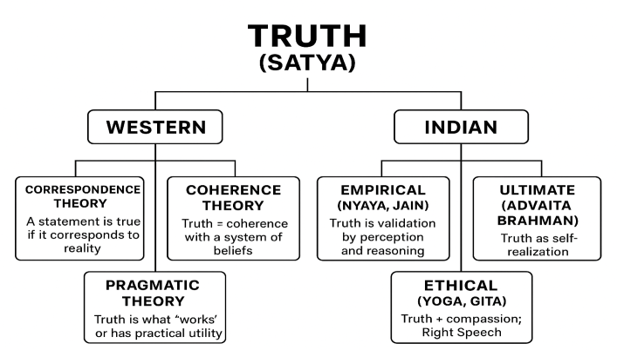
| Theory | Core Idea | Thinkers / Examples |
|---|---|---|
| Correspondence Theory | A statement is true if it corresponds to facts or reality. | Aristotle, Thomas Aquinas; e.g. “Snow is white” is true if snow is indeed white. |
| Coherence Theory | Truth = coherence with a system of beliefs or propositions. | Hegel, Bradley; e.g. a scientific theory is “true” if it fits with established principles. |
| Pragmatic Theory | Truth is what “works” or has practical utility. | William James, John Dewey; e.g. democracy is “true” as a principle because it works for society. |
| Consensus Theory | Truth emerges from rational agreement among individuals. | Jürgen Habermas; e.g. constitutional truths formed through debate. |
| Constructivist / Postmodern | Truth is constructed socially, shaped by power and culture. | Foucault; e.g. “madness” redefined over time. |
| Aletheia (Unconcealment) | Truth as disclosure or “unhiddenness.” | Heidegger; truth is a process of revealing. |
Truth as a Virtue
-
- Gandhi: “Truth is God.” Satya was the foundation of Satyagraha.
- Kant: Truthfulness is a categorical imperative — lying is always wrong because it uses others as means.
- Buddha: “Three things cannot be long hidden: the sun, the moon and the truth.”
Truth and Public Life / Administration
-
- Integrity and transparency in governance are grounded in truth.
- Example: Whistleblowers like Edward Snowden or Indian RTI activists embody truth-telling in public interest.
- Indian Constitution’s Article 51A(h) (develop scientific temper) implicitly calls for truth-seeking.
Ethical Dilemmas around Truth
-
- Absolute Truth vs. Situational Truth: Should a doctor tell the whole truth about a terminal diagnosis?
- Truth vs. Harmony: In diplomacy, full disclosure may harm relations.
- Truth vs. Security: In national security, secrecy sometimes overrides disclosure.
Quotes
-
- Aristotle: “The high-minded man must care more for the truth than for what people think.”
- Kant: “Honesty is better than any policy.”
- Tagore: “Facts are many, but truth is one.”
- Nietzsche: “All truths are illusions we have forgotten are illusions.”
Meaning of Truth in Indian Thought
In Indian philosophy, truth (Satya) is not just factual correctness but that which is eternal, unchanging and beneficial. It is both metaphysical (ultimate reality, Brahman) and ethical (truthfulness in conduct).
Indian Schools on Truth
| School / Tradition | View of Truth | Illustration / Key Texts |
|---|---|---|
| Nyāya(Logic/Realism) | Truth is pramā (valid knowledge) — cognition corresponding to the object. Knowledge is true when it matches the external object perceived. | Gautama’s Nyāya Sūtras; four pramāṇas (perception, inference, comparison, testimony). |
| Advaita Vedānta(Śaṅkara) | Ultimate truth is Brahman (non-dual reality). The world of names/forms is Mithyā (empirical truth) but not Pāramārthika Satya(absolute truth). | Rope-snake illusion as example of misperceived truth. |
| Buddhism(Four Noble Truths) | “Truth” = universal facts about suffering (dukkha) and the path to cessation. Emphasises Right Speech (truthful speech) as part of the Eightfold Path. | Dhammapada: “Three things cannot be long hidden: the sun, the moon and the truth.” |
| Jainism(Anekāntavāda) | Truth is multi-faceted; no single viewpoint captures it fully. Promotes Syādvāda (“in some respect it is…”). Leads to intellectual humility and non-violence in speech. | Blind men and the elephant parable. |
| Yoga-Sūtra(Patañjali) | Satya (truthfulness) is the second Yama (ethical restraint) after non-violence. Lies disturb inner harmony. | Practicing Satya leads to “fruits of action” being realised spontaneously. |
| Bhagavad Gītā | Truthfulness (Satyam) is one of the divine qualities (16.1). Yet, Krishna also teaches about “pleasant vs. unpleasant truth” (17.15). Duty sometimes requires timing and manner of truth. | Krishna’s counsel to Arjuna blends factual truth with higher dharma. |
Ethical Dilemmas Illustrated with Indian Thought
-
- Jain Anekāntavāda: In policymaking, no single narrative is “the truth”; diverse stakeholder views must be reconciled.
- Bhagavad Gītā: Sometimes one must choose between harsh truth and socially beneficial silence (Krishna’s counsel vs. Arjuna’s doubts).
Quotes
-
- Rig Veda (10.85.1): “Truth alone triumphs” (Satyameva Jayate — later adopted as India’s national motto).
- Mundaka Upanishad 3.1.6: “Truth alone prevails, not falsehood.”
- Mahatma Gandhi: “There is no religion higher than Truth.”
- Sri Aurobindo: “Truth of being must govern truth of life.”
| Aspect | One (Absolute) Truth | Many (Relative) Truths |
|---|---|---|
| Definition | There is a single, unchanging reality which is true for all, regardless of perspective. | Different viewpoints reveal partial truths; no single account is complete. |
| Western Reference | Plato’s “World of Forms” = ultimate truth beyond appearances. Descartes’ “Cogito” as indubitable truth. | Postmodernism (Foucault, Derrida) — truth is constructed and plural. |
| Indian Reference | Advaita Vedānta: Brahman is one ultimate reality (Ekam Sat Vipra Bahudha Vadanti – Rig Veda: “Truth is one, sages call it by many names”). | Jainism’s Anekāntavāda: multiple perspectives, no monopoly on truth. |
The quotes categorized by their theme and paired with specific, strategic advice on exactly where and how to use them in essay
| Theme | Quote | Author | Where to Use in Your Essay |
|---|---|---|---|
| The Nature of Truth | Truth is like the sun. You can shut it out for a time, but it ain't goin' away. | Elvis Presley | Body Paragraph (Counterargument): Perfect for a paragraph discussing how attempts to cover up facts or history ultimately fail. |
| The Nature of Truth | Three things cannot be long hidden: the sun, the moon, and the truth. | Buddha | Body Paragraph (Transition): Great for transitioning into a section about the inevitable revelation of reality over deception. |
| The Nature of Truth | If you tell the truth, you don't have to remember anything. | Mark Twain | Body Paragraph (Practicality/Ethics): Use when discussing the psychological or social burdens of dishonesty versus the simplicity of truth. |
| The Nature of Truth | Truth resides in every human heart, and one has to search for it there... | Mahatma Gandhi | Body Paragraph (Individualism): Best used in a section exploring subjective truth, personal conscience, or tolerance of others' beliefs. |
| The Pursuit of Wisdom | The only true wisdom is in knowing you know nothing. | Socrates | Introduction: Use right after your hook to establish the concept of intellectual humility as the foundation of your essay. |
| The Pursuit of Wisdom | Knowledge is proud that he has learned so much; Wisdom is humble that he knows no more. | William Cowper | Body Paragraph (Comparison): Ideal for a paragraph that explicitly contrasts having "information" (knowledge) with having "insight" (wisdom). |
| The Pursuit of Wisdom | By three methods we may learn wisdom: First, by reflection... Second, by imitation... third by experience... | Confucius | Body Paragraph (Development): Use this to structure a paragraph analysing how people or characters in literature actually acquire wisdom. |
| The Pursuit of Wisdom | The doorstep to the temple of wisdom is a knowledge of our own ignorance. | Benjamin Franklin | Introduction or Body Opener: A strong way to begin a paragraph focused on education, growth, or self-awareness. |
| The Intersection of Both | Honesty is the first chapter in the book of wisdom. | Thomas Jefferson | Thesis Statement Support: Integrate this into your introduction to tie your two core themes (truth and wisdom) together right at the start. |
| The Intersection of Both | The truth is not always beautiful, nor are beautiful words the truth. | Lao Tzu | Body Paragraph (Reality vs. Illusion): Perfect for analysing the harshness of reality versus comforting lies or political rhetoric. |
| The Intersection of Both | A wise man adapts himself to circumstances, as water shapes itself to the vessel that contains it. | Chinese Proverb | Body Paragraph (Adaptability): Use when discussing how wise people accept the truth of their current reality rather than fighting it. |
| Short & Punchy | The truth will set you free, but first it will make you miserable. | James Garfield | The Hook (Opening Line): An excellent, attention-grabbing first sentence for your essay to instantly engage the reader. |
| Short & Punchy | Wisdom begins in wonder. | Socrates | The Hook or Conclusion: Works beautifully as a simple, elegant opening line or as a reflective closing thought. |
| Short & Punchy | What is right is not always popular and what is popular is not always right. | Albert Einstein | Body Paragraph (Social Commentary): Use in a section exploring societal peer pressure, ethics, or standing up for the truth against a crowd. |
| Short & Punchy | There is no greatness where there is not simplicity, goodness, and truth. | Leo Tolstoy | Conclusion (Final Thought): A powerful, sweeping statement to leave a lasting impression on the reader in your final sentences. |