What is Essay?
An essay is a structured piece of writing that explores a specific topic from a particular point of view, often expressing the author’s own ideas or arguments.
What is philosophical Essay?
A philosophical essay presents a clear, rational argument supporting a specific thesis about abstract concepts like truth, existence, or ethics, using critical thinking, deep reasoning, and logical structure rather than emotional appeals or storytelling. It involves breaking down a complex problem, considering different viewpoints, addressing potential objections, and drawing conclusions based on evidence from philosophical texts or reasoned arguments.
The primary goal is to explore an idea clearly and honestly, contributing to philosophical discourse through logical analysis and reasoned justification.
Key Characteristics
-
- Focus on Argument: The essay’s core is a well-supported argument for a specific claim or thesis.
- Rationality & Logic: It relies on clear, logical reasoning and evidence, not flowery language or personal opinion.
- Abstract Concepts: It explores fundamental questions about existence, knowledge, reality, and human experience.
- Critical Thinking: It requires deep analysis of ideas, critical evaluation of different perspectives, and the ability to integrate various theories coherently.
- Clarity & Precision: Language must be clear and precise to convey complex philosophical ideas effectively.
What is Non-Philosophical Essay?
A non-philosophical essay is a piece of writing that does not focus on philosophical concepts like the nature of reality, knowledge, or morality, but instead deals with other subjects using different methods of reasoning.
These essays can be based on factual, scientific, or empirical observations and can address practical or concrete topics that don’t require deep philosophical analysis.
Subject matter: The essay’s topic is not philosophical in nature; it could be about science, history, social issues, or everyday phenomena rather than abstract philosophical questions.
Method of reasoning: Instead of relying primarily on philosophical arguments and abstract reasoning, the essay might use methods like:
-
- Empirical evidence: Relying on scientific observations or data.
- Factual reporting: Presenting information and historical accounts.
- Practical application: Focusing on concrete problems and solutions in areas like business or technology.
Goal: The aim is not to explore fundamental philosophical truths but to explain, inform, or persuade about a non-philosophical subject.
Examples of non-philosophical content:
Types of Essay
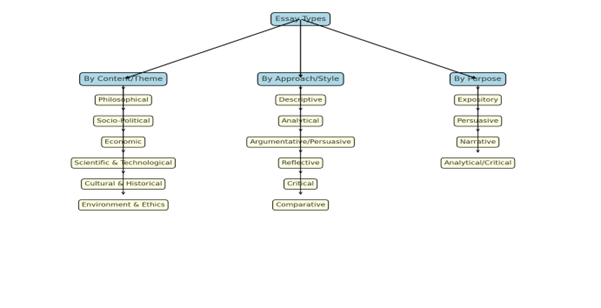
Note: But for UPSC, they are not important. UPSC demands analytical and structured essay with concise content and close expression.
PLANNING STAGE OF ESSAY WRITING
1. Selection of topic
-
- Do you have content-adequate facts and examples
- Are you confident
- Can you make objective and diversified
- Does it match to your strengths and weaknesses
2. Decoding the theme: Understanding of topics
-
- Interpretation: How, what, why, where, who, and which
- One word, two words, link vs contrast
- Meaning of the word
- Meaning of the topic as a whole
3. Brainstorming of topics
-
- A candidate should set aside 15 to 20 per cent of the total time in brainstorming and framing the essay.
- In case of philosophical essay, think about
I. Rationale behind the topic
II. Essence of the topic
III. Anecdote, body, way forward, conclusion
IV. Body part-thesis/antithesis(what will be the ratio-50-50, 70-30, 90-10)
V. Philosophical quotes, facts/examples
i. Dimensions-diverse link, social, political, economic, environmental, moral/ethical, legal, national, international, past, present, future, etc. (this will apply more in non-philosophical topics- PESTLE)
VI. The theme line and perspective
VII. Give a review of your brainstorming and structure/content and then ask
-
-
-
-
-
- Am I missing anything in terms of key facts, examples
- Am I giving the best examples and quotes
- The ripple effects of the facts and examples
- Are they obvious, subtle, complex, diverse
- Am I hitting the bull’s eye
- Am I making an in-depth analysis
-
-
-
-
VIV. Then link with UPSC demands to check the soundness of your structure and content –
-
-
-
-
-
- How close am I to the essay topic
- Whether arranged in the orderly fashion
- Conciseness
- Effective and exact expression
-
-
-
-
Tips
-
- “How” and “why” questions generally require more analysis than “who/ what/when/where” questions.
- Good analytical questions can highlight patterns/connections, scope of an argument or contradictions/dilemmas/problems.
STRUCTURE OF ESSAY
1. INTRODUCTION(80-100): The three principles of writing impressive and right introduction
-
- Orientation information/anecdote
- What’s at stake( anecdote must show)
- Thesis- relating to the main theme to be forwarded by
Topic: Hope is…
Vishnu Tiwari was convicted in 2003 when he was 23 for rape charge. He decided to fight from 2005. In 2023 was given acquittal.
2. BODY(500-600 words)
I. Interpretation( 50-60 words): Deconstruct the meaning of the essay
II. Elaboration(over 500 words): The main core of the essay
-
- Thesis- follow A-SEA (Assertion, Support with evidence and analysis)
- DEEPHIR/PESTLE: Political, Economic, Social, Technological, Legal, and Environmental
Tips for Organizing Your Essay: It can be daunting to think about how to structure your ideas in a longer essay. Once you’ve established your thesis, you need to think about how you will move your reader through your argument. In some courses, you will be expected to provide a roadmap in your introduction that explicitly tells readers how your argument is organized. But even when you don’t provide a roadmap, your reader should be able to see the connections between your ideas. As you think about how your ideas fit together, try these three strategies:
-
- Decompose your thesis into paragraphs
- Create a reverse outline from your draft
While you may have learned to outline a paper before writing a draft, this step is often difficult because our ideas develop as we write. In some cases, it can be more helpful to write a draft in which you get all of your ideas out and then do a “reverse outline” of what you’ve already written. This doesn’t have to be formal; you can just make a list of the point in each paragraph of your draft and then ask these questions:
-
- Are those points in an order that makes sense to you?
- Are there gaps in your argument?
- Do the topic sentences of the paragraphs clearly state these main points?
- Do you have more than one paragraph that focuses on the same point? If so, do you need both paragraphs?
- Are there points missing from this draft?
HOW TO MAKE INDEPTH AND EFFECTIVE ANALYSIS

III. ANTI-THESIS (200 words)
It is about the reverse side of the essay. It is important to find out whether the topic can have a counter view.
3. TRANSITION (100 words)
4. CONCLUSION (60-80 words)
FROM OLD TO NEW STYLE OF ESSAY WRITING
The UPSC Civil Services Mains Essay Paper (Paper-I) has undergone a structural and thematic metamorphosis since 2015. What used to be a paper heavily reliant on General Studies (GS) themes—like economy, governance, and science—has evolved into a deeply reflective, abstract, and philosophical testing ground.
A comprehensive statistical and thematic analysis of the essay topics from 2015 to 2025/2026 highlights notable patterns, structural shifts, and strategic implications for candidates.
MACRO SHIFT: FACTUAL VS. PHILOSOPHICAL ESSAYS
The most stark statistical trend is the decline of data-heavy, sector-specific topics (e.g., “Non-Alignment Movement,” “Jobless Growth,” “Cooperative Federalism”) and the absolute dominance of quote-based, abstract, or philosophical topics.
| Year | Factual / Sectoral Topics (GS-linked) | Philosophical / Abstract Topics | Key Characteristics |
|---|---|---|---|
| 2015–2017 | 60% | 40% | Clear segregation; Section A usually had abstract themes, Section B focused on standard socio-economic/polity issues. |
| 2018–2020 | 30% | 70% | Philosophical topics began encroaching heavily into Section B. Quotes by famous personalities became standard. |
| 2021–2025 | 0% – 12.5% | 87.5% – 100% | Near-total elimination of direct GS topics. Even Section B now requires evaluating abstract life lessons, ethics, and wisdom. |
CORE THEMATIC BREAKDOWN (2015–PRESENT)
Even within abstract and philosophical essays, UPSC operates around specific recurring core pillars. An analysis of the past decade reveals that topics generally cluster around the following major themes:
UPSC ESSAY THEMES SINCE 2015
| Ethics, Morality & Justice | 25% |
| Human Condition & Self-Actualization | 20% |
| Education, Value Systems & Youth | 15% |
| Science, Technology & Rationality | 15% |
| Social Structures & Gender Dynamics | 15% |
| Environment & Ecocentric Philosophy | 10% |
DEATH OF THE PESTEL TEMPLATE
Historically, candidates could force any topic into a rigid template: Political, Economic, Social, Technological, Environmental, Legal. UPSC’s shift to topics like “Mathematics is the music of reason” makes this formulaic approach look shallow and mechanical.
Before 2020, Section B was almost universally an extension of your General Studies (GS) syllabus. You could pick up a topic on Women’s Empowerment, Federalism, Non-State Actors, or Renewable Energy, and essentially dump a highly polished GS-1, 2, or 3 answer across 1,200 words.
The commission is actively penalizing the “techno-optimist” narrative. They want to see if you understand the silent psychological, humanistic, and ethical costs of blind economic growth and algorithmic governance.
Consider how these apparently abstract quotes translate directly into the psychology of a district administrator:
| The Philosophical Prompt | The Hidden Administrative Test |
|---|---|
| A ship in harbour is safe, but that is not what ship is for" (2022) | Risk Appetite vs. Bureaucratic Inertia: Testing whether you will be a status-quo bureaucrat or take calculated risks for systemic reform. |
| Muddy water is best cleared by leaving it alone" (2025) | Strategic Patience vs. Policy Knee-Jerk: Testing if you understand when not to interfere, resisting the urge to over-regulate complex organic societal eco-systems. |
| The supreme art of war is to subdue the enemy without fighting"(2025) | Consensus Building vs. Coercive Power: Evaluating your faith in soft diplomacy, mediation, and structural prevention over brute enforcement. |
| There are better practices to 'best practices'" (2021) | Contextual Innovation vs. Copy-Paste Policy: Explicitly mocking the habit of copy-pasting global solutions onto complex indigenous Indian problems. |
THE NEW STRUCTURE OF ESSAY
-
- INTRODUCTION: Conceptual paradox with epistemological premise
- BODY STRUCTURE: DEEPHIR
- ANALYTICAL STYLE: Pendulum type
- CONCLUSION: Philosophical synthesis
PESTEL VS. DEEPHIR: A COMPARATIVE ANALYSIS
An analytical essay lives or dies by the framework used to deconstruct the topic. While PESTEL is the undisputed titan of corporate strategy and macro-environmental analysis, DEEPHIR—expanded as Dialectical probing, Eco-environment, Economy, Psychological/philosophical/humanistic, Historical, International relations, and Regulation-administration—serves as a highly sophisticated, dialectical alternative tailored for deep academic, geopolitical, and humanitarian critiques.
When choosing between them for an essay, you are essentially choosing between a sharp, structural snapshot of the present (PESTEL) and a deep, philosophical, and evolutionary critique of human systems (DEEPHIR).
Deconstructing the Frameworks
To write a comparative essay, we must first examine how each framework forces an author to categorize information.
PESTEL: The Macro-Environmental Checklist
PESTEL functions as a horizontal scan of external forces acting upon an entity (a country, an industry, or an organization):
-
- Political:Government interventions, political stability, and trade policies.
- Economic:Macroeconomic metrics like inflation, GDP growth, and interest rates.
- Social:Demographics, cultural norms, and consumer lifestyle shifts.
- Technological:Innovation, R&D activity, automation, and tech infrastructure.
- Environmental:Ecological impacts, climate change, and geographic constraints.
- Legal:Legislative frameworks, employment laws, and regulatory compliance.
DEEPHIR: The Dialectical and Humanistic Critique
DEEPHIR shifts the focus away from a purely corporate environment and pivots toward structural, historical, and humanistic analysis:
-
- Dialectical probing:Engaging with opposing arguments, thesis-antithesis-synthesis dynamics, and inherent systemic contradictions.
- Eco-environment:The foundational relationship between geography, ecosystems, and human societies.
- Economy:Financial systems, resource wealth, resource distribution, and labor markets.
- Psychological/Philosophical/Humanistic:The collective mindset, ideological convictions, human suffering, and ethical dimensions of an issue.
- Historical:Path dependency, legacy conflicts, and historical precedents that constrain modern choices.
- International relations:Geopolitics, global alliances, treaties, and foreign interventions.
- Regulation-administration:Bureaucratic structures, governance capabilities, and institutional frameworks.
Comparative Analysis
1. Structural Rigidity vs. Analytical Fluidity
-
- PESTEL offers a highly structured, plug-and-play format. It is exceptional for clean categorization, making it highly effective for report-style essays, policy briefs, and business case studies. However, its rigid boundaries often lead to “siloed” writing, where the “Political” paragraph does not interact with the “Social” paragraph.
- DEEPHIR prioritizes Dialectical probing, which naturally lends itself to a traditional, argumentative essay format. It requires the writer to juxtapose competing ideas (e.g., how Regulation-administration clashes with Psychological/philosophical desires for freedom). It yields a more fluid, cohesive, and sophisticated narrative arc.
2. Materialism vs. Ideology and Mindset
-
- PESTEL’s “Social” bucket is a catch-all that often defaults to superficial data points like age demographics or consumer trends. It struggles to capture the abstract motivations behind human movements.
- DEEPHIR splits this open into the Psychological/Philosophical/Humanistic lens.If your essay is exploring deep-seated social phenomena—such as the rise of populism, the psychological trauma of war, or philosophical shifts in human rights—DEEPHIR provides the vocabulary to explore why humans act, rather than just what they consume.
3. Chronological Depth: The Present vs. The Evolutionary
-
- PESTEL is fundamentally present- and future-oriented.It assesses the current environment to predict future impacts. It largely ignores how a society arrived at its current state.
- DEEPHIR embraces the Historical lens.It acknowledges that current geopolitical realities or systemic failures are bound by path dependency. An essay using DEEPHIR recognizes that an International relations crisis cannot be understood without examining its Historical
4. Governance: Legal Boundaries vs. Administrative Execution
-
- PESTEL separates “Political” and “Legal.”In essays, this often causes repetitive arguments, as laws are inherently passed by political bodies.
- DEEPHIR refines this into “Regulation-administration.”This focuses less on the abstract text of the law and more on the state’s capacity to enforce and administer It pairs neatly with Economy and International relations, providing a realistic view of institutional strength.
While PESTEL remains an efficient tool for a cross-sectional, structural audit of a modern macro-environment, DEEPHIR offers a superior framework for academic essays requiring dialectical depth, historicism, and a nuanced understanding of human and institutional behaviour.
THEMES OF UPSC ESSAYS (PYQS 2011-2024)
| Themes | Essay Topics |
|---|---|
| 2025: All 8 topics as philosophical | SECTION-A 1. Truth knows no colour. 2. The supreme art of war is to subdue the enemy without fighting. 3. Thought finds a world and creates one also. 4. Best lessons are learnt through bitter experiences. SECTION-B 5. Muddy water is best cleared by leaving it alone. 6. The years teach much which the days never know. 7. It is best to see life as a journey, not as a destination. 8. Contentment is natural wealth; luxury is artificial poverty. |
| Happiness, Joy, love, Smile, good/happy life | • Contentment is natural wealth; luxury is artificial poverty. • There is no path to happiness; Happiness is the path. (2024) • A smile is the chosen vehicle for all ambiguities (2022) • A good life is one inspired by love and guided by knowledge (2018) • Joy is the simplest form of gratitude. (2017) • GDP (Gross Domestic Product) Along with GDH (Gross Domestic Happiness) Would Be The Right Indices For Judging The Well-being Of A Country (2013) |
| Success, failure, mistakes | • Best lessons are learnt through bitter experiences (2025) • The time to repair the roof is when the sun is shining (2022) • You cannot step twice in the same river (2022) • Courage to accept and dedication to improve are two keys to success (2019) • Quick but steady wins the race (2015) |
| Science, Scientific temper, Rationality, Reasoning, Knowledge, Wisdom, Truth | • Truth knows no colour. (2025) • Thought finds a world and creates one also. (2025) • The doubter is a true man of science. (2024) • Visionary decision-making happens at the intersection of intuition and logic. (2023) • Mathematics is the music of reason. (2023) • The real is rational and the rational is real. (2021) • What is research, but a blind date with knowledge! (2021) • Wisdom finds truth (2019) • Reality does not conform to the ideal, but confirms it (2018) • Words are Sharper than the two-edged sword. (2014) • Science and Mysticism: Are they compatible? (2012) |
| Courage, Character, Power, Human Nature, Greed, Corruption, Human actions, Ethical dilemmas, Ethical issues, Values | • Nearly all men can stand adversity, but to test the character, give him power. (2024) • The cost of being wrong is less than the cost of doing nothing. (2024) • Just because you have a choice, it does not mean that any of them has to be right. (2022) • A ship in harbour is safe, but that is not what ship is for (2022) • Your perception of me is a reflection of you; my reaction to you is an awareness of me. (2021) • Hand that rocks the cradle rules the world. (2021) • Philosophy of wantlessness is Utopian, while materialism is a chimera. (2021) • Life is long journey between human being and being humane (2020) • Ships do not sink because of water around them , ships sink because of water that gets into them (2020) • Simplicity is the ultimate sophistication (2020) • Values are not what humanity is, but what humanity ought to be (2019) • Customary morality cannot be a guide to modern life (2018) • “The past’ is a permanent dimension of human consciousness and values (2018) • A people that values its privileges above its principles loses both (2018) • We may brave human laws but cannot resist natural laws. (2017) • Need brings greed, if greed increases it spoils breed (2016) • Character of an institution is reflected in its leader. (2015) • Education without values, as useful as it is, seems rather to make a man more clever devil. (2015) • With greater power comes greater responsibility. (2014) • “Be The Change You Want To See In Others” – Gandhiji (2013) |
| Ideas, thinking, power of mind, Intellect, creativity, innovations | • Muddy water is best cleared by leaving it alone. (2025) • The years teach much which the days never know. (2025) • It is best to see life as a journey, not as a destination. (2025) • All ideas having large consequences are always simple. (2024) • The empires of the future will be the empires of the mind. (2024) • Thinking is like a game, it does not begin unless there is an opposite team. (2023) • Not all who wander are lost. (2023) • Inspiration for creativity springs from the effort to look for the magical in the mundane. (2023) • Poets are the unacknowledged legislators of the world (2022) • The process of self-discovery has now been technologically outsourced. (2021) • There are better practices to “best practices”. (2021) • Mindful manifesto is the catalyst to a tranquil self (2020) |
| Environment | • Forests precede civilizations and deserts follow them. (2024) • Forests are the best case studies for economic excellence (2022) • Alternative technologies for a climate change resilient India (2018) |
| Gender Equality, Women empowerment | • Girls are weighed down by restrictions, boys with demands – two equally harmful disciplines. (2023) • Patriarchy is the least noticed yet the most significant structure of social inequality (2020) • Fulfillment of ‘new woman’ in India is a myth. (2017) • If development is not engendered, it is endangered (2016) • Managing work and home – is the Indian working woman getting a fair deal? (2012) |
| Social justice, justice, societal issues, Culture | • A society that has more justice is a society that needs less charity. (2023) • Culture is what we are, civilization is what we have (2020) • There can be no social justice without economic prosperity but economic prosperity without social justice is meaningless (2020) • Best for an individual is not necessarily best for the society (2019) • Does Indian cinema shape our popular culture or merely reflect it? (2011) |
| Economy, poverty, unemployment, economic inequality, inclusive growth, regional development, Agriculture, Industry | • Poverty anywhere is a threat to prosperity everywhere (2018) • Farming has lost the ability to be a source of subsistence for majority of farmers in India. (2017) • Innovation is the key determinant of economic growth and social welfare (2016) • Near jobless growth in India: An anomaly or an outcome of economic reforms (2016) • Digital economy: A leveller or a source of economic inequality (2016) • Lending hands to someone is better than giving a dole. (2015) • Crisis faced in India – moral or economic. (2015) • Dreams which should not let India sleep. (2015) • Can capitalism bring inclusive growth? (2015) • Tourism: Can this be the next big thing for India? (2014) • Is The Colonial Mentality Hindering India’s Success? (2013) • GDP (Gross Domestic Product) Along with GDH (Gross Domestic Happiness) Would Be The Right Indices For Judging The Well-being Of A Country (2013) • Is the criticism that the ‘Public-Private-Partnership (PPP) model for development is more of a bane than a boon in the Indian context, justified? (2012) |
| Education | • Education is what remains after one has forgotten what one has learned in school. (2023) • Education without values, as useful as it is, seems rather to make a man more clever devil. (2015) • Are the standardized tests good measure of academic ability or progress? (2015) • Words are Sharper than the two-edged sword. (2014) • Credit-based higher education system-status, opportunities and challenges. (2011) |
| History | • History is a series of victories won by the scientific man over the romantic man (2023) • History repeats itself, first as a tragedy, second as a farce. (2021) |
| International relations, World Peace, India’s foreign relations | • The supreme art of war is to subdue the enemy without fighting. (2025) • Technology as the silent factor in international relations (2020) • South Asian societies are woven not around the state, but around their plural cultures and plural identities (2019) • Has the Non- Alignment Movement (NAM) lost its relevance in a multipolar world. (2017) |
| Education | • Neglect of primary health care and education in India are reasons for its backwardness (2019) • Destiny of a nation is shaped in its classrooms. (2017) |
| Democracy, Media, Rights & Duties, Elections, Governance, Federalism | • Biased media is a real threat to Indian democracy (2019) • Impact of the new economic measures on fiscal ties between the union and states in India. (2017) • Water disputes between states in federal India (2016) • Cooperative federalism: Myth or reality (2016) • Was it the policy paralysis or the paralysis of implementation which slowed the growth of our country? (2014) • Is sting operation an invasion on privacy? (2014) • In the context of Gandhiji’s views on the matter, explore, on an evolutionary scale, the terms ‘Swadhinata’, ‘Swaraj’ and ‘Dharmarajya’. Critically comment on their contemporary relevance to Indian democracy. (2012) • Creation of smaller states and the consequent administrative, economic and developmental implications. (2011) |
| Security threats, Cyber security, Border management, Drug abuse, Terrorism | • Management of Indian border disputes – a complex task (2018) • Science and Technology Is The Panacea For The Growth and Security Of The Nation. (2013) • In the Indian context, both human intelligence and technical intelligence are crucial in combating terrorism. (2011) |
| Technology, social media, Internet | • Social media is triggering ‘Fear of Missing Out’ amongst the youth, precipitating depression and loneliness. (2024) • Rise of Artificial Intelligence: the threat of jobless future or better job opportunities through reskilling and upskilling (2019) • Social media is inherently a selfish medium. (2017) • Cyberspace and internet: Blessing or curse to the human civilization in the long run (2016) • Technology cannot replace manpower. (2015) • Science and Technology Is The Panacea For The Growth and Security Of The Nation. (2013) |
| Sports, Youth | • Is the growing level of competition good for the youth? (2014) • Fifty Golds in Olympics: Can this be a reality for India? (2014) |