Topic-1: Statutory Restructuring of the Agrobiodiversity Expert Committee under the NBA
GS Paper 2: Statutory, regulatory, and various quasi-judicial bodies (National Biodiversity Authority); Government policies and interventions for development in various sectors and issues arising out of their design and implementation.
GS Paper 3: Conservation, environmental pollution, and degradation; Environmental Impact Assessment (EIA); Access and Benefit-Sharing (ABS) mechanics; Infrastructure and technology in aid of farmers (Genetic Resource Security).
Context: The National Biodiversity Authority (NBA) has officially reconstituted its apex advisory body, the Expert Committee on Agrobiodiversity. Formed under the statutory powers of the Biological Diversity Act, 2002, the committee will be led by renowned agricultural scientist and Padma Shri awardee Dr. P. L. Gautam for a one-year tenure. The Chairperson of the Protection of Plant Varieties and Farmers’ Rights Authority (PPVFRA) will serve as the Co-Chair.
Statutory and Institutional Foundation
The National Biodiversity Authority operates as a statutory autonomous body under the Ministry of Environment, Forest and Climate Change (MoEFCC).
-
- The Enabling Provision: The reconstitution of this specialized committee is executed strictly under Section 13(1) of the Biological Diversity Act, 2002, which empowers the NBA to appoint committees to manage specific biological sectors.
- The Institutional Core: The panel brings together high-level experts from India’s top biological and legal institutions, creating an inter-disciplinary review framework:
- Genetic Repositories: ICAR and the National Bureaus of Plant (NBPGR), Animal (NBAGR), and Fish (NBFGR) Genetic Resources.
- Grassroots & Legal Safeguards: The National Innovation Foundation (NIF) and NALSAR University of Law (to manage complex intellectual property and international environmental law).
Strategic Mandate: Balancing Research with Sovereign Safeguards
The Agrobiodiversity Expert Committee acts as a primary check against the unmonitored extraction of India’s genetic wealth (Biopiracy), balancing strict conservation with the needs of domestic agricultural innovation.
1. Access and Benefit-Sharing (ABS) Enforcement
-
- The committee designs the regulatory guidelines for the international export of seed varieties, tissue cultures, and livestock embryos.
- It ensures that foreign commercial entities utilizing Indian genetic resources sign binding ABS contracts. This guarantees that a fixed percentage of commercial royalties flows back directly to local farmers and indigenous communities who have preserved those native strains for generations.
2. Regulating Collaborative Research (Section 5 Exceptions)
-
- Under Section 5 of the Biological Diversity Act, collaborative international research projects involving Indian biological resources require strict center-level approval formats. The committee acts as the primary auditor to ensure these projects are genuine academic exchanges and do not serve as covert commercial bio-prospecting channels.
- It provides legal and technical clarifications to distinguish between corporate genetic modifications and routine, conventional plant breeding activities executed by Indian farmers.
3. Protecting Threatened Native Strains
-
- The panel maps out localized target actions to protect endangered, climate-resilient native crop varieties and indigenous livestock breeds. This preserves a natural genetic buffer against emerging agricultural pests and extreme weather events.
International Treaties and National Commitments
The reconstituted body aligns India’s domestic agricultural governance with several macro-scale global environmental pacts.
-
- ITPGRFA (International Treaty on Plant Genetic Resources for Food and Agriculture): The committee provides technical and policy briefs to guide India’s engagement with this treaty. It ensures that cross-border seed exchanges under the treaty’s Multilateral System (MLS) respect India’s sovereign biological rights.
- National Biodiversity Strategy and Action Plan (NBSAP): Directly supports India’s updated NBSAP Targets 4 and 13, which focus on reducing genetic erosion, preserving traditional knowledge networks, and implementing fair equity sharing by Viksit Bharat @2047.
UPSC Prelims Fodder: Fact-Check
| Feature | Details |
| Pact/Body Reconstituted | Expert Committee on Agrobiodiversity. |
| Statutory Root | Section 13(1) of the Biological Diversity Act, 2002. |
| Committee Chair | Padma Shri Dr. P. L. Gautam (Former NBA & PPVFRA chief). |
| Committee Co-Chair | Active Chairperson of the PPVFRA. |
| Key Operational Laws | Section 5 (Collaborative research approvals) of the BD Act. |
| Target Alignments | India’s NBSAP Targets 4 & 13 | UN SDGs 2, 13, and 15. |
Conclusion:
The reorganization of the Expert Committee on Agrobiodiversity highlights the government’s focus on securing India’s sovereign genetic assets. By pairing agricultural scientists with legal experts, the National Biodiversity Authority is building a robust defense against biopiracy while supporting domestic crop innovation.
Topic-2: Ex-Situ Conservation Breakthroughs under Project Great Indian Bustard
GS Paper 3: Conservation, environmental pollution, and degradation; Environmental Impact Assessment; Wildlife protection initiatives (Ex-situ vs. In-situ conservation frameworks).
Context: Union Minister for Environment, Forest and Climate Change, Shri Bhupender Yadav, announced a significant milestone for Project Great Indian Bustard (GIB). The conservation breeding initiative added three more chicks to its program, raising the total captive breeding stock to 94 birds.
In the current fourth year of captive breeding alone, a record 26 chicks have successfully hatched, highlighting India’s growing technical capability in avian reproductive science.
The Great Indian Bustard
The Great Indian Bustard (Ardeotis nigriceps) is one of the heaviest flying birds in the world and stands as a flagship indicator species for the health of India’s grassland ecosystems.
-
- Extinction Horizon: With fewer than 150 individuals remaining in the wild, the species faces an imminent threat of extinction. The wild population is primarily restricted to the desert grasslands of Rajasthan (particularly the Desert National Park, Jaisalmer), with fragmented groups in Gujarat.
- Primary Threat Vectors:
- High-Voltage Power Lines: The birds possess poor frontal vision and heavy bodies, making them prone to fatal collisions with overhead power lines linked to solar and wind energy farms in their habitat.
- Habitat Fragmentation: Widespread conversion of semi-arid grasslands into intensive agricultural land or industrial zones.
- Predation Pressures: High rates of egg predation by invasive feral dogs, foxes, and monitor lizards.
Technical Architecture of the Captive Breeding Program
To save the species from extinction, the Ministry of Environment, Forest and Climate Change (MoEFCC), alongside the Wildlife Institute of India (WII) and the Rajasthan Forest Department, established specialized conservation breeding centers at Sam and Ramdevra in Jaisalmer.
The fourth-year reproductive pipeline relies on a highly scientific mix of assisted reproductive technologies (ex-situ) and field management (in-situ):
1. Assisted Reproductive Telemetry
The 26 chicks hatched during the current season were delivered through three distinct pipelines:
-
- Artificial Insemination (18 Chicks): This forms the cornerstone of the current season’s success. Scientists use advanced artificial insemination techniques to bypass behavioral barriers in captivity, maximize genetic pairings, and ensure high fertility rates from elite male lineages.
- Natural Captive Breeding (4 Chicks): Achieved by mimicking natural grassland micro-habitats within specialized, large enclosure aviaries to encourage voluntary pair bonding.
- Wild-Collected Eggs (4 Chicks): Specialized field teams locate vulnerable nesting sites in the wild, harvest the eggs before predators can destroy them, and transport them via climate-controlled portable incubators to the breeding facility for automated hatching.
The Jumpstart Intervention: Enhancing Wild Diversity
A primary risk in long-term captive breeding programs is inbreeding depression, which occurs when a small closed pool of birds reproduces, leading to genetic weaknesses and lower disease immunity. To counter this, Project GIB deployed a dual-track exchange strategy known as the Jumpstart Intervention.
-
- The Mechanism: In exchange for the fragile wild eggs brought into the high-tech incubators, three healthy, facility-hatched chicks were introduced directly into wild nests in Rajasthan.
- The Strategic Benefit: This exchange mitigates immediate predation risks for the vulnerable egg stage, while introducing new bloodlines back into the wild. This step is essential to maintain founder genetic diversity and build a resilient wild population capable of long-term survival.
UPSC Prelims Fodder: Fact-Check
| Feature | Details |
| Species Identity | Great Indian Bustard (Ardeotis nigriceps) — Flagship grassland bird. |
| IUCN Red List Status | Critically Endangered (Facing imminent threat of extinction). |
| Wildlife Protection Act | Schedule I (Highest level of legal protection in India). |
| Current Captive Stock | 94 birds maintained across specialized conservation centers. |
| Primary Breeding Tool | Artificial Insemination (Accounted for 18 out of 26 new hatches). |
| Field Strategy Node | Jumpstart Intervention for balancing wild genetic diversity. |
| Core Habitat Node | Desert National Park (DNP), Jaisalmer, Rajasthan. |
Conclusion:
The expansion of the Great Indian Bustard captive stock to 94 birds marks a significant milestone for India’s wildlife conservation efforts. By combining advanced techniques like artificial insemination with field strategies like the Jumpstart Intervention, Project GIB has created a reliable safety net against immediate extinction.
Topic-3: Rural Enterprise Scaling, Open Networks, and the Lakhpati Didi Infrastructure Framework
GS Paper 2: Welfare schemes for vulnerable sections of the population by the Centre and States and the performance of these schemes; Mechanisms, laws, institutions and Bodies constituted for the protection and betterment of these vulnerable sections.
GS Paper 3: Indian Economy and issues relating to planning, mobilization of resources, growth, development, and employment; Inclusive growth and issues arising from it; Institutional frameworks for micro-enterprises and Self-Help Groups (SHGs).
Context: Shri Rohit Kansal, Secretary, Department of Rural Development, chaired a high-level review meeting of the Deendayal Antyodaya Yojana – National Rural Livelihoods Mission (DAY-NRLM). To deliver on the Union Government’s expanded mandate of creating 6 crore “Lakhpati Didis” (rural women generating a sustainable annual net income of $\ge \text{₹1 Lakh}$), the department finalized a major expansion of physical and digital marketing infrastructure.
SHE-MARTs and District Fulfilment Centres
To transition Self-Help Group (SHG) members from basic, survival-level livelihoods to competitive, community-owned business owners, the Ministry has introduced a dual-tier supply chain model.
-
- 700 SHE-MARTs (The Front-End Retail Engine): These are flagship brick-and-mortar retail outlets established in high-footfall commercial zones across the country. They are designed to serve as primary consumer connection points, linking rural artisans with premium urban markets through robust backward and forward marketing linkages.
- 1,000 District Fulfilment Centres (The Logistics Backbone): These serve as backend regional supply chain centers. They collect unorganized rural inventory, implement strict quality control and standardization checks, handle product packaging, and manage local distribution.
The Digital Unified Commerce Strategy
The core structural bottleneck for rural SHGs has historically been fragmented local marketing. The new strategy moves away from seasonal rural fairs toward a continuous, omni-channel, and multi-vendor digital model:
1. Redeveloping the e-Saras Marketplace Portal
-
- The platform is transitioning from a slow, single-vendor website into a robust, multi-vendor omni-channel marketplace architecture.
- This change allows individual State-Level Federations and local producer groups to list their inventories directly, manage variable pricing, and fulfill commercial orders independently.
2. The Producer Group Mobile Application
-
- The Ministry announced the rollout of the dedicated Producer Group App. This application allows rural women entrepreneurs to log day-to-day production volumes, calculate exact input costs, upload product images, and track dynamic market demand signals right from their smartphones.
3. Rebranding via the Saras Aajeevika National Identity
-
- To bridge the quality-perception gap in premium consumer markets, fragmented regional sub-brands are being merged into a single, high-value brand: Saras Aajeevika.
- This unified brand focuses on standardized, culturally rich packaging and clear label narratives that showcase the craftsmanship and local communities behind each product, allowing them to compete in high-end global and national e-commerce channels.
Product Innovation Hubs & Financial Inclusion
-
- National Hubs for Product Innovation & Excellence: To ensure products can withstand international market scrutiny, these centers will guide SHGs on design trends, shelf-life extension, packaging regulations, and global safety standards.
- Jan Samarth Portal Streamlining: The Secretary issued strict directives to eliminate administrative delays in loan applications submitted through the Jan Samarth Portal. This step ensures that as SHGs scale up operations, they have access to low-cost, formal credit lines via better-trained and responsive banking networks.
UPSC Prelims Fodder: Fact-Check
| Feature | Details |
| Flagship Mission | DAY-NRLM (Deendayal Antyodaya Yojana – National Rural Livelihoods Mission). |
| Macro Target Scale | Creating 6 Crore Lakhpati Didis across India. |
| Physical Nodes | 700 SHE-MARTs and 1,000 District Fulfilment Centres. |
| Unified Brand Core | Saras Aajeevika (Consolidating all regional SHG products). |
| Digital Nodes | Redesigned multi-vendor e-Saras portal and the Producer Group App. |
| Credit Platform | Jan Samarth Portal (Integrated credit-linked lending tracking). |
Conclusion:
The comprehensive upgrade of DAY-NRLM’s marketing framework marks a shift in India’s rural development approach. By combining physical infrastructure like SHE-MARTs and Fulfilment Centres with digital platforms and a unified national identity (Saras Aajeevika), the Ministry of Rural Development is addressing structural marketing inefficiencies.
Topic-4: India-France Strategic Techno-Diplomacy & Innovation Roadmap 2030
GS Paper 2: Bilateral, regional, and global groupings and agreements involving India and/or affecting India’s interests; Effect of policies and politics of developed and developing countries on India’s interests; International academic mobility and qualification frameworks.
GS Paper 3: Science and Technology- developments and their applications and effects in everyday life; Indigenization of technology (Space, AI, and Aviation engineering); Security challenges and their management in cyberspace.
Context: Building upon the established Horizon 2047 Roadmap, India and France have officially adopted the India-France Innovation Roadmap 2030. This comprehensive framework aligns India’s developmental blueprint of Viksit Bharat 2047 with France’s industrial transformation agenda, France 2030.
The roadmap deepens bilateral cooperation across critical and emerging technologies, space exploration, and cross-border digital governance networks.
Dual-Track Sovereign AI Framework: ‘Trusted AI’
Moving past unmonitored commercial software deployment, the bilateral roadmap establishes a strict, value-driven framework for safe and ethnically aligned computing:
1. Techno-Legal Alignment & Interoperable AI Governance
-
- Both nations will co-develop risk-based approaches to regulate frontier and generative AI models.
- The framework blocks algorithmic discrimination and counters automated disinformation campaigns, ensuring AI systems remain firmly aligned with democratic governance standards.
2. Specialized AI Child Safety Protocols
-
- Addressing the vulnerabilities of minors online, the roadmap sets up a dedicated priority vector to deploy automated, privacy-preserving age assurance mechanisms.
- It mandates safety-by-design architectures and outcome-based verification standards for any foundational AI engine interacting directly with children.
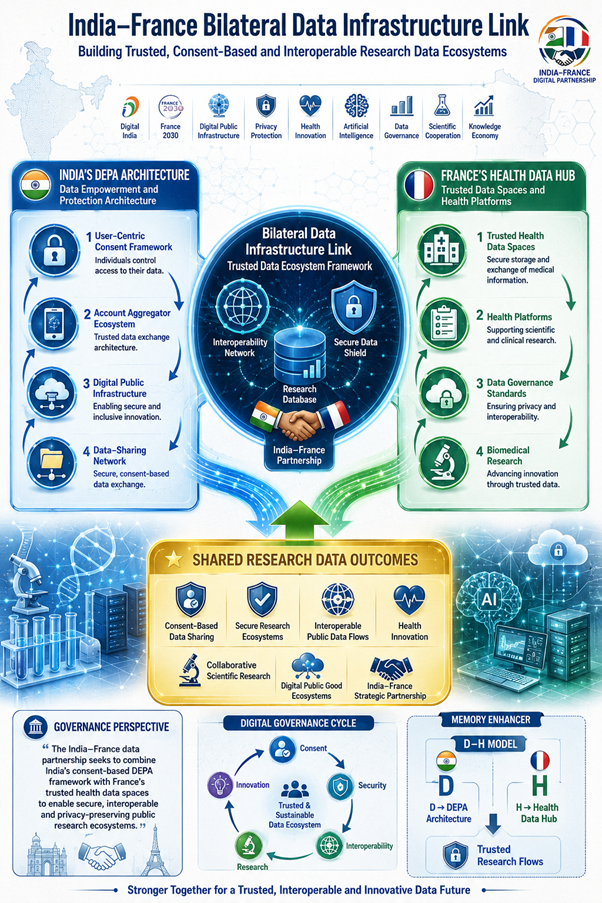
3. Privacy-Preserving Cross-Border Data Flows
-
- The partnership combines two major data-governance models to allow secure, consent-based information flows for medical and scientific research:
Strategic Industry-Academia Linkages & Technological Sovereignty
To build independent deep-tech capabilities and secure supply chains, the roadmap introduces four major operational corridors:
-
- India-France InnoXchange Bridge: Establishes a permanent startup and research residency corridor. It provides reciprocal, soft-landing access to hardware testing facilities, corporate venture capital networks, and technology clusters like France’s Station-F.
- Franco-Indian Campus for Aeronautics Training: Located in Kanpur in partnership with the Ministry of Skill Development and Entrepreneurship (MSDE). This campus will co-develop an advanced workforce to feed the rising global aerospace manufacturing and defense supply chains.
- The Academic Anchor Engines: Strengthening the Indo-French Centre for the Promotion of Advanced Research (CEFIPRA) and scaling the newly formed digital India-France Innovation Network (IFIN) under a joint steering committee.
Private-Public Space Integration & Low Earth Orbit (LEO) Engineering
The agreement expands historical center-level space relations into deep commercial business-to-business (B2B) ecosystem integration:
-
- Human Spaceflight & Space Station Dynamics: France will provide specialized Zero-G flight testing capabilities and human exploration expertise to directly support the development of India’s upcoming indigenous space station in Low Earth Orbit (LEO).
- Earth Observation & Telemetry: Co-developing high-resolution satellite arrays to monitor real-time global climate shifts, oceanography metrics, and land-degradation topography.
- The Twin-Summit Synchronisation: To align private space startups from both nations, the alliance will host two synchronized mega-events in the same week:
- Bengaluru Space Expo (BSX): 7–9 September 2026 in Bengaluru, India.
- International Space Summit: 9–10 September 2026 in Paris, France.
Talent Mobility & Qualification Standardisation
-
- The 30,000 Intake Target: Reaffirming France’s structural target to welcome 30,000 Indian higher-education students by 2030.
- Expanding the Mutual Recognition of Qualifications (MRQ): Upgrading the landmark 2018 MRQ agreement. The updated framework expands recognition to a wider range of emerging technology domains and regulated engineering fields, paving the way for dual-degree programs and co-supervised doctoral research.
UPSC Prelims Fodder: Fact-Check
The bilateral roadmap is backed by 19 specialized institutional MoUs, with key deep-tech collaborations highlighted below:
| Indian Academic Anchor | French Institutional Partner | Specific Technology Vector |
| IIT Kanpur & MSDE | Government of France | Franco-Indian Campus for Aeronautics Training. |
| IIT Tirupati | Safran Electronics & Defense | Positioning, Navigation, and Timing (PNT) Systems. |
| IIT Hyderabad | Dassault Systèmes & Crimson Energy | 3D Computing & Multi-Physics Simulation. |
| IIT Bombay | Institut Polytechnique de Paris (IPP) | Incubation, technology acceleration & translation. |
| IIT Delhi | Institut Mines-Télécom | Advanced Scientific and Academic Exchange. |
| IIT Gandhinagar | Comuto SA / BlaBlaCar | AI, Smart Transportation, and Mobility Systems. |
| IISc Bengaluru | Université Grenoble Alpes (UGA) | Advanced Academic and Scientific Collaboration. |
Conclusion:
The adoption of the India-France Innovation Roadmap 2030 highlights a strategic maturation of the bilateral relationship. By linking the goals of Viksit Bharat 2047 with France 2030, the framework moves beyond traditional commerce to emphasize technological sovereignty. Through concrete initiatives—such as Trusted AI frameworks, the Kanpur aeronautical campus, and joint development for India’s upcoming LEO space station—the partnership provides a comprehensive model for equitable, secure, and human-centric innovation.
Spread the Word