
The UPSC Prelims 2026 Shocker: Unconventional, Unpredictable, and Uncomfortable
For over 5.49 lakh candidates who walked into examination halls across the country on May 24, 2026, the Civil Services Preliminary Examination was anything but business as usual. Historically famous for its curveballs, the Union Public Service Commission (UPSC) outdid itself this year. What was anticipated to be a standard test of endurance turned into a masterclass in psychological warfare and intellectual depth.
If 2023 was the year of elimination-technique elimination, 2026 will be remembered as the year UPSC blurred the lines between the Prelims and the Mains, throwing aspirants into a state of collective shock.
The 2026 Anatomy: Why Was It a Shocker?
The paper completely disrupted the traditional comfort zones of aspirants. According to major institutional analyses, the exam saw a massive shift toward unconventional, highly analytical, and deeply factual questions.
-
- The Case Study Curveball: In an unprecedented move, UPSC introduced full-fledged, Ethics-style case studies right into GS Paper 1. Candidates were forced to make situational, administrative decisions—like handling a corrupt vaccine contract or managing a tribal protest—concepts traditionally reserved for the Mains GS-4 paper.
- The “Assertion-Reasoning” Evolution: The classic “Statement I and Statement II” format evolved into a brand new headache. Candidates were asked to evaluate complex relationships between statements—determining if one validated, supported, or actively contradicted the other.
- A Biodiversity Census: The Environment section skipped broad concepts to test hyper-specific details on obscure species, Large-Scale Low-Emission Development Strategies (LT-LEDS), and localized reserves.
- The S&T Leap: Science and Technology heavily relied on real-world tech from the last two years, including Large Language Models (LLMs), drone swarms, stealth technology, and the DHRUV64 chip.
Meanwhile, CSAT (Paper 2) didn’t offer the emotional recovery candidates hoped for. While Reading Comprehension was relatively manageable, the Quant and Reasoning sections featured unusual, time-consuming patterns designed to trigger panic under a ticking clock.
Expected Cut-Off for UPSC Prelims 2026
Because the paper heavily penalized shallow preparation and required immense logic under pressure, experts predict a significant drop in the cut-off marks. While the official answer keys and cut-offs will only be revealed with the final results next year, premier coaching institutes and subject-matter experts project the General Category cut-off to hover around 72±2 marks.
Past Years’ Cut-Off Comparison
To put this year’s difficulty into perspective, let’s look at how the official CS(P) General Category cut-offs (out of 200 in GS Paper 1) have trended over the years:
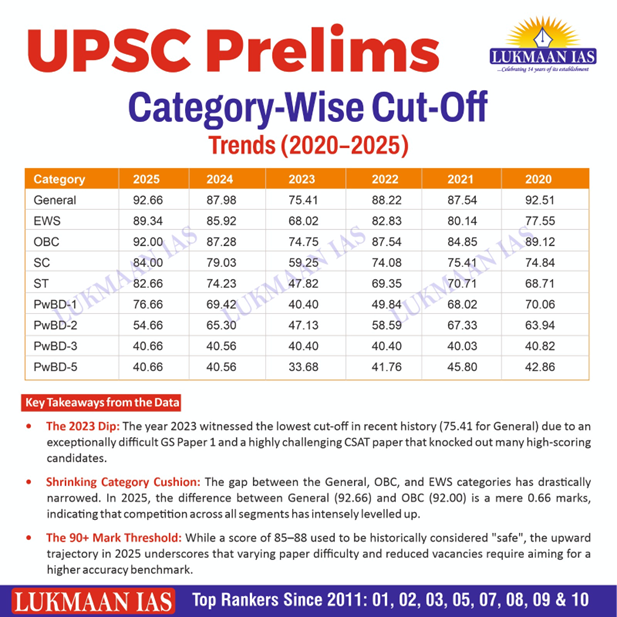
If these projections hold true, the 2026 Prelims might register the lowest cut-off in the history of the Civil Services Examination, sliding even past the infamous 2023 paper.
Post-Exam Trauma: How Aspirants and Experts Reacted
The atmosphere outside exam centers and across social media platforms like X (formerly Twitter), Telegram, and Reddit was a mix of existential dread and dark humour.
The Student Sentiment
For many of the 5.49 lakh candidates, the paper felt like an unfair transition. One aspirant in Old Rajinder Nagar, Delhi, dryly noted:
“I spent a whole year memorizing Lakshmikanth for Polity and standard economics briefs. I get into the hall, and UPSC expects me to act like a seasoned bureaucrat solving a vaccine scam. I thought I was writing Prelims, not sitting in a cabinet meeting.”
Another candidate shared:
“CSAT didn’t kill me because GS Paper 1 had already done the job. Trying to figure out if Statement 1 ‘contradicts’ or ‘validates’ Statement 2 felt like trying to solve an argument with an ex-partner.”
The Expert Verdict
Educators and chief mentors across the country including S Ansari, Director Lukmaan IAS unanimously agree that the era of rote memorization or relying purely on monthly current affairs compilations is dead.
Experts point out that the 2026 paper rewarded “survival skills over pure knowledge.” The successful candidates won’t necessarily be the ones who knew everything, but those who maintained their composure, smartly utilized elimination where possible, and had the wisdom to walk away from impossible questions before they destroyed their confidence.
The Ultimate Takeaway
The ultimate message from UPSC Prelims 2026 is loud and clear: “Close enough” is no longer a constitutional principle. UPSC is actively looking for candidates who can link static concepts to dynamic realities, read between the lines with absolute legal precision, and think critically under stress. For those who managed to keep their heads cool during those brutal four hours, your names might very well find a place on the upcoming Prelims PDF.
To the 5.49 lakh who fought the battle: take a few days off. If the paper was a nightmare for you, it was a nightmare for everyone else. Breathe, recalibrate, and remember that the curve always adjusts to the chaos.
Spread the Word