Introduction: Hidden hunger persists in India even where calorie intake is adequate. To address it, ICAR-CPRI (Central Potato Research Institute) has developed biofortified coloured potato varieties i.e. Kufri Neelkanth, Kufri Manik and Kufri Jamunia.
What is ICAR-CPRI?
-
- ICAR-Central Potato Research Institute (CPRI) is the national institute for potato research. It is functioning under the Indian Council of Agricultural Research (ICAR) which is an apex body for agricultural research and education under the Ministry of Agriculture and Farmers Welfare.
- Headquarters: Shimla (Himachal Pradesh) and was established in 1949 (at Patna) and later shifted to Shimla, with regional stations in major potato-growing areas such as Jalandhar, Modipuram, Patna, Gwalior and Shillong (my knowledge; verify).
- Mandate: Developing improved potato varieties (“Kufri” series), quality seed potato production, crop management, post-harvest and storage technologies and processing.
- Coloured potatoes: ICAR-CPRI developed the nutrient-rich coloured varieties Kufri Neelkanth, Kufri Manik and Kufri Jamunia.
Why Do We Need Coloured Potatoes?
-
- Hidden hunger: A condition where people consume sufficient food (calories) but lack essential vitamins and minerals, a major public health challenge.
- Biofortification: Improving the nutrient content of crops through plant breeding, so that commonly eaten food naturally provides higher nutrients.
- Coloured potatoes (red, purple and blue-fleshed) contain natural pigments such as anthocyanins and carotenoids, and are rich in antioxidants, iron and zinc.
| Biofortification | Conventional Fortification |
|---|---|
| • Nutrients built into the crop through plant breeding. | • Nutrients added during processing. |
| • Sustainable and cost-effective; strengthens long-term nutritional security. | • Depends on processing and supply chains (my addition). |
| • Kufri Jamunia, coloured potatoes. | • Fortified food products (my addition). |
About Kufri Jamunia
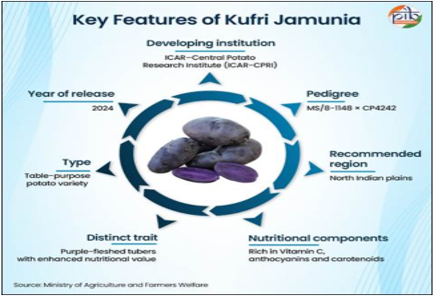
Kufri Jamunia was released in 2024 with higher Vitamin C, anthocyanins, carotenoids, zinc and iron and strong consumer appeal. Thus, making it a useful tool for nutritional security through a common staple crop. Nutrient-rich coloured potato varieties developed by ICAR-CPRI are as follows:
| Variety | Year | Key Features |
|---|---|---|
| Kufri Neelkanth | 2018 | First purple-skinned specialty potato of ICAR-CPRI; high antioxidant content; suitable for all age groups; cultivation in Punjab, Haryana, Uttar Pradesh, Uttarakhand, Bihar, Madhya Pradesh and Chhattisgarh. |
| Kufri Manik | 2021 | Deep red, round tubers, medium eyes, yellow flesh; rich in anthocyanin, zinc and iron. |
| Kufri Jamunia | 2024 | Purple flesh; higher ascorbic acid (Vitamin C), anthocyanin and carotenoids than Manik and Neelkanth; enhanced zinc and iron; suitable for table use; very high consumer appeal. |
Characteristics of Kufri Jamunia
-
- Plant: Medium-maturing, medium-tall plants with a semi-compact canopy.
- Tubers: Dark purple skin and purple flesh; oblong, shallow eyes, mealy texture; 10–12 medium to large tubers per plant.
- Yield: 32–35 tonnes/hectare under recommended practices; about 49 tonnes/hectare in station trials at 90 days.
- Marketable yield: Nearly 90% of total production in trials.
- Storage: Medium dormancy of 6–8 weeks (tubers do not sprout quickly); low rottage and minimal weight loss.
- Suitability: Stable performance in multi-location trials; recommended for the North Indian plains.
Other Initiatives of the Government of India
Biofortified potatoes are one part of a wider strategy to fight malnutrition and micronutrient deficiency. Other related initiatives are:
| Initiative | Focus |
|---|---|
| Biofortified varieties by ICAR | A set of biofortified, climate-resilient crop varieties has been released and dedicated to the nation (2021 and 2024). For example iron-rich pearl millet, zinc-rich rice and high-protein wheat. |
| Fortified rice | Fortified rice (iron, folic acid, Vitamin B12) supplied through PDS, Anganwadi (ICDS) and PM POSHAN. |
| Poshan Abhiyaan / Mission Poshan 2.0 | Convergent approach to reduce stunting, wasting, anaemia and low birth weight. Poshan Tracker for monitoring. |
| PM POSHAN | Hot cooked meals for school children, improving nutrition and attendance. |
| Anemia Mukt Bharat (2018) | Iron-folic acid supplementation, deworming and testing across life stages (6x6x6 strategy). |
| National Food Security Act, 2013 | Legal right to subsidised foodgrains for about two-thirds of the population. |
| FSSAI fortification regulations | Food Safety and Standards (Fortification of Foods) Regulations, 2018 and the “+F” logo. Eat Right India movement. |
| Shree Anna / Millets promotion | Nutri-cereals promoted for dietary diversity (International Year of Millets, 2023). |
| Mission for Integrated Development of Horticulture (MIDH) | Supports horticulture crops including cold storage, post-harvest infrastructure and planting material, which helps crops like potato. |
Significance
i. It addresses hidden hunger (iron, zinc, Vitamin C) through a widely consumed staple, without changing food habits.
ii. Breeding-based nutrition is built into the crop and reaches people through normal consumption.
iii. High yield (32–35 t/ha), ~90% marketable yield and good storage make it commercially attractive, with scope for premium markets.
iv. Purple potato flour, daliya and bakery items open opportunities for food processors and start-ups.
v. Anthocyanin-rich food adds health-promoting antioxidants.
vi. Shows the role of ICAR institutions in science-led agriculture and Viksit Bharat goals.
Challenges
i. Recommended mainly for the North Indian plains, so eastern, southern and hill regions are not yet covered. Also seed availability and multiplication of quality seed potato are crucial for wider adoption.
ii. Unfamiliar purple colour and potential price premium may limit demand, particularly among low-income households who need it most.
iii. A single serving provides only a part of daily iron and zinc needs, so it should complement, not replace, dietary diversity.
iv. Nutrient values are trial-based & anthocyanins and Vitamin C may change with cooking and processing.
v. Weak processing, cold-chain and procurement links may leave farmers without assured prices.
vi. Farmers may prefer familiar high-yielding, processing-grade varieties.
Way Forward
i. Follow HarvestPlus-style delivery as followed in orange-fleshed sweet potato in Africa and Brazil’s BioFORT programme. It combines breeding, seed systems, awareness campaigns and market creation.
ii. Learn from Peru and the International Potato Center (CIP) on native-coloured potatoes and farmer-based seed systems.
iii. Expand multi-location trials to other agro-climatic regions and promote certified seed through State agriculture departments and FPOs.
iv. Link with nutrition schemes (PM POSHAN, Anganwadi/Poshan 2.0, PDS) and public procurement to create demand.
v. Support processing (potato flour, daliya, bakery) through food processing schemes such as PMFME and cold storage investments.
vi. Promote diverse biofortified crops (iron pearl millet, zinc wheat and rice) for a holistic strategy against hidden hunger.
Conclusion
Kufri Jamunia can support dietary diversity and nutritional security, provided that seed supply, awareness and market linkages are strengthened for wider adoption.
Spread the Word