
GS Paper-III: Economy, Agriculture, Science & Technology, Environment, Disaster Management and Internal Security
Q1. What do you mean by Digital Rupee? In this context, explain the working and progress of India’s Central Bank Digital Currency (CBDC).
ANS.
STRUCTURE
1. INTRODUCTION: Definition of the Digital Rupee as India’s sovereign CBDC.
2. BODY: How it works (architecture) and its progress to date.
3. CONCLUSION: Punchline on calibrated scale-up over big-bang rollout.
INTRODUCTION
The Digital Rupee (e₹) is the Reserve Bank of India’s Central Bank Digital Currency — a tokenised, legaltender digital form of the rupee, issued directly as a liability of the RBI (unlike private wallet balances or bank deposits), distinguishing it from UPI, which merely moves commercial-bank money.
BODY
Working:
1. Two variants: e₹-Wholesale (e₹-W), for interbank settlement of government securities, and e₹- Retail (e₹-R), for person-to-person and person-to-merchant payments — piloted separately from November-December 2022.
2. Two-tier distribution model: RBI issues the token centrally; regulated banks distribute it to users through digital wallets, mirroring physical-currency distribution and preserving the existing banking channel’s KYC/AML checks.
3. Technology: token-based (not account-based) representation, using distributed-ledger-inspired but centrally-controlled infrastructure, enabling offline transactions, programmability (restricting use to a specified purpose, e.g., fertiliser subsidy or scholarship disbursal), and traceability superior to cash.
The Digital Rupee’s two-tier architecture is shown below:
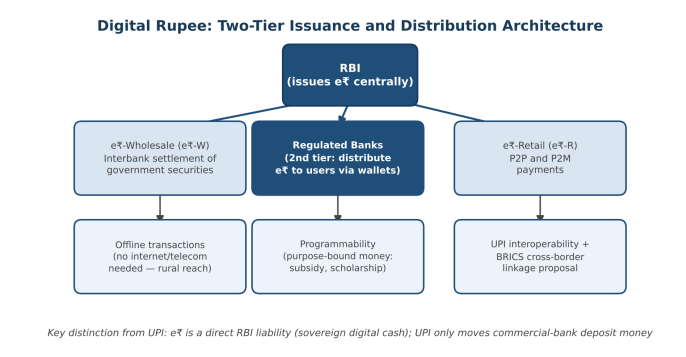
Fig: Digital Rupee (e₹) two-tier issuance and distribution architecture
Progress:
1. Steady pilot expansion: retail pilot grew from 4 banks and select cities in December 2022 to most major public and private banks, with user numbers crossing several million wallets.
2. Offline functionality: RBI operationalised offline e₹ transactions (usable without internet or telecom connectivity), extending reach to low-connectivity rural areas — a step beyond what UPI can offer.
3. Programmability trials: pilots for targeted welfare delivery (input subsidies, corporate expense disbursal) tested the CBDC’s unique advantage over cash and bank transfers of purpose-bound money.
4. Interoperability and cross-border push: e₹ was integrated with UPI QR infrastructure, and India has proposed linking CBDCs across BRICS members to enable cheaper, faster cross-border settlement and reduce dollar-dependence.
5. Cautious calibration: the RBI has repeatedly emphasised a graduated, learning-by-doing approach over a fixed rollout timeline, prioritising resilience and privacy safeguards over scale.
CONCLUSION
The Digital Rupee’s trajectory — from a narrow wholesale pilot to an offline-capable, programmable, UPIinteroperable retail instrument — shows the RBI treating CBDC issuance as a long-horizon infrastructure build rather than a race to scale, precisely because a sovereign digital currency’s credibility depends on getting settlement finality, privacy, and resilience right the first time.