Context: Over last five years, more than 3.61 crore saplings have been planted across about 1.32 lakh km of National Highways (as of July 2026). India’s green highway approach is transforming road infrastructure through plantation, climate-resilient design and resource-efficient construction. They are shifting highways from mere connectivity corridors to environmentally responsible infrastructure.
Why Do Green Highways Matter?
India’s National Highway (NH) network has grown by nearly 61%, from 91,287 km (2014) to 1,46,572 km (March 2026). This has improved market access and the movement of people and goods, but it has also increased pressure on green cover, natural resources and air quality.
-
- Highway construction involves tree felling, soil disturbance, dust and heavy use of fossil-fuel-based materials such as bitumen.
- India imports nearly 50% of its bitumen requirement, creating a strategic and economic vulnerability.
- Therefore, growth must be aligned with climate action, self-reliance and inclusive growth, as underlined in the Viksit Bharat
Green Highways (Plantation, Transplantation, Beautification & Maintenance) Policy, 2015:
Its objectives are to:
-
- Evolve a policy framework for plantation along National Highways.
- Reduce the impact of air pollution and dust, as trees and shrubs act as natural sinks for pollutants.
- Arrest soil erosion at embankment slopes.
- Moderate the effect of wind and incoming radiation.
- Create employment opportunities for local people.
Implementation Mechanism: Plantation is undertaken by Self Help Groups (SHGs), private agencies, State Forest Departments, Forest Corporations and contractors, depending on the sanctioned works. A Plantation Cell monitors the work through the regional offices of the National Highways Authority of India (NHAI) and other agencies.
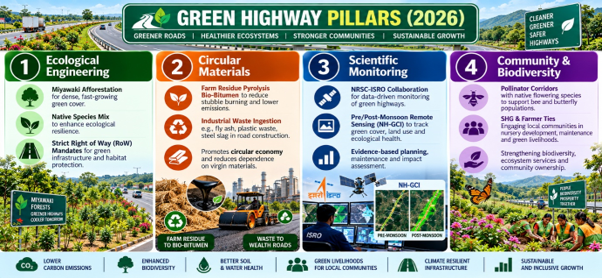
Key Dimensions of the Green Highway Approach
| Dimension | Key Features |
| Plantation & Afforestation | 3.61 crore saplings over 1.32 lakh km (last 5 years); Miyawaki plantations; compensatory afforestation and tree transplantation where felling is unavoidable. |
| Monitoring | Shift from site visits to drone and satellite-based monitoring; NH-GCI with ISRO’s NRSC. |
| Sustainable Materials | Bio-bitumen, fly ash, pond ash, RAP, C&D waste, plastic waste, slag, crumb rubber. |
| Community & Biodiversity | Pollinator corridors (“Trees for Bees”), Ek Ped Maa Ke Naam, SHG participation. |
| Accountability | NHAI guidelines (Sept 2026) with plantation and survival benchmarks; Green Highways Excellence Awards. |
Miyawaki Technique
-
- Method of creating dense forests in limited spaces; also called the ‘pot plantation method’.
- Trees and shrubs are planted close to one another, promoting rapid growth of forest-like ecosystems.
- Plants can grow up to 10 times faster, making it suitable for space-constrained urban areas.
NHAI Guidelines (September 2026):
| Benchmark | Requirement |
| Area coverage | At least 80% of available Right of Way (RoW) earmarked for plantation must be covered for provisional completion certificate. |
| Survival rate | Minimum 90% survival at the time of official inspection. |
| O&M period | Same 90% benchmark continues, with timely replacement of dead plants. |
Green Highways Excellence Awards (instituted 2025): The 2026 awards gave highest weightage to plantation survival, along with species diversity, native species, site-specific plans and protection measures.
-
- Avenue Plantation: Six-laning of Chilakaluripet Bypass, NH-16 (Andhra Pradesh).
- Median Plantation: Four-laning of Hyderabad–Yadgiri section, NH-163.
- Plantation in Land Parcels: Jamtha Clover Leaf Oxygen Bird Park, NH-44 (Nagpur).
National Highways – Green Cover Index (NH-GCI)
-
- First Annual Report (2025–26) was prepared with the National Remote Sensing Centre (NRSC), ISRO.
- India’s first scientific and quantitative assessment of green cover within the RoW along NHs.
- Covers nearly 30,000 km of NHs under Operation & Maintenance (O&M) across 24 States, with pre- and post-monsoon
- Establishes a baseline and reveals significant variation in green cover, enabling comparison, ranking and targeted interventions.
What is Bio-Bitumen Process?
Bio-Bitumen via Pyrolysis (“From Farm Residue to Roads”) was announced in January 2026 through technology transfer (TT). It was developed jointly by CSIR-CRRI (New Delhi) and CSIR-IIP (Dehradun).
-
- Process: Post-harvest rice straw → bio-oil through pyrolysis → blended with conventional bitumen → bio-bitumen blend.
- Multiple value streams: bio-binders for roads, energy-efficient gaseous fuel, bio-pesticide fractions and high-grade carbon (batteries, water purification, advanced materials).
- Field trial: 100-metre stretch laid on Jorabat–Shillong Expressway (NH-40), Meghalaya; plans to integrate it into national highway construction standards.
- India is the first country to scale bio-bitumen to industrial and commercial levels within the same year.
- Also supports farm residue management, which helps address stubble burning and reduces import dependence.
Recycled and Waste-Derived Materials Uses
| Material | Use in Highways |
| Fly ash / Pond ash (thermal power by-product) | Embankments and structural works. |
| Reclaimed Asphalt Pavement (RAP) | Reused in suitable pavement works. |
| C&D waste, recycled aggregates | Used as per technical specifications. |
| Plastic waste, slag, crumb rubber | Promoted as recycled or industrial by-products. |
CASE STUDIES
-
- Pollinator Corridors: Along identified stretches of the Delhi–Amritsar–Katra Expressway under the “Trees for Bees” campaign; flowering, locally suitable species give nectar and pollen across seasons, creating continuous habitat for bees and pollinators.
- Andhra Pradesh: About 18 lakh seedlings planted (2010–2025) through avenue and median plantations; 3.86 lakh saplings targeted for 2026–27.
- Ek Ped Maa Ke Naam: About 3,200 saplings planted in Andhra Pradesh on World Environment Day 2026.
Significance of Green Highways
-
- Environmental: Plantation acts as a carbon and pollutant sink, reduces dust, controls soil erosion and supports climate mitigation and adaptation (shade, wind and radiation moderation).
- Economic: Use of waste-derived materials and bio-bitumen reduces import dependence on bitumen (~50%), lowers material costs and promotes circular economy
- Technological: Satellite and drone-based monitoring (NH-GCI) makes evidence-based, transparent assessment possible instead of ad hoc site inspections.
- Social: Plantation work provides local employment, especially through SHGs, and community campaigns build ownership.
- Ecological: Pollinator corridors and native species integrate highways with biodiversity conservation.
- Policy alignment: Supports Viksit Bharat, Atmanirbhar Bharat, Net Zero 2070 and LiFE (Mission Life)
- Waste management: Fly ash, plastic, C&D waste and farm residue are converted from liabilities into resources.
Challenges
-
- CAG audits of compensatory afforestation under CAMPA have repeatedly flagged delays and weak survival monitoring. Thus, raising concerns that felled mature trees are not fully replaced by new saplings.
- Ecologists caution that avenue plantations with limited species diversity or non-native species offer lower ecological value than natural vegetation.
- The 90% survival benchmark works only if independent verification, water availability and long-term maintenance are ensured.
- NH-GCI covers only ~30,000 km, a fraction of the 1.46 lakh km network. Its coverage across the entire NH network, including under-construction stretches, is yet to be achieved.
- Bio-bitumen is at an early stage as only a 100 m trial has been laid. Cost competitiveness, feedstock logistics (rice straw collection), durability and standardisation remain uncertain.
- Greening cannot offset the core emissions of highway construction (cement, steel, bitumen) or induced vehicular traffic.
Way Forward
-
- Adopt the Netherlands’ approach of ecologically managed road verges with native flowering species and mowing regimes that support biodiversity.
- Follow Sweden’s model of climate requirements in infrastructure procurement setting carbon-emission limits on highway projects.
- Learn from Germany’s high reuse of reclaimed asphalt to scale RAP, C&D waste and industrial by-products through mandatory standards.
- Extend NH-GCI to the entire NH network with annual publication, and link NHAI contractor ratings and payments to green performance.
- Fast-track bio-bitumen standardisation (IRC/BIS codes), scale pilots across States and link it to stubble management for farmer income.
- Promote SHG-led maintenance models and convergence with MGNREGS, CAMPA and Ek Ped Maa Ke Naam for sustained community ownership.
Conclusion:
Green Highways reflect a shift from building roads to building sustainable corridors, where growth need not come at the expense of green cover. The real test now lies in ensuring survival of plantations, scaling indigenous technologies like bio-bitumen and sustaining community participation. So that India’s highway expansion strengthens climate action, self-reliance and inclusive growth on the path to Viksit Bharat.
Spread the Word