Introduction: India is emerging as a competitive player in the digital manufacturing revolution through Additive Manufacturing (AM), a 3D printing technology in which a digital file controls the manufacturing process. The National Strategy for Additive Manufacturing (NSAM), introduced in 2022, has trained over 1,54,000 individuals and supported 56 AM start-ups and is now moving into NSAM 2.0, positioning AM as a building block of Atmanirbhar Bharat and Viksit Bharat.
Why Does Additive Manufacturing Matter?
-
- India has moved from being a user of technology to a builder of it as seen in Digital Public Infrastructure. AM extends this confidence from the digital world into the physical world of design and manufacturing.
- The global AM machines market is projected to reach USD 149 billion by 2035, while the AM-electronics supply chain is set to grow from USD 18 billion to USD 112 billion, giving India an opening to become a competitive manufacturer of AM platforms (polymers, metals, composites, ceramics, semiconductor-grade materials).
- AM converges computing, electronics, design software and materials science, and is linked to CAD, AI and pattern recognition.
What is Additive Manufacturing?
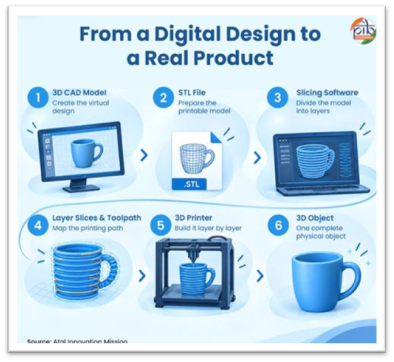
AM builds an object layer by layer from a digital file, i.e. “building up” rather than “cutting down” (as in conventional subtractive manufacturing). The digital file controls material deposition and, at times, material composition. There are 40+ AM processes in the market and in R&D.
| Stage | What happens |
| 1. Virtual design | Digital design in CAD, made from scratch, captured through a 3D scanner or now generated using AI from mobile phone photos. |
| 2. STL file | Standard Tessellation Language represents the 3D model as a collection of triangular surfaces; tells the machine what to build. |
| 3. Slicing | Software divides the model into hundreds or thousands of horizontal layers and instructs the machine how to print. |
| 4. Printing | Sliced file is fed into the AM machine which reads each layer and builds step by step. |
| 5. Additive process | Successive layers are deposited until the final shape forms. Accuracy is such that without digital instructions the process fails. |
| 6. Final object | Layers fuse into one 3D object. Post-processing makes it marketable. |
Additive Manufacturing Materials
| Material | Examples and Use |
| Thermoplastics | Most popular: ABS, polycarbonate (PC), PLA; water-soluble PVA used for temporary support structures. |
| Metals | From precious metals (gold, silver) to strategic metals (stainless steel, titanium). |
| Ceramics | Zirconia, alumina, tricalcium phosphate; layers of powdered glass and adhesive baked to make new glass products. |
| Bio-materials | Silicon, calcium phosphate, zinc for bone support; bio-inks from stem cells explored for blood vessels, bladders and organs (liver tissue, kidney, heart). |
Applications Across Sectors
| Sector | Key Examples |
| Space & Aerospace | Agnikul Cosmos (IIT Madras-incubated) launched Agnibaan SOrTeD (May 2024) with a single-piece, AM-printed semi-cryogenic engine. NSAM supports start-ups for critical engine parts. |
| Defence | Indian Army’s first AM-printed two-storey dwelling unit at Ahmedabad (12 weeks); extended to precast defences in Ladakh. NSAM supports workshop-level MRO facilities for all three services. |
| Healthcare | MeitY-supported AM medical devices. OsteoForge (silk-based implants), Technology Development Board supports 3D-printed bone grafts from indigenous bioceramics, which are patient-specific and reduce imports. |
| Electronics | AM-printed batteries, antennas, varistors, capacitors. IISc demonstrated Photonic Integrated Circuit blocks (a global first); concrete-based supercapacitors for solar energy storage under development. |
| Construction | Kelvin 6K Pro on-site printer builds 2,500 sq ft homes in under 30 days using low-carbon geopolymer. Early indications of 30% lower material and logistics costs and 90% lower emissions than cement-based construction. |
Government Initiatives in Building Indian AM Ecosystem
-
- National Strategy for Additive Manufacturing (NSAM), February 2022: Released by MeitY as the guiding framework for 3D printing and AM, aligned with Make in India and Atmanirbhar Bharat, with time-bound targets pursued through Centre, States, industry and academia. Seven specialised Development and Deployment Centres support R&D, skilling and hands-on technology access.
NSAM 2.0 (Proposed)
-
- Accelerate Intellectual Property Rights (IPR) generation and grow the AM network through digital integration.
- Develop globally competitive AM technologies for commercialisation.
- Improve affordability of machines and materials through clusters; strengthen the AM-electronics value chain.
- Expand the start-up base, give extensive support to defence, and promote SDG-driven pilot programmes.
- Deepen international cooperation through standards, joint research and technology partnerships.
-
- National Additive Manufacturing Symposium (NAMS): National platform of policymakers, scientists, industry, start-ups and academia. The 2nd edition (13 March 2026, New Delhi) saw MoUs, new product launches and discussions on NSAM 2.0 and defence adoption.
- Atal Tinkering Labs (ATLs): ₹20 lakh grant per lab, 1,200–1,500 sq ft workspaces with 3D printers, robotics and IoT kits for students of Classes VI–XII, building the future AM workforce.
- ESTIC-2026 (CSIR): 27–29 October 2026, Bharat Mandapam, New Delhi. Theme “Creative Minds, Catalyzing Science, Empowering Technologies”, 12 thematic areas, including AM.
Significance of Additive Manufacturing
-
- Indigenous machines, materials and software reduce import dependence, especially in medical devices, defence MRO and electronics.
- Enables complex, lightweight, single-piece designs (e.g., rocket engines), faster prototyping and lower material waste than subtractive methods.
- Creates a skilled digital workforce (1.54 lakh trained) and start-up ecosystem.
- Supports on-site, rapid repair and construction in remote terrains like Ladakh and reduces dependence on long supply chains.
- Patient-specific implants and bone grafts enable personalised, affordable treatment.
- Resource efficiency, localised production and low-carbon construction support SDGs and Industry 5.0 (distributed, flexible manufacturing).
Challenges
-
- AM machines, metal powders and specialised materials are largely imported, keeping costs high, especially for MSMEs. NSAM 2.0 itself targets affordability through clusters.
- Only 56 of the 100 targeted start-ups have been supported and India’s share of the global AM market remains far below the 5% target.
- AM is currently better for customised, low-volume or complex parts than mass production because of slower build speeds, post-processing needs and quality consistency.
- Industry bodies and global benchmarks such as the Wohlers Report point to the importance of qualification standards for aerospace, defence and medical parts. Gaps in BIS-level standards and testing facilities can slow adoption.
- Bio-printing of tissues and organs, medical device approval (CDSCO) and 3D-printed firearms (“ghost guns”) raise safety, ethical and security concerns under the Arms Act, 1959.
- IP and data security because the digital file is the product, design piracy and cyber-theft of CAD/STL files are major risks.
Way Forward
-
- Follow the USA’s America Makes model (public–private national AM innovation institute) and Singapore’s National AM Innovation Cluster (NAMIC) to link industry, research and defence
- Use NSAM 2.0 to create AM clusters and shared facilities for MSMEs with incentives for indigenous machines and metal powders (on the lines of PLI).
- Develop BIS standards, testing and certification aligned with ISO/ASTM norms so that AM parts can be qualified for aerospace, defence and medical use.
- Build IPR and cybersecurity frameworks for digital design files and set clear regulation for bio-printing and 3D-printed weapons.
- Expand defence procurement of AM parts and public construction pilots (housing, disaster relief) as anchor demand, aligned with Make in India and iDEX.
- Promote recycled powders and low-carbon materials to keep AM consistent with Net Zero 2070.
Conclusion
AM by converting NSAM’s early gains into affordable machines and large-scale adoption. India can make AM a core pillar of indigenous manufacturing, skilled employment and sustainable growth.
Spread the Word