TOPIC-1: World Rhino Day 2026 Celebrations & Eco-Club Outreach at National Zoological Park
-
- UPSC Relevance: GS Paper 3 (Environment & Ecology — Biodiversity Conservation, In-Situ vs Ex-Situ Conservation, Species Protection Status [Greater One-Horned Rhino], and Environmental Education & Public Awareness).
Introduction: The National Zoological Park (NZP), New Delhi, observed World Rhino Day 2026 on September 22, 2026, by launching its first-ever Eco-Club Teachers’ Orientation Programme alongside public awareness activities. The initiative connects ex-situ conservation facilities with school outreach programs to strengthen environmental education and biodiversity protection among youth.
About World Rhino Day:
-
- World Rhino Day is celebrated annually on September 22 to raise awareness about the five extant rhinoceros species worldwide (Greater One-Horned, Black, White, Javan, and Sumatran rhinos).
- India is home to the Greater One-Horned Rhinoceros (Rhinoceros unicornis), protected under ex-situ scientific care in zoos like NZP (which currently houses an adult female named Anjuha) and in-situ national parks such as Kaziranga, Manas, Pobitora, and Orang in Assam and Jaldapara in West Bengal.
Key Highlights:
-
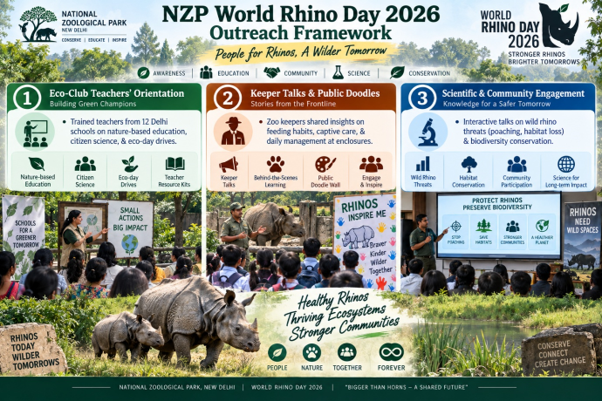
- First Eco-Club Teachers’ Orientation: Brought together eco-club in-charge teachers from 12 schools in Delhi to integrate zoo-based nature activities, citizen science initiatives, and biodiversity workshops into primary and secondary school curricula.
- Keeper Talk Series: Featured live interactions at the rhino enclosure, where zoo keepers educated visitors on rhino behavior, nutrition, dietary management, and veterinary care in captivity.
- Visitor Awareness & Public Doodles: Conducted public awareness sessions and doodle activities at the zoo’s exit gate, focusing on the ecological importance of rhinos as ecosystem engineers in riverine grasslands.
- Promoting Ex-Situ to In-Situ Linkages: Emphasized how captive breeding, scientific management, and public education in zoos complement field conservation efforts to combat poaching, invasive species, and habitat fragmentation.
UPSC Quick Reference Table
| Feature | Detailed Specification |
| Nodal Body | National Zoological Park (NZP), New Delhi (MoEF&CC) |
| Global Observance | World Rhino Day (September 22) |
| Key Outreach Launch | First Eco-Club Teachers’ Orientation Programme (12 Delhi Schools) |
| Indian Native Species | Greater One-Horned Rhinoceros (Rhinoceros unicornis) |
| IUCN Status | Vulnerable (Listed under Schedule I of Wildlife Protection Act, 1972) |
| Major In-Situ Habitats | Kaziranga, Manas, Pobitora, Orang (Assam); Jaldapara, Gorumara (West Bengal) |
Conclusion:
World Rhino Day 2026 at the National Zoological Park highlights the role of urban zoos in environmental stewardship. Engaging teachers and students through eco-club networks bridges ex-situ wildlife education with in-situ habitat conservation and their ecosystems across India.
TOPIC-2: NSO Domestic Tourism Expenditure Survey (DTES) 2025–2026
-
- UPSC Relevance: GS Paper 2 (Government Policies, Data Collection Frameworks, & Statistical Surveying — MoSPI/NSO) & GS Paper 3 (Indian Economy — Domestic Tourism Trends, Service Sector Expenditure, Rural vs. Urban Consumption Patterns, and Infrastructure Demand).
Introduction: The National Statistics Office (NSO), under the Ministry of Statistics and Programme Implementation (MoSPI), released the findings of the Domestic Tourism Expenditure Survey (DTES) 2025–2026 (conducted during July 2025–June 2026 as part of the NSS 80th Round). The report titled ‘Domestic Tourism in India’ provides key insights into trip frequencies, travel purposes, expenditure patterns, and preferred modes of transport across rural and urban India.
About the NSO Domestic Tourism Expenditure Survey (NSS 80th Round):
The survey covered 2,46,113 households across 24,778 First Stage Units (FSUs) nationwide using Computer Assisted Personal Interviewing (CAPI).
Data was categorized into three distinct reference periods:
1. 365-Day Reference Period: Overnight trips for leisure, pilgrimage/religion, health/medical care, and shopping.
2. 30-Day Reference Period: Overnight trips for business, social visits, education, and training.
3. Same-Day Trips (30-Day Reference Period): Excursions lasting under 12 hours without an overnight stay.
Key Findings:
-
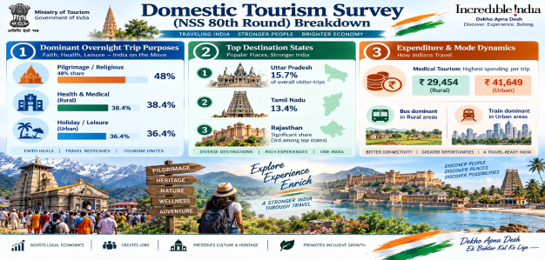
- Pilgrimage & Health Lead 365-Day Trips: Among 365-day overnight trips, Pilgrimage & Religious visits accounted for the highest share across both sectors (48%). Health & Medical formed the second-largest purpose in rural areas (38.4%), whereas Holidaying/Leisure led in urban areas (36.4%).
-
- Social Visits & Business Expenses (30-Day Trips): Social visits dominated 30-day overnight trips (89%). However, Business Trips recorded the highest average expenditure at ₹5,949 per trip.
- Top Destination States: Combining intra-state and inter-state visitors, Uttar Pradesh registered the highest overall share of visitor-trips (15.7%), followed by Tamil Nadu (13.4%), Rajasthan (8.0%), and Bihar (10.5%).
- Highest Single-Purpose Spending: Health & Medical trips incurred the highest average expenditure per trip in both rural (₹29,454) and urban (₹41,649) sectors.
- Travel Modes & Accommodation: Buses served as the primary mode of travel in rural areas (32% share for long-term, 48% for short-term), while urban travelers preferred railways (35%) and commercial hotels/guesthouses (36%).
UPSC Quick Reference Table
| Feature | Detailed Specification |
| Nodal Ministry / Body | MoSPI / National Statistics Office (NSO) |
| Survey Round & Title | NSS 80th Round — ‘Domestic Tourism in India’ |
| Survey Period | July 2025 to June 2026 (Sample Size: 2,46,113 Households) |
| Most Frequent Trip Purpose | Pilgrimage & Religious (48% of 365-day overnight trips) |
| Highest Spending Purpose | Health & Medical Trips (₹29,454 Rural / ₹41,649 Urban) |
| Top Destination State | Uttar Pradesh (15.7% overall share), followed by Tamil Nadu |
| Same-Day Excursions | Shopping accounted for the largest expenditure share (51% Rural / 41% Urban) |
Conclusion:
The NSS 80th Round DTES report highlighted the dominance of religious tourism, medical travel, and shopping excursions offers policymakers data to improve transit corridors, expand hospitality infrastructure, and boost local service economies.
Spread the Word