ANS.
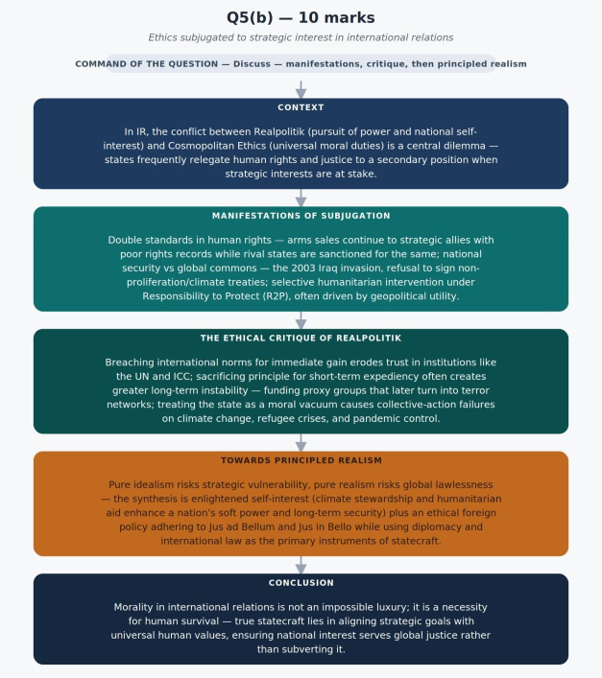
STRUCTURE
1. Explain the statement CONTEXT in brief with ethics in IR
2. Then explain how ethical considerations are often subjugated to the strategic interests of nation-states
3. Write its other side
4. Conclusion with a philosophy or quote
THE CONTEXT (INTRODUCTION)
In international relations (IR), the conflict between MORAL REALISM–Realpolitik (pursuit of power and national self-interest) and MORAL IDEALISM–Cosmopolitan Ethics (universal moral duties) is a central dilemma.
States frequently relegate ethical values—such as human rights, justice, and non-intervention—to a secondary position when vital strategic, economic, or security interests are at stake.
BODY
Manifestations of Ethical Subjugation
-
- TRUMP/Europe double standard against India’s oil import from Russia
- Double Standards in Human Rights: Powerful nations often overlook authoritarian practices or human rights abuses committed by strategic allies (e.g., weapon sales to regimes with poor human rights records) while sanctioning rival states for similar violations.
- National Security vs. Global Commons: Unilateral military actions (e.g., the 2003 invasion of Iraq) or refusal to sign non-proliferation/climate treaties highlight how states prioritize sovereignty and strategic dominance over collective global ethics.
- Selective Humanitarian Intervention: Intervention decisions under frameworks like Responsibility to Protect (R2P) are frequently influenced by geopolitical utility rather than pure moral imperative.
“ends justify means”-Machiavelli
Ethical Critique of Realpolitik
1. Erosion of Global Trust & Institutions: When nations breach international norms for immediate gain, they weaken multilateral bodies (e.g., the UN, ICC) and undermine the rule-based international order.
2. Short-Term Gains Long-Term Instability: Sacrificing moral principles for expediency often creates greater long-term chaos (e.g., funding proxy groups that later turn into terror networks).
3. The Trap of “National Egoism”: Treating the state as a moral vacuum leads to collective action failures on planetary challenges like climate change, refugee crises, and pandemic control.
It is against what India propagates- Vasudhaiv Kutumbakam
Towards ‘Principled Realism’
Pure idealism can lead to strategic vulnerability, but pure realism leads to global lawlessness. Modern governance requires a synthesis of morality and national interest:
-
- Enlightened Self-Interest: Recognizing that ethical actions—such as climate stewardship, humanitarian aid, and equitable trade—ultimately enhance a nation’s soft power, legitimacy, and long-term security.
- Ethical Foreign Policy: Adhering to Jus ad Bellum (justice of war) and Jus in Bello (justice in war), while using diplomacy and international law as the primary instruments of statecraft.
Jawaharlal Nehru: “The only policy that ultimately serves national interest is the policy of peace.”
CONCLUSION
The ideal approach is “Enlightened National Interest” — where a nation realises that its long-term wellbeing is inseparable from global peace, climate stability, and shared prosperity.
Spread the Word