
ANS.
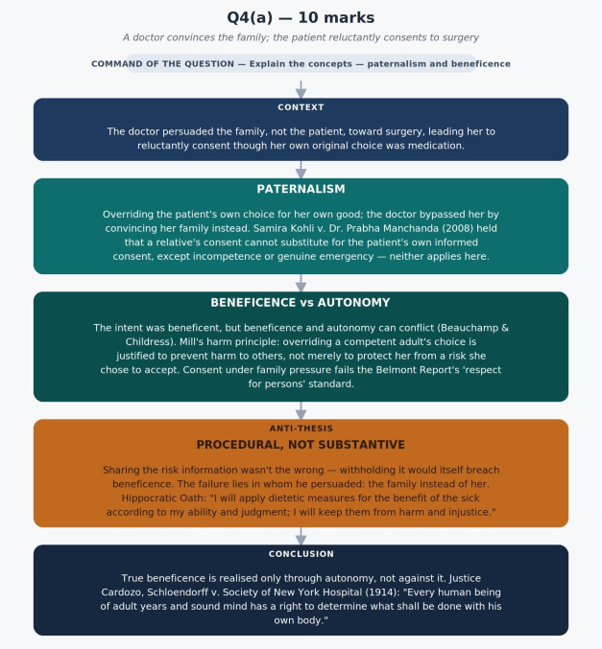
STRUCTURE
1. Explain the statement CONTEXT in brief
2. Then Explain the concepts of paternalism and beneficence by analysing the doctor’s action with positive and negative views
3. Conclusion with a philosophy or quote
THE CONTEXT (INTRODUCTION)
Medical ethics is a system of moral principles that applies values and judgments to the practice of clinical medicine. It governs the practitioner-patient relationship based on Four Core Pillars:
1. Autonomy
2. Beneficence
3. Non-Maleficence
4. Justice
BODY
The doctor’s decision to steer the patient toward surgery highlights a classic tension between two core ethical principles: Beneficence and Paternalism.
Paternalism
Paternalism is overriding a person’s own autonomous choice for what is judged to be their own good. Here the doctor did not directly argue the patient out of her preference — he bypassed her by convincing her family, who then brought pressure to bear on her.
Indian law has explicitly rejected this route: In Samira Kohli v. Dr. Prabha Manchanda (2008), the Supreme Court held that consent from a patient’s relatives cannot substitute for the patient’s own informed consent to a procedure, except where she is incompetent or it is a genuine emergency — neither of which applies here.
Beneficence Vs Autonomy
The doctor’s intent was beneficent — protecting the patient from documented long-term harm is a legitimate clinical goal, not mere paternalism for its own sake. But beneficence and autonomy can conflict, and modern medical ethics (Beauchamp and Childress’s four principles) treats neither as automatically superior.
Mill’s harm principle is the relevant limit: overriding a competent adult’s own choice is justifiable to prevent harm to others, not merely to protect her from a risk she has knowingly chosen to accept for herself. Consent obtained through family pressure, even for her own good, fails the Belmont Report’s “respect for persons” standard, which requires consent to be free of coercion or undue influence — including influence exerted through relatives rather than the clinician directly.
Anti-thesis — was this really paternalism?
A closer look suggests the ethical failure is procedural, not substantive. Sharing information about medication’s serious adverse effects is not paternalism — it is exactly what informed consent requires; a doctor withholding that information to avoid influencing her choice would itself be a lapse in beneficence.
The wrong lies specifically in whom the doctor persuaded: routing the case through the family, rather than returning to the patient herself with the same facts, treated her as someone to be managed through others rather than reasoned with directly. Recommending surgery was not the breach; disenfranchising her from that recommendation was.
“I will apply dietetic measures for the benefit of the sick according to my ability and judgment; I will keep them from harm and injustice.” — The Hippocratic Oath
Synthesis
True beneficence does not compete with autonomy — it is only realised through it: the doctor should have returned directly to the patient with the full clinical picture and let her, not her family, weigh medication’s risks against surgery’s.
CONCLUSION:
As Justice Cardozo held in Society of New York Hospital Case 1914: “Every human being of adult years and sound mind has a right to determine what shall be done with his own body.” Good intentions administered through someone else’s authority over her are still, in the end, someone else’s authority over her.
Spread the Word