ANS.
STRUCTURE
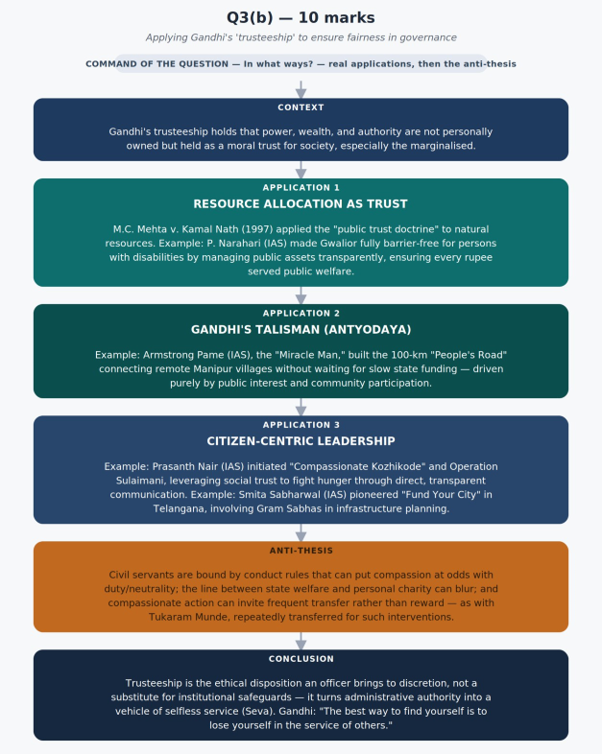
1. Explain the context in brief with Gandhi’s notion of ‘trusteeship’
2. Then relate to Indian Administrative Officer how to ensure fairness in governance with examples
3. Give any anti-thesis
4. Conclusion with a philosophy or quote
THE CONTEXT (INTRODUCTION)
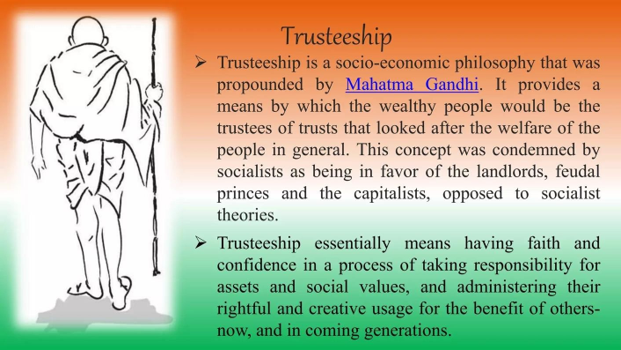
Mahatma Gandhi’s philosophy of Trusteeship posits that power, wealth, and authority are held not for personal ownership, but as a moral trust held on behalf of society—especially the marginalized.
BODY
Indian Administrative Officer operationalizing Trusteeship:
-
- Resource allocation as trust(Ethical Custodianship): C. Mehta v. Kamal Nath (1997)- where the Supreme Court applied the “public trust doctrine”.
Example: P. Narahari (IAS) applied this by managing public assets transparently to make Gwalior fully barrier-free for persons with disabilities, ensuring every rupee of the state budget served public welfare.
-
- Applying Gandhi’s ‘Talisman’ in Policy Execution (Focus on Antyodaya)
Example: Armstrong Pame (IAS), known as the “Miracle Man,” built the 100-km “People’s Road” connecting remote villages in Manipur without relying on slow state funding, driven purely by public interest and community participation.
-
- Ethical Leadership & Citizen-Centric Accessibility
Example: Prasanth Nair (IAS) initiated the “Compassionate Kozhikode” project and Operation Sulaimani, leveraging social trust to fight hunger while maintaining direct, transparent communication with citizens.
-
- Participatory Governance & Decentralized Power
Example: Smita Sabharwal (IAS) pioneered the “Fund Your City” and community-driven monitoring initiatives during her field postings in Telangana, actively involving Gram Sabhas and local residents in public infrastructure planning.
Anti-thesis
-
- Civil servants are bound by conduct rules which poses conflict between compassion and duty/neutrality-over activism by civil servants
- Blurring distinction between welfare by state and charity
- SIR for cleaning electoral role vs empathy and compassion
- Frequent transfer for compassionate action-Tukaram Munde
CONCLUSION
Trusteeship should be read as the ethical disposition an officer brings to discretion, not a substitute for institutional safeguards. By adopting Trusteeship, a civil servant transforms administrative authority from an instrument of control into a vehicle of self-less service (Seva). “The best way to find yourself to lose in service of others.”-Gandhi.
Spread the Word