ANS.
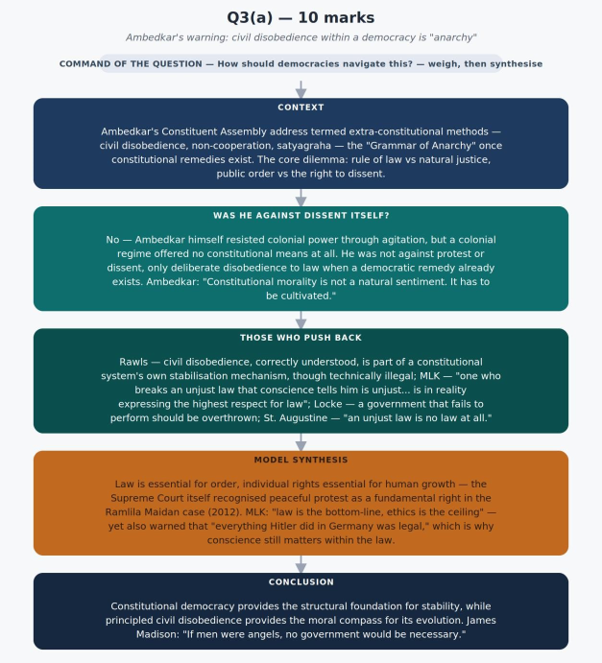
STRUCTURE
1. Explain the context in brief with B. R. Ambedkar philosophy
2. Then weigh down the both sides-define right vs anarchy with examples
3. Go for a synthesis type take away
4. Conclusion with a philosophy or quote
THE CONTEXT (INTRODUCTION)
Dr. B. R. Ambedkar, in his Constituent Assembly address, termed extra-constitutional methods—such as civil disobedience, non-cooperation, and satyagraha—the “Grammar of Anarchy” when constitutional remedies are available. He warned that bypassing legal channels weakens institutional legitimacy and risks mobocracy.
The Core Dilemma
-
- Rule of Law vs. Natural Justice
- Public Order Right to Dissent
BODY
But does it mean he was against right to show dissent or protest or how the constitution went on going balance both? Also, the history of protests all over the world and in India including the ongoing protests:
1. CJP protests and students protests throughput the country
2. Protests against the UGC guidelines
3. Farmers and CAA protests
4. Protest against Trump in US
Ambedkar was not against protest or dissent, he was only against deliberate disobedience to law when a better remedy was available. In a constitutional democracy, there is democratic system in place for grievance redressal.
He himself had resisted against case operations and led agitations but that was a colonial power without democratic means. He was against protest like Bangladesh in which people acted in barbaric manner.
As Dr. Ambedkar said, “Constitutional morality is not a natural sentiment. It has to be cultivated.”
Does it mean even an unjust law will not be protested like TADA or what if the democratic process itself is hostaged by those who are in power-should citizens wait for that threshold.
Examples:
-
- Democracy became dictatorship-Iraq/Turkey/Pakistan and even trump administration in US
- The civil right movement in US by Martin Luther King
- Anti-apartheid movement in SA by Mandela
“There is a higher court than courts of justice, and that is the court of conscience.” – Mahatma Gandhi
Those who may not agree with Ambedkar
| John Rawls | Martin Luther King Jr | John Locke | Einstein |
|---|---|---|---|
| Civil disobedience, correctly understood, is part of the stabilization mechanism of a constitutional system, although it is an illegal one. | One who breaks an unjust law that conscience tells him is unjust, …, is in reality expressing the highest respect for law. | A government which fails to perform should be overthrown-liberty and property as inalienable right | “Never do anything against conscience even if the state demands it.” – Albert Einstein |
“An unjust law is no law at all.” — St. Augustine
Model synthesis:
However, there should be balance between both. Law is essential for order in society, individual rights are essential for fullest human growth. Even the SC in Ramlila Maidan case 2012, recognised right to peaceful protest as fundamental right.
“Law is bottom-line, ethics is ceiling”-Martin Luther King Jr
Martin Luther King Jr.: “Never forget that everything Hitler did in Germany was legal.”
CONCLUSION
Constitutional democracy provides the structural foundation for stability, while principled civil disobedience provides the moral compass for evolution.
“If men were angels, no government would be necessary. If angels were to govern men, neither external nor internal controls on government would be necessary.”— James Madison
Spread the Word