
ANS.
STRUCTURE
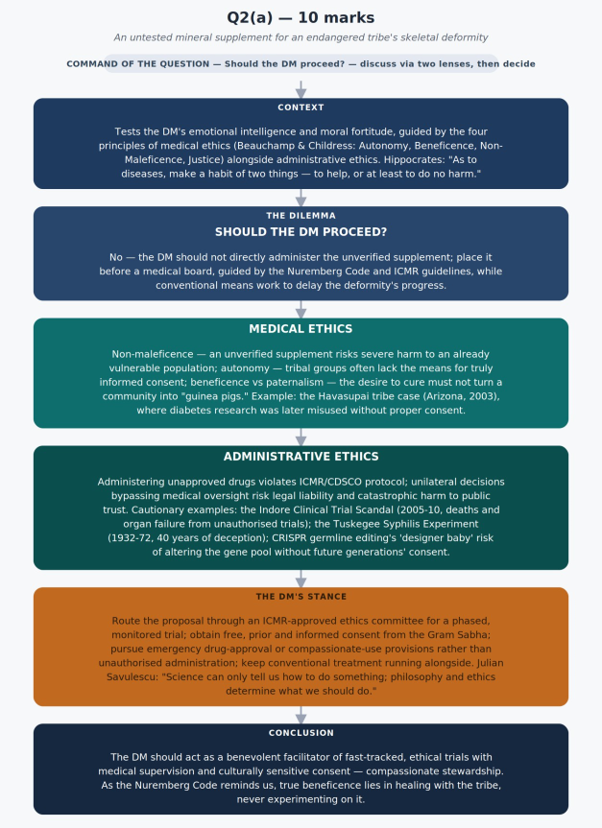
1. Explain the context in brief
2. Then relate and explain the role of the District Magistrate from the perspective of medical and administrative ethics
3. Conclusion with a philosophy or quote
THE CONTEXT (INTRODUCTION)
The given situation in the questions tests emotional intelligence and moral fortitude of District Magistrate that involves a conflict between the urgent need to save an endangered tribe and clinical trials SoP.
The action must be guided by the four principles of medical ethics- Autonomy, Beneficence, Non-Maleficence and Justice (The Four Core Principles of Beauchamp & Childress) on the one hand and administrative ethics on the other-based on code of conduct/ethics(ARC-II).
“As to diseases, make a habit of two things — to help, or at least, to do no harm.” — Hippocrates.
Should the District Magistrate (DM) use this research on the tribe?
-
- No, the DM should not directly administer the unverified mineral supplement as a
- The DM with the help of medical board in the district to delay the skeletal deformity
- The mineral supplement be placed before the medical board and the action must be guided by principles of medical ethics, Nuremberg Code and ICMR guidelines
The reasons why from Medical Ethics and Administrative Ethics perspective:
Medical Ethics:
-
- Non-Maleficence: Deploying unverified research poses severe safety risks, side effects, or toxicity that could further threaten the survival of a vulnerable, endangered population. “Wherever the art of Medicine is loved, there is also a love of Humanity.” — Hippocrates
- Autonomy and Informed Consent: Vulnerable tribal groups often lack the awareness to provide fully informed consent, raising serious concerns regarding human subject
- Beneficence vs. Paternalism: The desire to cure must not degenerate into administrative overreach or using a marginal community as “guinea pigs.”
Example: The Havasupai tribe case (Arizona, 2003), where diabetes research was later misused without proper consent, shows how easily vulnerable, endangered communities become subjects rather than partners.
The Nuremberg Code holds that “voluntary consent of the human subject is absolutely essential”
EXAMPLES
-
- The Indore Clinical Trial Scandal (2005–2010): Clinical trials were conducted on thousands of vulnerable patients at MY Hospital. Dozens of trial participants died during these unauthorized trials, while hundreds suffered severe, long-term health complications, including organ failure, chronic internal bleeding, and neurological damage.
- CRISPR and Heritable Human Genome Editing: The ability to alter DNA in human embryos using technologies like CRISPR-Cas9 creates a tension between preventing devastating genetic diseases and stepping onto a “designer baby” slippery slope. Modifying germline cells alters the gene pool for future generations without their consent.
- The Tuskegee Syphilis Experiment (1932–1972): 40-year study syphilis in nearly 400 impoverished Black sharecroppers in Alabama. Researchers actively deceived the men, telling them they were being treated for “bad blood” when they were actually given placebos. Dozens of participants died, many wives contracted the disease, and children were born with congenital syphilis.
Administrative Ethics:
-
- Rule of Law and Due Process: Administering unapproved drugs violates statutory protocol (ICMR guidelines and CDSCO approvals).
- Accountability: Unilateral administrative decisions bypassing medical oversight risk legal liability and catastrophic harm to public trust.
ANALYSIS
The DM should route the proposal through an ICMR-approved ethics committee for a phased, monitored trial, obtain free, prior and informed consent from the Gram Sabha, and pursue emergency drug-approval or compassionate-use provisions rather than unauthorised administration, while arranging conventional treatment alongside so refusal does not mean abandonment.
“Science can only tell us how to do something; philosophy and ethics determine what we should do.” — Julian Savulescu
CONCLUSION
The DM should act as a benevolent facilitator to initiate fast-tracked, ethical clinical trials with medical supervision and culturally sensitive informed consent, upholding the principle of compassionate stewardship.
As the Nuremberg Code reminds us, good intentions can never substitute for consent — true beneficence lies in healing with the tribe, never experimenting on it.
Spread the Word