ANS.
STRUCTURE
1. Explain the context in brief
2. Then relate and explain administrative officer ethical challenges
3. How to overcome
4. Conclusion with a philosophy or quote
THE CONTEXT (INTRODUCTION)
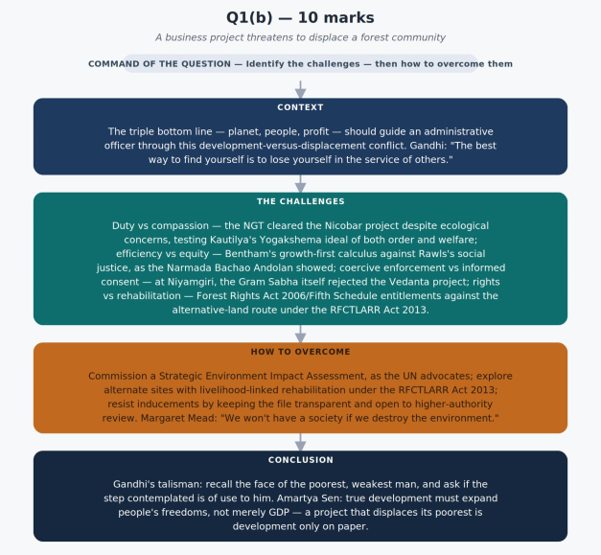
The triple bottom line -planet, people and profit should work as the guiding principle being an administrative officer to play the role of environmental stewardship and get through the challenges.
“The best way to find yourself is to lose in service of others”-Gandhi.
BODY
Development-environment conflict in the given situation poses following ethical challenges:
-
- Duty vs. Compassion: One is bound to enforce law as administrative officer but at the same time the state is supposed to be compassionate-Yogakshema of Kautilya-the go ahead of Nicobar Project by NGT.
- Efficiency vs. equity: Ease of doing business and its profit motive is to be protected for the sake of growth-Bentham’s GGGN but then state also has welfare commitment-John Rawls’ social justice-the issue highlighted by Narmada Bachau Andolan.
- Good governance vs. ethical governance: Adopting outcome driven approach on the one hand and rightness of action on the other-the recent stay by SC on Aravalli case.
- Coercive enforcement of law vs. informed consent: The case related to Niyamgiri Hills, in which thee Gram Sabha rejected approval of Vedant project.
- Rights alternative: The forest community has right under the Forest Rights Act 2006 and the Fifth Schedule and the alternative land for rehabilitation or dislocation-as will happen in case of Nicobar Project.
- De-growth/deep ecology vs. growth/anthropocentricism: Whether to adopt life as per the nature or follow growth with the least destruction and dislocation.
Since it is a case of conflict between development and environment, there exists past judicial precedents and administrative interventions in resolutions of the ethical challenges:
1. Strategic Environment Impact Assessment advocated by UNs
2. Exploring alternate sites to ensure livelihood-linked rehabilitation under the RFCTLARR Act 2013
3. Resist inducements by keeping the file transparent and open to higher-authority
“We won’t has society if we destroy the environment”-Margaret Mead
CONCLUSION:
Gandhi’s talisman remains the surest test, ‘recall the face of the poorest, weakest man, and ask if the step contemplated will be of use to him’. As Amartya Sen reminds us, true development must expand people’s freedoms, not merely GDP-a project that displaces its poorest is development only on paper.
Spread the Word