Introduction:
The intense heat in the Earth’s interior is a powerful source of clean energy called geothermal energy. The National Policy on Geothermal Energy aims to harness this potential. It seeks to make geothermal energy a key part of the nation’s renewable energy story as India drives towards Net Zero by 2070. The recent commissioning of the first two geothermal wells at Puga Valley, Ladakh by ONGC Energy Centre marks the beginning of this journe
Understanding Geothermal Energy:
-
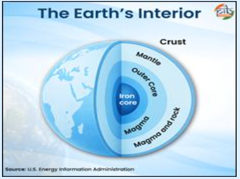
- The Earth’s interior crust, mantle, outer core and inner core grow hotter with depth, driven by radioactive decay of elements like uranium, thorium and potassium plus residual heat from planetary formation. This heat drives mantle convection, which in turn causes tectonic activity.
- In geologically active zones faults let hot water and steam rise close to the surface. Thus, forming reservoirs that can be tapped as geothermal energy through deep wells that bring steam up to drive turbines much like conventional thermal plants but without fuel combustion.
Why is Geothermal Energy Different?
| Energy source | Major characteristic | Key limitation |
|---|---|---|
| Solar | Abundant and scalable | Daylight/weather dependent |
| Wind | Low-carbon electricity | Variable and location dependent |
| Hydropower | Flexible renewable power | Ecological and geographical constraints |
| Geothermal | Firm, weather-independent energy | Site-specific and drilling intensive |
India’s Geothermal Resource Base:
-
- The Geological Survey of India (GSI) has mapped 381 hot springs since 1973 and identified 10 geothermal provinces including the Himalayan Geothermal Province, Naga-Lusai, Andaman & Nicobar, SONATA, West Coast, Cambay Graben, Aravalli, Mahanadi, Godavari and South Indian Cratonic regions of which 42 sites are recognised as promising.
National Policy on Geothermal Energy (2025):
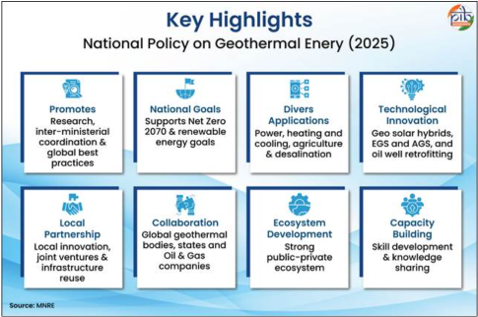
It provides a sequential roadmap and permits 100% FDI offers fiscal incentives (tax holidays, import-duty/GST exemptions, viability gap funding) and encourages repurposing of abandoned oil and gas wells and joint ventures with the oil & gas sector.
Ongoing Pilot Project:
| Project | Current Status |
|---|---|
| i. Ankleshwar, Gujarat | Pilot evaluating power generation via retrofitted oil/gas wells; baseline data completed |
| ii. Gandhinagar, Gujarat | Solar-geothermal hybrid; 3 wells drilled (70–80°C fluid); 50–90 kW generated |
| iii. Tawang, Arunachal Pradesh | Resource assessment underway at 5 sites via field & geochemical studies |
| iv. Hyderabad, Telangana | R&D on geothermal cooling systems for air-conditioning applications |
| v. Shallow Geothermal (Pan-India) | Pilot modelling of Borehole Heat Exchangers for heating/cooling |
Where India Stands Globally:
-
- Global installed geothermal capacity stood at 67 GW by end-2025 with Indonesia, US, Philippines, Türkiye and New Zealand together holding around 67% of it.
- India currently has no major operational geothermal power plant as development remains at the pilot and feasibility stage. Yet the International Energy Agency (IEA) has flagged China, US and India as holding the largest market potential for next-generation (enhanced) geothermal systems together accounting for three-quarters of the global total. Thus, indicating a genuine first-mover opportunity if execution keeps pace with ambition.
Challenges:
i. At approximately Rs 36 crore per MW, geothermal drilling and reservoir assessment costs are significantly higher than solar or wind at equivalent scale.
ii. Geothermal requires drilling before viability is confirmed. A geologically unviable well means sunk investment. Thereby, making financiers and private developers cautious a factor that stalled Cambay Basin ONGC-Talboom joint venture in 2012.
iii. India’s most promising reserves (Puga Valley, Ladakh) sit above 14,000 feet where sub-zero temperatures, thin atmosphere, short working seasons and narrow mountain passes sharply restrict heavy drilling operations and raise logistics costs.
iv. Geothermal fluids carry dissolved silica, hydrogen sulfide and salts that cause corrosion, pipe scaling and mechanical degradation of turbine blades.
v. India lacks large-scale commercial deployment experience and indigenous EGS/AGS technology.
Way Forward:
i. Fast-track the proposed Viability Gap Funding (VGF) scheme, concessional loans through IREDA and other institutions, sovereign green bonds and risk-mitigation grants/loans to lower the effective cost of capital for early-stage drilling.
ii. Explore government or public-sector-backed exploration risk-sharing mechanisms to tackle outcome of drilling success or failure.
iii. Prioritise retrofitting inactive or unproductive oil and gas wells (as at Ankleshwar, Gujarat) to leverage existing drilling data and expertise from ONGC.
iv. Set up the promised geothermal Centres of Excellence and expand the national geothermal data repository (with GSI, CSIR-NGRI, DGH and CGWB) to reduce information asymmetry for investors and shorten project gestation.
Conclusion:
However, 10,600 MW of theoretical potential should not be mistaken for 10,600 MW of economically recoverable electricity. Thus, translating a 10.6 GW (or larger technical) resource base into installed capacity will require overcoming same high-cost, high-risk exploration barriers that have historically kept geothermal on the margins of the global renewable mix even in resource-rich countries.
Spread the Word