Introduction:
Indian farms have grown well over the years. But years of heavy chemical use and erratic rain have tired out the soil. Regenerative agriculture restores soil health. It also builds biodiversity. Sustainable farming just tries to hold conditions steady. Regenerative farming goes further. It tries to improve the land, not just protect it.
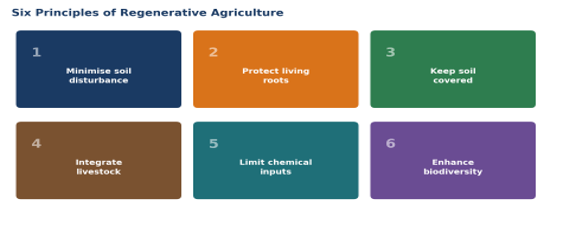
Fig. 1 – The six core principles behind regenerative farming.
Key Practices Used in India:
i. Micro-irrigation: Drip and sprinkler systems send water straight to plant roots. This cuts water waste.
ii. Natural farming: A chemical-free method. It uses farm inputs like Jeevamrut and Beejamrut, made from cow dung and urine.
iii. Green manuring, cover cropping and mulching: These build soil organic matter. They also stop erosion and hold in moisture.
iv. Integrated Farming Systems (IFS): Combines crops, livestock, fisheries and horticulture in one system. This spreads risk and adds income.
v. Agroforestry: Grows trees along with crops. It adds income, stores carbon, and helps in dry areas.
vi. Climate-Resilient Agriculture: Uses balanced fertiliser, better pest control, and smart water use to protect crops from climate shocks.
Key Government Schemes:
i. National Mission on Natural Farming (NMNF, 2024): Gives farmers ₹4,000 per acre per year for two years. As of March 2026, it covers 8.80 lakh hectares and 18.19 lakh farmers, through 18,786 clusters.
ii. Paramparagat Krishi Vikas Yojana (PKVY, 2015): Supports organic farming. Gives ₹31,500 per hectare over three years. It has covered 16.90 lakh hectares so far.
iii. Per Drop More Crop (PDMC, 2015-16): Funds micro-irrigation. Small farmers get 55% subsidy, others get 45%. It covers about 109 lakh hectares. ₹26,325 crore has been released so far.
iv. Rainfed Area Development (RAD, 2014-15): Builds Integrated Farming System clusters of 20 hectares. Farmers get ₹30,000 per family. It has helped 15.73 lakh farmers on 9.53 lakh hectares.
v. Agroforestry Component under PM-RKVY: Funds nurseries for quality saplings. In 2025-26 so far, it set up 135 new nurseries and raised 176.59 lakh saplings.
vi. Soil Health Card Scheme (2015): Gives farmers a soil test report every two years. It checks 12 soil parameters. 25.89 crore cards have been issued so far.
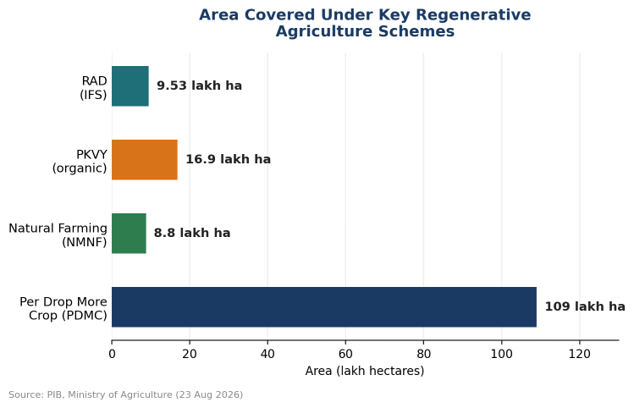
Fig. 2 – Area covered so far under India’s main regenerative farming schemes.
Significance:
-
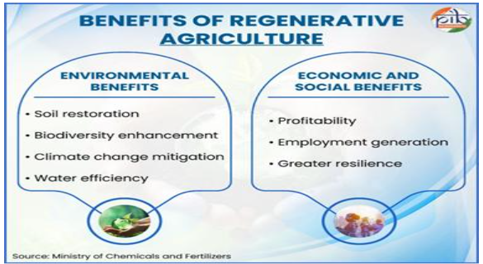
- Better soil means stable yields, even when rain is unpredictable.
- Lower use of chemical inputs cuts farmer costs over time.
- These practices support SDG 13 (Climate Action) by cutting farm-linked emissions.
- Healthier soil holds more water. This means less runoff and cleaner rivers.
- New jobs can grow in advisory services, bio-input production, and eco-farming.
Challenges
-
- ICAR-Indian Institute of Farming Systems Research found large yield drops under natural farming versus regular farming. In their study, wheat yield fell by 59% and basmati rice yield fell by 32%.
- ICRIER report by Ashok Gulati and co-authors (2024) raised concerns about scaling up Zero Budget Natural Farming across India. It flagged risks to farm profits and to national food security if adopted too fast, without enough proof of yield stability.
- ICAR-NAARM study for NITI Aayog noted that most Indian farmers lack proper training in natural farming methods. This has led to low and uneven adoption on the ground.
- Down To Earth (April 2026), based on independent and CAG-style assessments found that Soil Health Card data is used mainly to count cards issued. It is rarely used to guide real fertiliser policy or change how dealers sell inputs to farmers.
- CAG and academic reviews of the Soil Health Card scheme have flagged uneven soil-testing lab capacity, delays between sample collection and card delivery, and low farmer awareness of the recommendations.
- Agricultural economists (cited across NITI Aayog consultations) note that opinion remains split. Some studies, like the one by the Centre for Economic and Social Studies, show gains from natural farming. Others, like the ICAR-IIFSR study, show yield loss. This gap in evidence makes fast, blanket scale-up risky.
Way Forward
-
- ICAR and Krishi Vigyan Kendras should run more long-term, multi-location trials. This will build clear, location-specific evidence on yield and income effects of natural farming.
- Ministry of Agriculture should expand farmer training before expanding area targets. Skilled adoption matters more than fast scale-up.
- State Agriculture Departments should link Soil Health Card data to real fertiliser subsidy rules and dealer regulation, not just track how many cards are issued.
- Government and State Soil Testing Labs should invest in more labs and staff. This can cut delays between sample collection and card delivery.
- NITI Aayog and ICAR should keep publishing balanced, transparent research comparing natural farming with conventional and organic methods. This will help farmers make informed choices.
Conclusion:
Government schemes like NMNF, PKVY, PDMC, RAD and Soil Health Card have already reached lakhs of farmers. But questions remain. Yield data is mixed. Training gaps persist. Soil data is not always used well. Closing these gaps with better research, training and monitoring will help India build farms that are both productive and resilient.,
Spread the Word