Introduction:
India’s Free Trade Agreement (FTA) strategy is entering a new phase from expanding the network of agreements to deepening their utilisation. It highlights rising preferential Certificate of Origin (CoO) issuance, early export gains under new-generation FTAs (UAE, Australia, EFTA, UK, Oman) and government platforms (e-CoO 2.0, Trade Connect) that help exporters convert market access into actual trade, investment and employment in line with India’s Viksit Bharat @2047 vision.
What is a Free Trade Agreement (FTA)?
An FTA is a treaty between two or more countries/blocs to reduce or eliminate tariffs, quotas and other trade barriers on goods and, increasingly, services and investment, granting preferential (not most-favoured-nation) market access to member countries. A related principle is Most-Favoured-Nation (MFN) treatment which is a WTO norm requiring a country to extend equal, non-discriminatory treatment to all trading partners. FTAs are the legal exception to MFN, permitted under GATT Article XXIV and GATS Article V.
India uses a spectrum of trade pacts of varying depth like
-
- Preferential Trade Agreements (PTA, partial tariff concessions)
- Comprehensive Economic Partnership/Cooperation Agreements (CEPA/CECPA, goods + services + investment)
- Economic Cooperation Trade Agreements (ECTA) before graduating to full Comprehensive Economic Cooperation Agreements (CECA).
Key Instruments Driving India’s FTA Utilisation
1. Certificate/Proof of Origin (CoO): Document certifying that goods meet the FTA’s Rules of Origin (RoO), entitling them to preferential duty. Since March 2025, CAROTAR Rules have replaced the term “Certificate” with “Proof” of Origin, tightening verification.
2. CAROTAR, 2020: Customs (Administration of Rules of Origin under Trade Agreements) Rules — require importers to exercise “reasonable care” and furnish origin evidence, mainly to check trans-shipment of Chinese goods via ASEAN.
3. e-CoO 2.0: End-to-end digital issuance platform integrating exporters, issuing agencies and chambers of commerce, using Aadhaar e-signatures and QR-based verification.
4. Trade Connect e-Platform: One-stop portal (with a Tariff Explorer) helping exporters, especially MSMEs, access tariff schedules, trade information and raise CoO-related grievances.
Recent Developments:
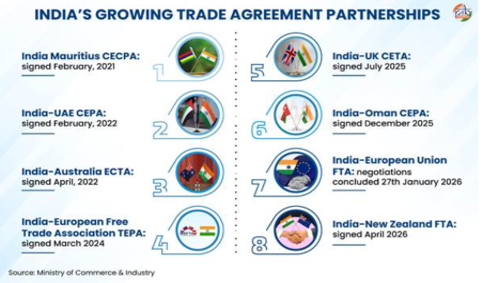
India has moved from a decade-long pause to signing a cluster of new-generation FTAs since 2022, each opening deeper goods, services and mobility access like:-
I. India-UAE CEPA (2022): India’s first full FTA in a decade negotiated in a record 88 days. UAE is India’s largest single FTA export market (US$ 37,359 million in FY 2025-26). Bilateral trade crossed US$ 100 billion in FY 2024-25 with a joint target of US$ 200 billion by 2032.
II. India-Australia ECTA (2022) → CECA under negotiation: India’s first FTA with a developed economy in over a decade. Australia now offers 100% duty-free access to Indian goods. A deeper Comprehensive Economic Cooperation Agreement (CECA) covering services, mobility and digital trade is being negotiated.
III. India-EFTA TEPA (Oct 2025): Covers Switzerland, Norway, Iceland, Liechtenstein & linked to a USD 100 billion investment and 1 million jobs commitment. Generated 7,885 CoOs in its first months includes Mutual Recognition Agreements (MRAs) in nursing, chartered accountancy and architecture.
IV. India-UK CETA (2025): Nearly 99% of Indian exports get duty-free entry. Double Contribution Convention avoids dual social-security payments for mobile professionals, saving an estimated ₹4,000 crore.
V. India-Oman CEPA (2026): Concessions on 98% of Oman’s tariff lines. 783 CoOs issued within the first month of implementation.
VI. India-EU FTA (signed Jan 2026, yet to enter into force): The EU deal is described as the “mother of all trade deals” as it covers 97% of EU tariff lines (~99.5% of bilateral trade value) and 144 services sub-sectors.
VII. India-New Zealand FTA (signed, yet to be effective): New Zealand FTA offers 100% duty-free access and a dedicated 5,000-person mobility quota for Indian professionals.
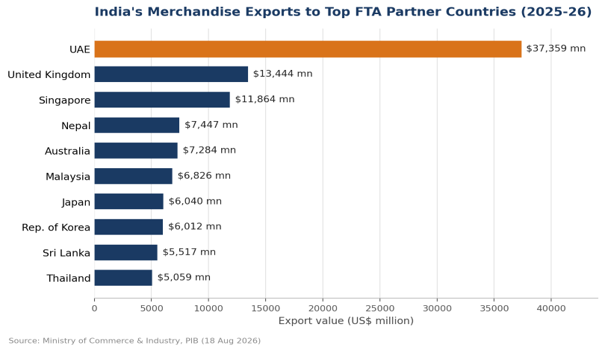
Fig. 1 — India’s merchandise exports to top FTA partners, FY 2025-26. Source: Ministry of Commerce & Industry / PIB.
Implementation Experience:
-
- Overall trade momentum: India’s combined goods + services exports hit a record US$ 863.1 billion in FY 2025-26; April-June FY 2026-27 exports rose 11.37% y-o-y to US$ 232.73 billion.
- Rising CoO issuance: Older FTAs (UAE, Australia) show high-volume origin certification; newer pacts (EFTA, Oman) show early uptake, signalling gradual utilisation deepening.
- Widening tariff-line coverage: Exported tariff lines to UAE rose from 7,546 (2021-22) to 8,053. Mauritius, from 3,593 to 4,345 (+20.9%) showing exporters using FTAs to diversify products, not just volumes.
- Services opening up: Services form ~30% of India’s employment and US$ 421.3 billion of exports (FY 2025-26). FTAs now bundle Mode-4 professional mobility (UK, NZ, EFTA, Oman) with MRAs in nursing, accountancy and architecture.
- Sectoral spread: Preferential access spans labour-intensive sectors i.e. textiles, leather and footwear, marine products, gems and jewellery, processed food, carpets and handicrafts. Thus, widening participation for smaller producers and MSMEs.
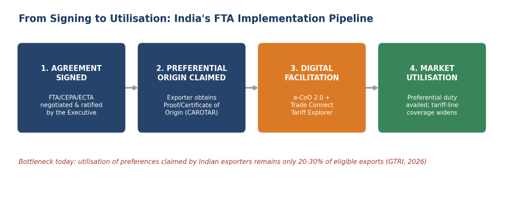
Fig. 2 — India’s FTA implementation pipeline: from signing to actual market utilisation.
Significance
-
- Diversifies India’s export basket away from a handful of destinations, cushioning against demand or tariff shocks in any single market (relevant amid global tariff uncertainty).
- Deepens Mode-4 services access and skilled-worker mobility i.e. a structural gain for an economy where services already outweigh goods in export value.
- Digital facilitation tools (e-CoO 2.0, Trade Connect) extend the benefits of FTAs to MSMEs and first-time exporters, not just large firms.
- Supports India’s broader Viksit Bharat @2047 goal of an export-oriented, globally integrated manufacturing and services base.
Challenges
-
- GTRI (Global Trade Research Initiative), 2026 found that India utilises only 20-30% of eligible exports under its FTA preferences, compared with 60-70% utilisation by partner-country exporters shipping into India. Therefore, reflecting high compliance costs and exporters simply not claiming the preferences negotiated for them.
- NITI Aayog’s Trade Watch recorded India’s exports to FTA partners falling 9% y-o-y even as imports from the same partners rose 10%, pushing the bilateral trade deficit with FTA partners up 59% y-o-y. Thus, suggesting FTAs are for now absorbing more imports than they are generating exports.
- Chief Economic Adviser 2026 publicly flagged that India’s FTA utilisation is “very poor” compared with peer economies. Thereby, pointing to a structural gap between negotiated market access and on-ground industry adoption.
- Observer Research Foundation (ORF) has documented the persistent misuse of Rules of Origin, especially Chinese-origin goods trans-shipped through ASEAN to fraudulently claim AITGA preferences.
- World Bank / OECD Services Trade Restrictiveness Index (STRI) research shows that Mode-4 restrictiveness (visa and mobility barriers) alone can reduce bilateral services exports by roughly 8%, meaning that mobility commitments on paper often under-deliver without matching visa and recognition reforms abroad.
- PRS Legislative Research has flagged that unlike some trading partners with statutory pre-ratification review (like UK’s CRAG Act model), India has no binding requirement for parliamentary scrutiny or ratification of FTAs before they take effect. Thus, limiting legislative oversight of trade concessions and sensitive-sector safeguards.
Way Forward:
-
- GTRI recommendation should operationalise a dedicated FTA Impact Monitoring Authority to track agreement-wise and sector-wise utilisation rates rather than relying only on aggregate trade data.
- Finance Ministry / CBIC should undertake a periodic review of India’s base MFN tariff structure not only FTA-linked duties but to correct the inverted duty structure before signing future deep agreements (India-EU FTA implementation, EFTA follow-through).
- CBIC should build on the 2025 CAROTAR shift to “Proof of Origin” with blockchain- or ledger-based cross-border traceability in coordination with partner customs authorities, to curb third-country trans-shipment without adding compliance burden on genuine exporters.
- Parliament / Department-related Standing Committee on Commerce could consider a structured pre-ratification consultation mechanism for future FTAs to build cross-party consensus on sensitive-sector safeguards.
- Trade Connect and District Export Hubs should scale outreach, multilingual training and handholding for MSME clusters so that first-time exporters can actually claim the preferences already negotiated on their behalf.
Conclusion:
India’s FTA journey is transitioning from a phase of signing agreements to a phase of extracting value from them. However, closing the utilisation gap through tariff rationalisation, origin-verification technology, deeper Mode-4 mobility and MSME outreach will determine whether India’s expanding FTA network truly converts market access into export-led growth on the path to Viksit Bharat @2047.
Spread the Word