Introduction:
India’s defence sector has changed a lot in the last decade. Budgets have grown. Local production has grown even faster. India now exports weapons to over 80 countries. But numbers alone do not tell you if India is truly ‘self-reliant’ in the way Israel, South Korea or the United States are.
The Idea Behind Self-Reliance:
-
- Import substitution model: Just make at home what you used to import. This saves foreign exchange, but if you only copy old designs, you stay a technology generation behind.
- Innovation-and-export model: Build new technology at home, test it on your own battlefield or armed forces, then sell it abroad. Exports force quality and speed, because a paying foreign buyer will not accept delays the way a home ministry sometimes does.
India’s Atmanirbhar Bharat push in defence started mostly as import substitution (positive indigenisation lists, DPSU-led production). It is now trying to shift toward the innovation-and-export model through iDEX, private-sector growth and rising exports.
Key Terms
-
- Atmanirbhar Bharat: The government’s push for self-reliance, including in defence manufacturing.
- DPSU (Defence Public Sector Undertaking): A government-owned company that makes defence goods, like HAL or BEL.
- Acceptance of Necessity (AoN): The first formal approval given before India buys or builds a defence system.
- Indigenous content: The share of a weapon or platform that is designed and built within India.
- Offset policy: A rule that makes a foreign seller invest part of the deal value back into the buyer’s domestic industry. Countries use this to force technology transfer.
Rising Investment in Defence
-
- Defence budget: Grew 3.1 times, from ₹2.53 lakh crore in 2013-14 to ₹7.85 lakh crore in 2026-27.
- Capital expenditure: Grew 2.3 times, from ₹94,587.95 crore in 2014-15 to ₹2.19 lakh crore in 2026-27. This money buys new equipment and builds new capacity.
- Defence production: Hit a record ₹1.78 lakh crore in 2025-26. DPSUs made 76% of this. Private firms made 24%.
- Defence exports: Grew 56 times, from ₹686 crore in 2013-14 to ₹38,424 crore in 2025-26 (about US$4.4 billion). Sales now reach over 80 countries.
- Targets: ₹3 lakh crore in yearly production and ₹50,000 crore in exports by 2029.
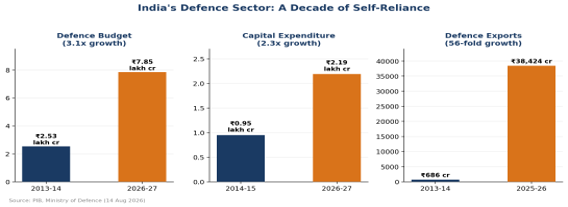
Fig. 1 – India’s defence budget, capital spending and exports have all grown fast.
Reforms Driving the Ecosystem
-
- Defence Acquisition Council (DAC): India’s top defence buying body. It has cleared over ₹6 lakh crore worth of Indian-designed, Indian-made systems.
- Key approvals: 97 Tejas Mk-1A jets (₹62,000 crore) and 156 LCH Prachand helicopters (₹62,700 crore).
- Procurement reforms: DPP 2016, then DAP 2020, then the Defence Procurement Manual 2025. Each round made buying faster and more friendly to Indian-made goods. The draft DAP 2026 proposes indigenous content of up to 60%.
- Innovation funds: iDEX has backed 676 startups and signed 551 contracts. ADITI and the Technology Development Fund (TDF) give extra grants for new defence tech.
- Tech transfer: DRDO has signed 2,180 technology transfer deals and opened over 2,780 patents for industry use.
- Vendor network: The Srijan-DEEP portal lists over 41,000 vendors and 2.7 lakh products, helping buyers find Indian suppliers.
- Easier business rules: Industrial licences now last up to 18 years. FDI limits rose to 74% (automatic route) and up to 100% (government route).
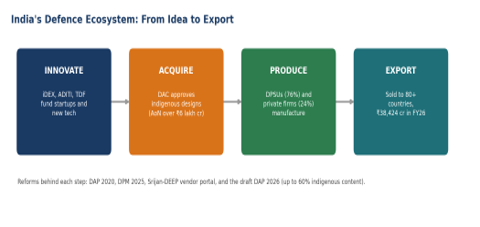
Fig. 2 – How an idea moves from innovation to a finished, exported defence product.
Recent Platform Milestones
-
- Army: About 91% self-sufficient in ammunition, with 159 of 175 variants now made in India.
- Missiles: Agni-4 and Agni-5 tested. Kusha air defence missile and VSHORADS under development. A scramjet combustor ground test supports future hypersonic missiles.
- Navy: 12 warships and submarines commissioned, including INS Surat and INS Vaghsheer. INS Mahendragiri has over 75% indigenous content.
How Other Countries Built Defence Power
| Country | Export Share (SIPRI 2021-25) | Signature Strategy | Still Depends On |
|---|---|---|---|
| USA | 42% (world's largest exporter) | Full-spectrum R&D, alliance-based sales, dominates every category | Almost nowhere; sets the technology frontier |
| France | 9.8% (2nd largest exporter) | State-backed champions like Dassault and Naval Group; strong Asia/Gulf sales | Very low dependency |
| Russia | ~6.8%, declining share | Cheap, rugged legacy platforms and easy financing/licensing deals | Sanctions since 2022 have hurt its own supply chains |
| Israel | High exports relative to its small size | Tight loop between military, startups and industry; sells combat-tested systems fast | Some high-end components and funding from the US |
| South Korea | Rising fast, targeting US$47.1 billion in exports in 2026 | Builds and exports platforms (K9, KF-21) even before full self-sufficiency; speed over perfection | 86% of its own arms imports come from the US; jet engines still foreign |
| China | Large, state-directed producer; steady exporter mainly to Asia/Africa | Mass domestic production, reverse engineering plus own R&D, low-cost bundled deals | Historically leaned on Russia for aircraft engines; improving |
| India | 8.2% of world arms IMPORTS (still the world's 2nd largest importer) | Policy-led reforms (Atmanirbhar Bharat); DPSU-led base now widening to private firms | Fighter jet engines, key sensors, submarine propulsion tech |
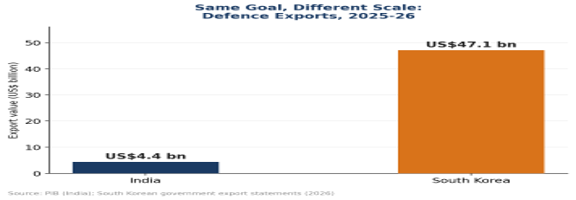
Fig. 3 – India and South Korea both chase self-reliance, but South Korea already exports about 10 times more.
What This Comparison Really Teaches
-
- Full self-sufficiency is a myth even for leaders: South Korea exports fighter jets that still use American General Electric engines. It did not wait for 100% indigenisation before entering the export market.
- Speed and export-first thinking matter more than perfection: South Korea’s defence analysts say its edge comes from a faster development cycle, not from having zero foreign parts.
- Israel shows the power of a tight loop: Its military, tech startups and defence firms work in one connected cycle, so battlefield lessons become new products quickly. India’s iDEX is trying to copy this model, but it is still young.
- India’s gap is less about ambition and more about a chosen few bottlenecks: Fighter engines, submarine propulsion, and advanced sensors are the recurring weak points, not the whole ecosystem. A targeted fix here would move India’s ranking fast.
Challenges
-
- Parliamentary Standing Committee on Defence (report submitted in 2025) asked the Ministry to push HAL to speed up Tejas Mk-1A production. Thus warning that India’s fighter squadron strength has been falling as older jets retire.
- Reports on the Tejas Mk-1A radar note that HAL used an Israeli radar instead of the DRDO-built Uttam radar in some jets. Since Indian radar was not ready in time. This lowered the aircraft’s indigenous content below the original plan.
- Parliamentary Committee on Public Undertakings (March 2025) criticised HAL for deep operational problems, pointing to both Tejas delays and the grounding of the Dhruv helicopter fleet after safety concerns.
- SIPRI’s 2026 arms transfer report found that India remains the world’s second-largest arms importer, at 8.2% of global arms imports between 2021 and 2025. Russia still supplies about 40% of India’s arms imports, with France and Israel next.
- Cross-country comparison shows that even fast-rising exporters like South Korea remain heavily import-dependent on a few critical items, like jet engines. This tells us India’s engine gap is a known, solvable bottleneck, not a sign that self-reliance itself has failed.
Way Forward
-
- Ministry of Defence and HAL should fix the production bottlenecks flagged by two separate parliamentary committees, especially around engine supply and testing timelines, before taking on new big-ticket projects.
- DRDO and Air Force should set clearer timelines for critical parts like the Uttam radar, so future jets do not need last-minute foreign substitutes that cut indigenous content.
- DRDO and MSMEs, learning from Israel’s model should deepen the innovation loop started by iDEX, so that battlefield feedback from the forces reaches startups and industry faster, turning field problems into new Indian products.
- Ministry of Defence should track and publish yearly progress against the SIPRI import share, alongside its own production and export data, for a fuller and more honest public picture of self-reliance.
- DAC and Ministry should keep simplifying acquisition rules under the coming DAP 2026, so private firms and startups can compete for bigger contracts, not just component supply.
Conclusion:
India’s defence sector has grown stronger. However, India’s story looks less like a finished success and more like a country still mid-journey because ahead of where it was a decade ago, but still behind export leaders like US, France and even South Korea. It still dependent on foreign engines and sensors for its most advanced platforms. Fixing a few known bottlenecks and exporting earlier and faster will matter more than chasing a indigenous platform on India’s path to Viksit Bharat by 2047.
Spread the Word