TOPIC-1: RBI’s USD-INR Forex Swap Facility
-
- GS Paper 3 (Indian Economy — Monetary Policy, Reserve Bank of India, External Sector & Forex Reserves, Foreign Currency Non-Resident (B) Deposits, and External Commercial Borrowings).
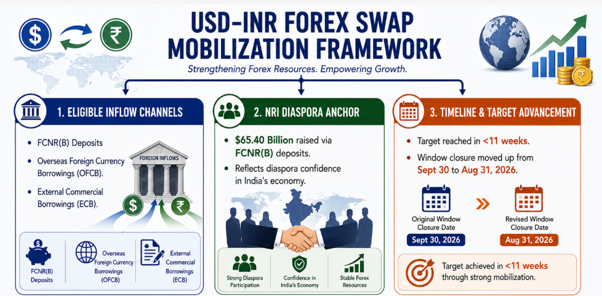
Context: The Reserve Bank of India’s (RBI) special USD-INR forex swap facility launched on June 8, 2026 generated US $73 billion in under eleven weeks (as of August 21, 2026). Non-Resident Indian (NRI) contributions through FCNR(B) deposits accounted for US $65.40 billion of the total mobilization.
Key Impact
-
- Reached US $73 billion within 11 weeks of its launch on June 8, 2026.
- Outperformed the 2013 FCNR(B) swap scheme, which mobilized ~$26 billion over a three-month window.
- FCNR(B) Deposits Share Contributed US $65.40 billion (~89.5% of total inflows), demonstrating strong engagement from the Indian diaspora.
- Builds up long-term foreign currency reserves, insulating the rupee against external financial shocks.
- Given the swift mobilization, the RBI moved the closing date for the FCNR(B) swap window from September 30, 2026, to August 31, 2026.
UPSC Quick Reference Table
| Feature | Detailed Specification |
| Nodal Regulator | Reserve Bank of India (RBI) / Ministry of Finance |
| Launch Date | June 8, 2026 |
| Total Funds Mobilized | US $73 Billion (as of August 21, 2026) |
| FCNR(B) Contribution | US $65.40 Billion |
| Inflow Channels | FCNR(B) deposits, OFCBs, and ECBs |
| Historical Baseline | 2013 FCNR(B) Swap Facility ($26 Billion raised) |
| Revised Closure Date | August 31, 2026 (Advanced from September 30) |
Conclusion:
The mobilization of US $73 billion under the RBI’s USD-INR forex swap facility highlights strong diaspora participation and external interest in India’s banking system by accumulating long-term foreign currency deposits. The facility strengthens national foreign exchange reserves, stabilizes currency environment, and builds external shock absorbers for the Indian economy.
TOPIC-2: Launch of India’s First Non-GMO High-Expansion Popcorn Maize Hybrid Seed
-
- GS Paper 2 (Government Policies & Interventions for Development; State-level Agricultural Initiatives)
- GS Paper 3 (Agricultural Technology, Indigenous Seed Innovations, Food Processing, & Import Substitution / Aatmanirbhar Bharat).
Context: Vice-President Shri C. P. Radhakrishnan launched India’s first non-GMO, high-expansion popcorn maize hybrid seed at Musunuru in Eluru district, Andhra Pradesh. Developed in collaboration with Gourmet Popcornica and local farming communities. The indigenous hybrid seed marks a step toward achieving Aatmanirbhar Bharat in the niche agricultural processing sector.
Key Highlights
-
- Replaces long-standing reliance on imported hybrid seed technology for high-quality popcorn maize.
- Helps conserve foreign exchange reserves while promoting indigenous seed research and development.
- Engages over 17,500 farmers cultivating ~40,000 acres across eight states.
- Aligns with central initiatives such as PM-KISAN, PM Fasal Bima Yojana, National Food Security and Nutrition Mission, and Namo Drone Didi.
- Complements state-level initiatives in Andhra Pradesh, including Rythu Bazaars, natural farming promotion, and horticulture support systems.
UPSC Quick Reference Table
| Feature | Detailed Specification |
| Nodal Event & Location | Musunuru, Eluru district, Andhra Pradesh |
| Unveiling Dignitary | Vice-President Shri C. P. Radhakrishnan |
| Core Innovation | India’s first non-GMO high-expansion popcorn maize hybrid seed |
| Industry Partner | Gourmet Popcornica |
| Farm Scale Footprint | 17,500+ farmers across 40,000 acres in 8 States |
| Economic Objective | Import substitution, seed indigenization, and export promotion |
Conclusion:
The development and launch of an indigenous, non-GMO popcorn maize hybrid seed demonstrate the role of enterprise-farmer partnerships in agricultural value addition. Reducing reliance on imported seed technology strengthens domestic food processing capabilities, improves farmer incomes, and supports agricultural self-reliance.
TOPIC-3: India-Japan Investment Partnership
-
- GS Paper 2 (Bilateral, Regional, and Global Groupings and Agreements involving India and/or affecting India’s Interests)
- GS Paper 3 (Indian Economy — Foreign Direct Investment, Capital Markets, GIFT City, Supply Chain Integration, and Infrastructure Financing).
Introduction: Union Minister of Commerce and Industry Shri Piyush Goyal held discussions in Tokyo with senior leaders of major Japanese financial and investment institutions. The meeting aimed to strengthen long-term capital flows, expand Japanese institutional investments and advance bilateral target of mobilizing 10 trillion yen of Japanese private investment into India over the next decade.
Key Highlights
-
- Investor Engagements & Industry Footprint:
- MUFG: Highlighted its investment of ~USD 4 billion in Shriram Finance and expanded focus on renewable energy and green hydrogen.
- Development Bank of Japan (DBJ): Outlined its dedicated India strategy targeting property development, venture capital, and long-term asset funding.
- Mizuho & Morgan Stanley: Emphasized operational expansions, including Mizuho’s Global Capability Centre in Pune and Morgan Stanley’s capital market operations employing over 19,000 professionals in India.
- Nomura & Nippon Life: Highlighted technology capital allocation in AI/cybersecurity and the performance of “patient capital” via strong returns from Indian operations.
- Facilitating Ease of Investment & Regulatory Ease:
- Addressed investor feedback regarding simplified processes for profit repatriation, easier access to domestic capital markets, and long-term regulatory predictability.
- Positioned GIFT City (Gujarat International Finance Tec-City) as an international financial gateway to streamline cross-border capital flows between Japan and India.
- Investor Engagements & Industry Footprint:
UPSC Quick Reference Table
| Feature | Detailed Specification |
| Nodal Ministry | Ministry of Commerce and Industry |
| Location of Summit | Tokyo, Japan |
| Bilateral Investment Goal | 10 Trillion Yen in Japanese private investments over the next decade |
| Key Institutions Attending | MUFG, DBJ, Mizuho, Morgan Stanley, Nomura, Nippon Life |
| Target Frontier Sectors | Semiconductors, AI, Renewable Energy, Green Hydrogen, Data Centres |
| Offshore Financial Hub | GIFT City (Gujarat) featured as a cross-border capital platform |
Conclusion:
Engagements with Japanese financial leaders reflect growing institutional interest in India’s long-term economic prospects. Simplifying profit repatriation norms, utilizing GIFT City as an international capital hub, and channeling investment into deep-tech and green energy support the target of mobilizing 10 trillion yen while integrating India into global supply chains.
TOPIC-4: 2nd India-New Zealand Defence Strategic Dialogue
-
- GS Paper 2 (Bilateral, Regional, and Global Groupings involving India — Strategic Partnerships; Free, Open, and Inclusive Indo-Pacific)
- GS Paper 3 (Defense Cooperation, Joint Military Exercises, and Maritime Security).
Context: The second edition of the Defence Strategic Dialogue between India and New Zealand was held in Wellington focused on advancing maritime security, expanding joint military training, and operationalizing the newly elevated Strategic Partnership.
Strategic Pillars
-
- Advanced the strategic objectives established under the newly elevated India-New Zealand Strategic Partnership Roadmap 2030 following last month’s summit-level talks.
- Reaffirmed commitment to maintaining a free, open, and inclusive Indo-Pacific region.
- Explored options to expand tri-service military-to-military engagement across land, air, and maritime forces.
- Emphasized cross-service personnel exchanges, joint training exercises, and institutional partnerships between defence staff colleges.
- Focused on sharing insights on joint capital procurement processes, matching operational frameworks, and coordinating upcoming engagements.
UPSC Quick Reference Table
| Feature | Detailed Specification |
| Nodal Ministries | Ministry of Defence (India) & Ministry of Defence (New Zealand) |
| Event & Location | 2nd Defence Strategic Dialogue, Wellington, New Zealand |
| Co-Chairs | Shri Amitabh Prasad (JS, MoD India) & Mr. Richard Schmidt (Deputy Secretary, NZ MoD) |
| Guiding Framework | India-New Zealand Strategic Partnership Roadmap 2030 |
| Key Focus Areas | Maritime Security, Staff College Exchanges, Procurement Insights, & Joint Training |
| Regional Commitment | Free, Open, and Inclusive Indo-Pacific |
Conclusion:
The 2nd India-New Zealand Defence Strategic Dialogue underlines the operationalization of the Strategic Partnership Roadmap 2030. Strengthening joint military training, staff college exchanges, procurement alignment, and maritime security ties supports India’s broader security footprint across the Indo-Pacific.
TOPIC-5: NITI Aayog’s Report on “Reimagining Skilling for Viksit Bharat@2047”
-
- GS Paper 2 (Government Policies and Interventions for Development; Issues Relating to Development and Management of Social Sector/Services relating to Education, Human Resources)
- GS Paper 3 (Indian Economy and Issues Relating to Employment, Growth, Development, and Skill Indigenization).
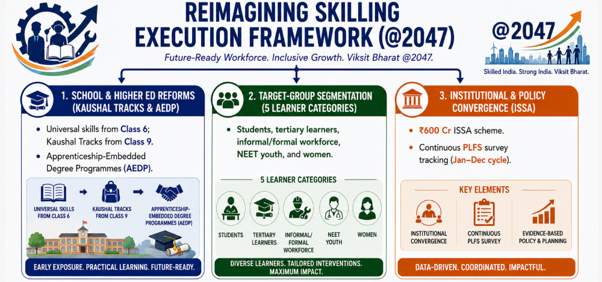
Introduction: NITI Aayog released a landmark report titled “Reimagining Skilling for Viksit Bharat@2047”, establishing an integrated blueprint to overhaul India’s skilling, education, and employment ecosystem. Government announced the ₹600 crore Integrated Scheme in Skilling Architecture (ISSA) under the Union Budget 2026–27 to drive convergence across education, skilling, and lifelong learning.
Strategic Development
-
- Qualification Mismatch: Flags that only 8.25% of graduates currently work in jobs aligned with their qualifications, highlighting a critical need for practical, industry-integrated curricula.
- Heavy Traditional Enrolments: Over 2 crore students are enrolled in generic BA, B.Sc., and B.Com degrees, often relying on formal qualifications primarily for government job eligibility rather than technical employability.
Categorization of NEET Youth:
-
- Identifies 5 learner segments: schooling youth, tertiary learners, formal/informal workers, NEET youth (15–29 years), and women.
- Clarifies that the 8.7 crore NEET figure—derived from the COVID-era NSS 78th Round (FY 2020–21)—includes domestic duties, voluntary work, and health-related inactivity, and is not synonymous with unemployment. Recent Periodic Labour Force Surveys (PLFS 2025) indicate significantly lower NEET percentages.
Major Policy Recommendations by NITI Aayog:
-
- School Curriculum Integration: Universalize General Employability & Entrepreneurship Skills for Classes 6–12, and introduce specialized vocational “Kaushal Tracks” starting from Class 9.
- Apprenticeship-Embedded Degrees (AEDP): Shift generic degree programs toward applied, work-integrated degrees (e.g., B.Com Analytics, B.A. Hospitality) and scale up MSME apprenticeship incentives.
- Flexible & Modular Learning: Implement modular, hybrid, and “earn-while-you-learn” models utilizing the National Credit Framework and a Digital Skills Passport.
- Outcome-Based Metrics: Transition skilling evaluations from training completion numbers to verified, outcome-linked employment placements.
UPSC Quick Reference Table
| Feature | Detailed Specification |
| Publishing Body | NITI Aayog (Skill Development, Labour and Employment Division) |
| Report Title | “Reimagining Skilling for Viksit Bharat@2047” |
| Key Precursor Scheme | Integrated Scheme in Skilling Architecture (ISSA) (₹600 Crore allocation) |
| NEET Definition | Youth Not in Education, Employment, or Training (Aged 15–29) |
| School Initiative | Kaushal Tracks (Vocational specialization from Class 9 onwards) |
| Core Higher Ed Reform | Apprenticeship-Embedded Degree Programmes (AEDP) & Applied Degrees |
| Survey Modernization | Annual PLFS shifted to a January–December calendar year tracking cycle |
Conclusion:
NITI Aayog’s Reimagining Skilling for Viksit Bharat@2047 report outlines a transition from generic education to outcome-linked, industry-aligned skilling will help bridge the gap between education and employment, creating a future-ready workforce for 2047.
Spread the Word