Introduction:
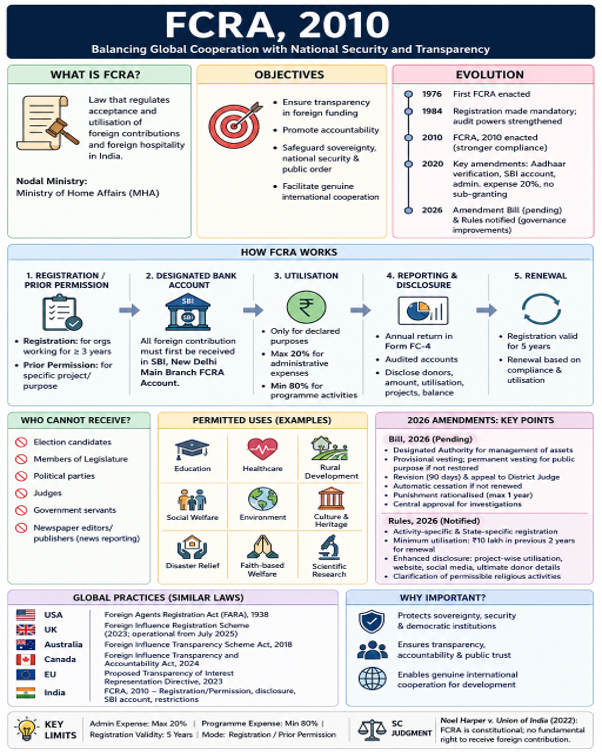
The Foreign Contribution (Regulation) Act (FCRA) provides India’s legal framework to facilitate genuine international cooperation while regulating foreign contributions in the national interest.
Key Highlights
-
- FCRA, 2010 regulates the acceptance and utilisation of foreign contributions and foreign hospitality in India.
- Administered by the Ministry of Home Affairs (MHA).
- Requires registration or prior permission before receiving foreign contributions.
- Mandates designated banking channels, annual disclosures and audited reporting.
- Regulates foreign contributions that may affect sovereignty, integrity, security of the State, public order or democratic institutions.
- The FCRA (Amendment) Bill, 2026 is under consideration of Parliament, while the FCRA Rules, 2026 have already been notified.
What is Foreign Contribution?
A foreign contribution refers to any donation, delivery or transfer of money, securities or articles received from a foreign source by an individual, association, trust, NGO or company to support developmental activities such as education, healthcare, disaster relief, environmental conservation, etc.
What is the Foreign Contribution (Regulation) Act (FCRA)?
The Foreign Contribution (Regulation) Act (FCRA), 2010 is the principal legislation governing how Indian individuals and organisations may receive and utilise foreign contributions. The Act seeks to ensure that foreign funding:
-
- is received only by eligible persons,
- is utilised for the declared lawful purposes,
- remains fully traceable through proper accounting and disclosure, and
- does not adversely affect India’s sovereignty, democratic institutions, national security or public order.
Objectives of FCRA
-
- To ensure transparency in foreign funding.
- To promote accountability.
- To safeguard sovereignty and national security.
- To facilitate genuine international cooperation.
Evolution of FCRA
| Year | MAJOR DEVELOPMENT |
|---|---|
| 1976 | First Foreign Contribution (Regulation) Act enacted to regulate acceptance and utilisation of foreign contributions and foreign hospitality. |
| 1984 | Registration with the Home Ministry made mandatory for NGOs receiving foreign funds, audit powers strengthened and definitions expanded. |
| 2010 | FCRA, 2010 replaced the 1976 Act with stronger compliance provisions, mandatory five-year renewal, suspension and cancellation mechanisms. |
| 2011 | FCRA Rules notified to operationalise registration, designated bank accounts and reporting procedures. |
| 2020 | Major amendments introduced Aadhaar/passport verification, mandatory SBI New Delhi account, prohibition on sub-granting, reduction of administrative expenditure limit from 50% to 20%, and stricter renewal provisions. |
| 2022 | Threshold for reporting foreign contributions from relatives increased from ₹1 lakh to ₹10 lakh; provisions for compounding certain offences introduced. |
| 2026 | Proposed Amendment Bill and notified Rules seek to improve governance, provide clarity regarding asset management, introduce activity- and State-specific registration, and strengthen disclosure requirements. |
Five Pillars of India’s FCRA Framework
1. Every sovereign State has the legitimate authority to regulate cross-border financial flows entering its domestic institutions.
2. The Act does not prohibit foreign contributions. Instead, it establishes a system of registration, disclosure and regulatory oversight, allowing legitimate organisations to continue receiving foreign funding within a transparent legal framework.
3. Democratic Accountability i.e Parliament and regulatory authorities to assess whether foreign contributions are being utilised for their declared purposes.
4. The Act recognises that covert foreign financing of advocacy, lobbying or political activity may pose risks to democratic institutions and national security, warranting an appropriate regulatory framework.
5. India’s approach is presented as consistent with the broader international trend of introducing foreign funding transparency and disclosure laws across major democracies rather than as an exceptional regulatory framework.
Features of FCRA ACT
1. FCRA Registration available to organisations that have been actively functioning for at least three years.
2. Prior Permission is intended for organisations that are not eligible for regular registration or require foreign contribution for a specific project or purpose. For large foreign contributions released in instalments, 75% of each instalment must be utilised and verified before the next instalment is released.
3. Every foreign contribution must first be received in the designated State Bank of India (SBI), New Delhi Main Branch FCRA Account.
4. The Act requires that foreign contributions be utilised strictly for the purposes declared at the time of registration or prior permission. Administrative expenditure cannot exceed 20% of the annual foreign contribution & at least 80% of the contribution must be utilised for programme and developmental activities.
5. Every registered organisation must file an annual return (Form FC-4) through the online FCRA portal & FCRA registration remains valid for five years.
| CANNOT RECEIVE FOREIGN CONTRIBUTION | CAN RECEIVE FOREIGN CONTRIBUTION |
|---|---|
| • Election candidates • Members of Legislature • Political parties • Judges • Government servants • Newspaper editors and publishers engaged in news reporting | • Education • Healthcare • Rural Development • Social Welfare • Environment • Culture & Heritage • Disaster Relief & Rehabilitation • Faith-based Welfare Activities • Scientific Research |
Need for the 2026 Amendments
The FCRA (Amendment) Bill, 2026 and the FCRA (Amendment) Rules, 2026 seek to address operational gaps that emerged during the implementation of the Act over the last decade. The changes are primarily administrative and governance-oriented, focusing on improving clarity, transparency, accountability and regulatory efficiency, rather than altering the fundamental objectives of the FCRA.
Features of FCRA (Amendment) Bill, 2026 (Pending in Parliament)
1. Bill proposes the creation of a Designated Authority to manage foreign contribution assets when an organisation’s registration lapses, is cancelled or surrendered. The Designated Authority is legally required to preserve the religious character of any place of worship.
2. Permanent vesting will occur only if the organisation fails to restore its registration within the prescribed period & assets will then be utilised for public purposes, while proceeds from any sale will be credited to the Consolidated Fund of India.
3. Organisations aggrieved by the orders of the Designated Authority may seek revision within 90 days, and file an appeal before the District Judge. This introduces an explicit statutory mechanism for judicial oversight.
4. The Bill proposes to reduce the maximum imprisonment for FCRA violations from five years to one year.
5. State Governments and investigating agencies will require prior approval of the Central Government before initiating investigations under the FCRA. The objective is to avoid parallel or conflicting proceedings under a Central law.
Comparative analysis
| Country | Law | Major Feature |
|---|---|---|
| United States | Foreign Agents Registration Act (FARA), 1938 | Registration and public disclosure for persons acting on behalf of foreign principals in political or lobbying activities. |
| Australia | Foreign Influence Transparency Scheme Act, 2018 | Mandatory registration for activities undertaken on behalf of foreign principals to influence government or political processes. |
| United Kingdom | Foreign Influence Registration Scheme (FIRS), National Security Act, 2023 | Two-tier registration mechanism for foreign political influence arrangements, operational from 1 July 2025. |
| Canada | Foreign Influence Transparency and Accountability Act, 2024 | Public registry of arrangements with foreign principals intended to influence political or governmental processes. |
| European Union | Proposed Transparency of Interest Representation Directive (2023) | Proposal for transparency registers across EU member States regarding lobbying on behalf of third countries. |
| India | Foreign Contribution (Regulation) Act, 2010 | Registration or prior permission, designated bank account, annual disclosure, regulation of foreign contributions and specified restrictions. |
Thus, recent developments indicate that democracies are moving towards stronger foreign influence transparency frameworks rather than deregulation. For examples,
-
-
- UK’s Foreign Influence Registration Scheme becoming operational in 2025.
- Canada’s Foreign Influence Transparency and Accountability Act enacted in 2024.
- European Union’s proposed transparency framework for foreign influence.
- More assertive enforcement of the United States’ Foreign Agents Registration Act (FARA).
A GLOBAL CONSENSUS:
Canada’s Foreign Influence Transparency and Accountability Act, enacted in 2024, records in its preamble a ‘growing consensus in Canada and among its allies that foreign influence registries are a necessary tool to lessen foreign interference in the affairs of state.’ India has maintained a comparable framework since 1976.
-
Significance of FCRA
1. FCRA enables regulatory authorities to track the complete flow of foreign funds from the donor to the implementing organisation.
2. Strengthens accountability by promoting financial discipline among organisations receiving foreign contributions.
3. It protects sovereignty & national security.
4. The act enhances public confidence through transparent disclosure and auditing. Donors, beneficiaries and citizens gain greater confidence that foreign contributions are utilised for the intended public purposes.
5. Aligns India with international practices like United States, United Kingdom, Australia, Canada and European Union.
Challenges
1. Smaller NGOs often struggle with complex registration, renewal, audit and disclosure requirements due to limited administrative capacity, affecting service delivery.
2. The prohibition on transferring foreign contributions to other FCRA-registered organisations has reduced funding support for grassroots NGOs that depend on larger intermediary organisations. Nearly 20,000 organisations lost their FCRA licences during the last 12 years.
3. The reduction of the administrative expenditure ceiling from 50% to 20% may constrain expenditure on professional staff, training, monitoring and institutional capacity-building.
4. UN Special Rapporteurs have emphasised that while regulating foreign funding is legitimate, restrictions should remain necessary and proportionate so that legitimate civil society activities are not adversely affected.
5. Administrative delays in processing FCRA registrations and renewals can interrupt ongoing development projects and reduce donor confidence, particularly for organisations dependent on foreign assistance.
6. Frequent amendments and evolving compliance requirements require organisations to continually adapt, increasing compliance costs while maintaining transparency objectives.
Way Forward
1. OECD recommended for adopting predictable, transparent and evidence-based regulation, including Regulatory Impact Assessments (RIA), before introducing major amendments affecting NGOs.
2. Like the UK Charity Commission, adopt risk-based inspections and differentiated supervision, where compliance requirements vary according to organisational risk and size.
3. Ensure time-bound online processing of registration and renewal applications through the FCRA portal to reduce procedural delays and improve ease of compliance.
4. The Ministry of Home Affairs should issue simplified compliance manuals and conduct regular awareness programmes, particularly for smaller NGOs.
5. Implement FCRA in a manner that safeguards national security and sovereignty while ensuring that genuine developmental, humanitarian and research organisations continue to function effectively.
6. Undertake periodic consultations with NGOs, donors and subject experts before major regulatory changes to improve implementation and reduce compliance challenges.
Supreme Court Position: Noel Harper & Others v. Union of India (2022)
The Supreme Court upheld the constitutional validity of the FCRA (Amendment) Act, 2020, observing that:
-
- There is no fundamental right to receive foreign contributions.
- Parliament is competent to regulate foreign funding in the interests of national sovereignty and integrity.
- The restrictions imposed by the Act were held to be reasonable in furtherance of legitimate public objectives.
Conclusion:
However, Foreign Contribution (Regulation) Act, 2010 seeks to strike a balance between facilitating legitimate international cooperation and protecting India’s sovereignty. As cross-border financial flows become increasingly complex, an effective FCRA framework should combine transparency, accountability and efficient regulation while ensuring that genuine civil society organisations continue to contribute to India’s socio-economic development.