Topic-1: 45th UNESCO World Heritage Site of India
-
- GS Paper 1 (Indian Culture – Salient aspects of Art Forms, Literature, and Architecture from ancient to modern times; Buddhism);
- GS Paper 2 (International Bodies, UNESCO World Heritage Committee, Cultural Diplomacy).
What is the Historic Inscription?
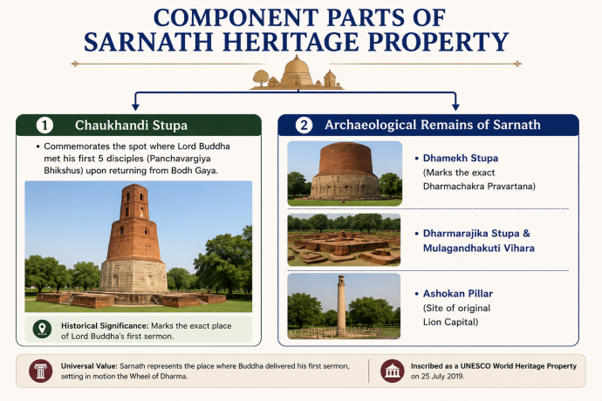
At the 48th Session of the UNESCO World Heritage Committee held in Busan, South Korea, the “Ancient Buddhist Site of Sarnath” was officially inscribed on the UNESCO World Heritage List. It became India’s 45th World Heritage Site, strengthening India’s rank as the 6th globally and 2nd in the Asia-Pacific region for the total number of recognized World Heritage properties.
Core Components
1. Sacred Geography
-
- Ancient Names: Known in classical Buddhist texts as Rishipatana, Ishipatana, and Mrigadava (Deer Park).
- Dharmachakra Pravartana: The site where Gautama Buddha delivered his first sermon after attaining enlightenment, setting in motion the “Wheel of the Law.” This event established the Buddhist Sangha and laid out the Four Noble Truths and the Noble Eightfold Path.
- Four Sacred Pilgrimage Destinations: Indicated by the Buddha himself as one of the four mandatory sites for Buddhist pilgrims—alongside Lumbini (Nepal), Bodh Gaya (Bihar), and Kushinagar (Uttar Pradesh).
2. Architectural Ensemble
-
- Stratified Settlement: Excavations by the Archaeological Survey of India (ASI) revealed continuous architectural development spanning 16 centuries—from the pre-Mauryan era (5th–4th Century BCE) through the Mauryan, Shunga, Kushana, and Gupta periods, up to its decline in the 12th Century CE.
- National Icons: Excavations at Sarnath yielded two defining symbols of Indian heritage:
- The Ashokan Lion Capital (Adopted as the National Emblem of India).
- The Dharmachakrapravartana Buddha Image (A masterpiece of Classic Gupta Art).
UNESCO Inscription Criteria
The site was inscribed under two specific Cultural Criteria:
-
- Criterion (iii): Bears exceptional testimony to the enduring spiritual and monastic traditions of Buddhism as demonstrated by centuries of continuous construction, rebuilding, and royal patronage.
- Criterion (vi): Directly and tangibly associated with pivotal events in human history—the Buddha’s first sermon, the founding of the Sangha, and the propagation of Triratna (Buddha, Dhamma, Sangha).
UPSC Quick Reference Table
| Feature | Detailed Specification |
| Site Name | Ancient Buddhist Site of Sarnath |
| UNESCO Inscription Number | 45th Property of India (6th globally, 2nd in Asia-Pacific) |
| Location | Varanasi, Uttar Pradesh |
| Decision Venue | 48th Session of the World Heritage Committee (Busan, South Korea) |
| UNESCO Criteria | Criteria (iii) & (vi) |
| Key Excavated Treasures | Ashokan Lion Capital (National Emblem) & Gupta Dharmachakra Buddha |
| Nodal Agency in India | Archaeological Survey of India (ASI), Ministry of Culture |
Conclusion:
The UNESCO World Heritage status for Sarnath reinforces India’s position as the birthplace of Buddhism and enhances cultural diplomacy across South, East, and Southeast Asia. Preserving its Outstanding Universal Value (OUV) ensures sustainable tourism management while protecting the site’s historical integrity.
Topic-2: Key Developments in Ministry of Law and Justice
-
- GS Paper 2 (Functions and responsibilities of the Union and the States; Governance, transparency, and accountability; Structure, organization, and functioning of the Executive and the Judiciary; Statutory, regulatory, and various quasi-judicial bodies).
1. Digital Justice & eCourts Project Phase III
-
- Budget Allocation: The Centre allocated ₹2,010 crore in the Union Budget 2026 for Judicial Infrastructure and eCourts Modernisation.
- Core Technological Upgrades:
- e-Filing 3.0: Fully operationalized across all District Courts in Punjab to streamline case filing and digital verification.
- Digital Justice Integration: Government continues expanding access to digital justice and legal aid across states like Odisha through integrated eCourts and Tele-Law services.
- Objective: Drive full digital transformation, enable online dispute resolution, digitize physical court records, and significantly reduce overall case pendency nationwide.
2. DISHA 2.0 (Designing Innovative Solutions for Holistic Access to Justice)
-
- Financial Outlay: Launched with a dedicated outlay of ₹255 crore.
- Key Features:
- Merges access-to-justice initiatives like Tele-Law, Nyaya Bandhu (Pro Bono Legal Services), and legal literacy programs into a single technology-driven umbrella scheme.
- Extends digital legal aid and advisory services to underserved regions, with special emphasis on accessibility features for Persons with Disabilities (PwDs).
3. Fast Track Special Courts (FTSC) Scheme
-
- Scheme Extension: Extended by the Central Government till September 2026.
- Current Operational Footprint: 775 FTSCs functional across 29 States and UTs.
- Exclusive POCSO Courts: Includes dedicated infrastructure for sexual offense cases; for instance, Madhya Pradesh operates 67 FTSCs, of which 56 are Exclusive POCSO (e-POCSO) Courts.
4. Judicial Infrastructure Development (Centrally Sponsored Scheme)
-
- Financial Support: Financial assistance provided to States—including Andhra Pradesh, Karnataka, and Himachal Pradesh—for constructing court halls, residential units for judicial officers, computer rooms, and barrier-free digital access centers.
5. Constitutional & Judicial Policy Updates
A. Ninth Schedule Inclusions
-
- The Government deferred the proposal to include the Karnataka Reservation Act, 2022 in the Ninth Schedule of the Constitution, citing pending sub-judice proceedings in courts.
B. Judicial Independence & Tribunal Reforms
-
- Tribunal Law Alignments: The Government affirmed that future tribunal legislation will strictly align with Supreme Court precedents (e.g., Rojer Mathew and Madras Bar Association cases) to safeguard judicial independence and streamline tribunal appointments.
- High Court Appointments: Reaffirmed that transfers and appointments of High Court judges continue to be governed by Articles 217, 222, and 224 of the Constitution, read alongside the established Memorandum of Procedure (MoP).
UPSC Quick Reference Table
| Initiative / Reform | Key Technical Specification / Outlay | Primary Focus |
|---|---|---|
| DISHA 2.0 | ₹255 Crore Outlay | Tech-driven access to justice, Tele-Law, & legal literacy |
| eCourts Modernisation Budget | ₹2,010 Crore Allocation | Infrastructure, digital courts, e-Filing 3.0 |
| FTSC Scheme Extension | Extended till September 2026 | 775 operational courts for speedy trial of POCSO & rape cases |
| New Judicial Tech Milestone | e-Filing 3.0 in Punjab | Seamless digital filing across District Judiciary |
Conclusion:
Through sustained funding under eCourts Phase III, the launch of DISHA 2.0, and the extension of Fast Track Special Courts, the Ministry of Law and Justice is strengthening judicial infrastructure and accelerating digital justice delivery across India.
Topic-3: Lokayan 26 Expedition
-
- GS Paper 2 (Bilateral, regional, and global groupings and agreements involving India and/or affecting India’s interests; Effect of policies and politics of developed and developing countries on India’s interests);
- GS Paper 3 (Security challenges and their management; Role of Armed Forces in Maritime Diplomacy).
What is Lokayan 26?
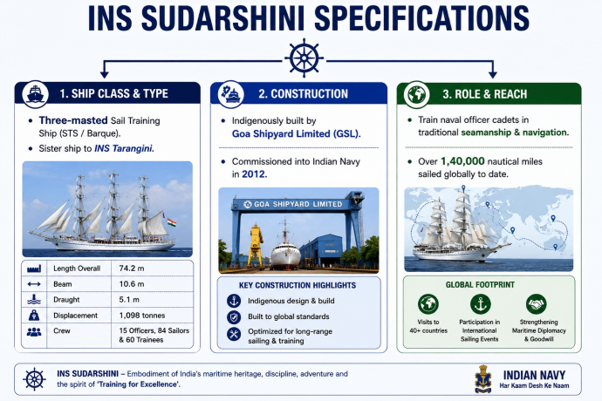
Lokayan 26 is a 10-month transoceanic sail training deployment conducted by the Indian Navy using its indigenously built sail training ship, INS Sudarshini. Embarking from Kochi in January 2026, the expedition covers over 22,000 nautical miles, visiting 18 foreign ports across 13 countries. The mission combines officer seamanship training with naval diplomacy under India’s broader vision of Vasudhaiva Kutumbakam (The World is One Family) and MAHASAGAR (Mutual and Holistic Advancement for Security and Growth Across the Region).
Key Highlights
1. Participation in SAIL 250 & International Naval Review 250
-
- Context: Commemorating the 250th anniversary of the independence of the United States.
- Port Calls in the US: The three-masted barque participated in SAIL 250 events across key US East Coast ports—Norfolk, Baltimore, New York, and Boston.
- Parade of Sail: Featured alongside international tall ships and naval vessels in a parade past the Statue of Liberty and along the Hudson River in New York.
2. Departure & Next Destination
-
- Boston Departure: INS Sudarshini departed Boston, USA, on July 25, 2026.
- Next Course: The ship is en route to Ponta Delgada, Azores (Portugal) for her next Atlantic leg.
INS Sudarshini Vessel Profile
UPSC Quick Reference Table
| Component | Detailed Specification |
| Nodal Agency | Indian Navy (Ministry of Defence) |
| Ship Name | INS Sudarshini (Indigenously built Sail Training Ship) |
| Expedition Name | Lokayan 26 (10-month, 22,000+ nautical mile deployment) |
| US Anchor Event | SAIL 250 & International Naval Review 250 (US 250th Independence) |
| US Ports Covered | Norfolk, Baltimore, New York, and Boston |
| Next Destination | Ponta Delgada, Azores (Portugal) |
Conclusion:
The deployment of INS Sudarshini under Lokayan 26 highlights India’s naval training standards and maritime outreach. Participating in global events like SAIL 250 strengthens naval partnerships across the Atlantic, promoting regional security and international cooperation.
Topic-4: 3rd Bharat CPSEs’ Consultative Conclave 2026
-
- GS Paper 2 (Government policies and interventions for development; Governance, capacity building, and institutional reforms);
- GS Paper 3 (Indian Economy – Infrastructure: Railways, Energy, Mining; Capital investment and project management).
What is the Bharat CPSEs’ Consultative Conclave?
The 3rd Bharat CPSEs’ Consultative Conclave 2026 is a high-level strategic forum focusing on Project Execution, Asset Management, and Organisational Excellence across Central Public Sector Enterprises (CPSEs). Held at Gati Shakti Vishwavidyalaya (GSV) in Vadodara, Gujarat, the 2026 edition focused specifically on CPSEs operating in the Energy and Mining sectors.
Core Focus Areas
1. Project Execution & Contract Management: Deliberated on mechanisms to prevent cost and time overruns by modernizing contract management frameworks, risk mitigation strategies, and Detailed Project Report (DPR) preparation.
2. Asset Lifecycle Management: Emphasized data-driven, innovative approaches to maximize the operational efficiency and life cycle of existing public infrastructure assets.
3. PM Gati Shakti Integration: Utilized the PM Gati Shakti National Master Plan platform for spatial planning, land acquisition, multimodal connectivity, and streamlining inter-departmental clearances.
4. Deep-Tech Adoption: Focus on integrating advanced technology (AI, IoT, digital twin modeling) in project monitoring and asset health assessment.
Key Deliverables
-
- Bharat CPSE Compendium of Best Practices: The Capacity Building Commission (CBC) and GSV will jointly publish a compendium capturing actionable insights, case studies, and recommendations to institutionalize best practices across CPSEs.
- Long-Term GSV-CBC Strategic Partnership: Reaffirmed the ongoing collaboration under the GSV-CBC Memorandum of Understanding (MoU) to build professional, sector-specific capacity across railways, highways, aviation, maritime, and logistics sectors.
UPSC Quick Reference Table
| Feature | Detailed Specification |
| Conclave Focus | Project & Asset Management for Energy & Mining CPSEs |
| Venue | Gati Shakti Vishwavidyalaya (GSV), Vadodara |
| Organizers | Capacity Building Commission (CBC) & Department of Public Enterprises (DPE) |
| Knowledge Partner | Gati Shakti Vishwavidyalaya (GSV) |
| Key Output | Bharat CPSE Compendium of Best Practices |
| Overarching Goal | Infrastructure capacity building aligned with Viksit Bharat 2047 |
Conclusion:
By leveraging the PM Gati Shakti platform and institutionalizing data-driven project management, the joint initiative by CBC, DPE, and GSV seeks to address long-standing delays in public infrastructure projects.
Spread the Word