
Introduction:
India’s agrarian economy completed a significant policy cycle on 30 June 2026, marking over a decade of the Pradhan Mantri Krishi Sinchayee Yojana (PMKSY). This structural transition has shifted national planning from fragmented, input-based canal outlays into a unified, water-secure farming paradigm by connecting upstream major infrastructure projects with precision field application methods.
Pradhan Mantri Krishi Sinchayee Yojana (PMKSY)
PMKSY is a comprehensive, mission-mode framework designed to expand assured irrigation, improve on-farm water-use efficiency, and optimize land productivity.
-
- Operating through a coordinated system traditionally divided into Jal Sanchay (rainwater harvesting) and Jal Sinchan (precision water application). It replaces seasonal rain dependency with localized water distribution assets.
- The scheme operates across the full water lifecycle, providing central capital outlays to complete delayed canal networks while offering targeted subsidies to individual farmers for installing micro-irrigation systems.
Key Features of PMKSY
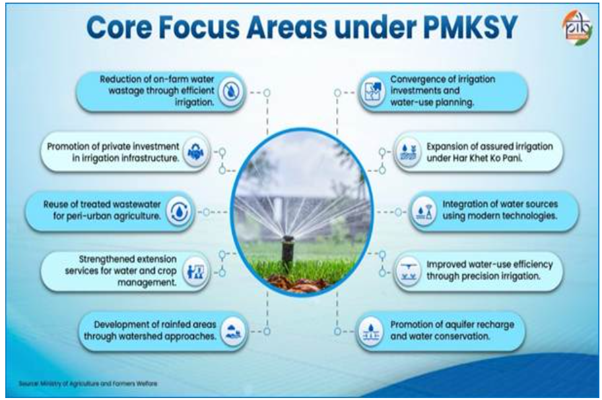
The policy framework coordinates across four core functional components to manage water resource allocation and precision application:
-
- Accelerated Irrigation Benefit Programme (AIBP): Focuses on the rapid deployment of funds to complete long-delayed major, medium, and strategic national canal projects.
- Har Khet Ko Pani (HKKP): Expands the net cultivable area under assured irrigation by developing new water sources through surface minor irrigation schemes and the restoration of traditional water bodies.
- Watershed Development: Promotes sustainable land management by introducing specialized rainwater harvesting, ridge-to-valley treatments, and soil-moisture conservation across rainfed areas.
- Per Drop More Crop (PDMC): Focuses on farm-level efficiency by expanding micro-irrigation technologies—specifically customized drip and sprinkler networks—to maximize crop yield per unit of water.
Recent Developments: Institutional Extensions and Command Area Upgrades
The government extended the operational lifecycle of PMKSY to cover the 2021–2026 funding loop with a total outlay of ₹93,068.56 crore, introducing structural modifications to improve last-mile distribution:
-
- The M-CADWM Integration (2025-26): The government launched the Modernization of Command Area Development and Water Management sub-scheme under PMKSY-AIBP with an initial allocation of ₹1,600 crore. This replaces traditional field channels with pressurized piped grids and micro-irrigation links.
- PDMC Structural Realignment: To improve agricultural scheme coordination, the Per Drop More Crop component was moved into the broader Pradhan Mantri Rashtriya Krishi Vikas Yojana (PM-RKVY) platform.
- Targeted Union Budget Capitalization: The Union Budget 2026–27 allocated ₹6,587 crore specifically to PMKSY to fast-track micro-irrigation adoption among small and marginal farmers.
Experience and Performance Metrics
-
- Macro Financial and Farmer Saturation: Total central financial assistance crossed ₹64,407 crore, directly creating or restoring irrigation networks across 24.61 million hectares and benefiting over 27 million farmers.
- Micro-Irrigation Footprint: The PDMC framework brought 110.92 lakh hectares under micro-irrigation, now commanding 7.98% of India’s net sown area and supporting 9.3 lakh farmers annually.
- Sub-Component Execution Metrics: Under AIBP alone, ₹21,023 crore in targeted central outlays benefited 17.30 million cultivators. Concurrently, the HKKP component completed 3,462 surface minor irrigation and tank restoration schemes, creating 5.93 lakh hectares of fresh irrigation capacity.
- Field Efficiency Optimization: Ground evaluations indicate that switching from conventional flood irrigation to sprinkler systems slashes water, electricity, and fertilizer consumption by nearly 50%, while increasing localized crop yields by up to 30%.
Challenges
-
- Field evaluations reveal a persistent gap between the structural completion of main canals under AIBP and the construction of last-mile field channels. This distribution gap leaves large command areas unutilized despite major upstream spending.
- Investigations indicate that while the Micro Irrigation Fund under NABARD supports growth, micro-irrigation remains skewed toward water-abundant, cash-crop states. High-risk, rainfed semi-arid zones face low adoption due to high initial technology costs for smallholders.
- Observer Research Foundation show that the expansion of HKKP groundwater interventions occasionally conflicts with state-level power subsidies.
- PRS Legislative Research show that several major AIBP canal clearances remain delayed due to prolonged interstate river water disputes. This is compounded by high siltation rates in legacy reservoirs, which reduce water capacity.
Way Forward
-
- Ministry of Jal Shakti should make pressurized piped distribution networks mandatory for all upcoming AIBP command installations, eliminating the land acquisition delays of open field channels.
- Introducing Front-End Subsidy Financing via NABARD to protect marginal farmers from informal debt traps.
- Deploying Solar-Powered Micro-Irrigation Cooperatives to control groundwater draw while providing off-grid energy.
- Establishing Desiltation and Integrated Watershed Management Frameworks to run continuous mechanical desilting across major reservoirs, recycling nutrient-rich silt into adjacent agricultural fields to improve soil health.
- Utilizing the 731 Krishi Vigyan Kendras network to train local panchayats in dynamic crop water budgeting, matching local cropping patterns with seasonal aquifer levels to counter over-extraction.
Conclusion:
The structural transformation under PMKSY highlights India’s successful evolution into an infrastructure-backed, water-efficient agricultural economy. Closing the last-mile canal delivery gap and shifting micro-irrigation subsidies to front-end models.
Spread the Word