Introduction:
Digital India Programme launched on 1 July 2015, has transformed India’s governance architecture from a fragmented e-Governance model into an integrated Digital Public Infrastructure (DPI) ecosystem by leveraging digital technologies. The programme has enhanced transparency, accountability, financial inclusion and service delivery, while strengthening India’s digital economy.
The Nine Strategic Pillars:
The architecture of Digital India is structured around nine foundational pillars that provide an integrated operational framework for digital penetration and domestic high-tech manufacturing:
1. Pillar 1: Broadband Highways: Focuses on national network coverage under the BharatNet initiative, laying over 7 lakh km of optical fiber cable to build rural e-governance, telemedicine, and retail links.
2. Pillar 2: Universal Access to Mobile Connectivity: Targets total network density across isolated geographic pockets, expanding the national broadband subscriber base to ensure seamless last-mile digital availability.
3. Pillar 3: Public Internet Access Programme: Expands local tech entry points by deploying a nationwide grid of Common Service Centres (CSCs) and digitized post offices to deliver rural banking and public utilities.
4. Pillar 4: e-Governance — Reforming Government through Technology: Transitions state workflows into integrated, paperless public administrations using automated verification tools like DigiLocker and single sign-on frameworks.
5. Pillar 5: e-Kranti — Electronic Delivery of Services: Handles domain-specific public utility saturation through connected platforms such as e-Hospital, e-Courts, and the e-Sanjeevani national telemedicine portal.
6. Pillar 6: Information for All: Strengthens participatory democracy by opening public data layers via Open Government Data (OGD) portals and encouraging collaborative public engagement on platforms like MyGov.
7. Pillar 7: Electronics Manufacturing: Uses financial and structural policy levers to build localized manufacturing value chains, targeting zero net imports across active electronic component networks.
8. Pillar 8: IT for Jobs: Focuses on human resource capability scaling, training youth in Tier-2 and Tier-3 urban segments to fill automated roles within domestic and global IT ecosystems.
9. Pillar 9: Early Harvest Programmes: deploys immediate, high-impact digital tools including biometric workplace attendance systems, secure public Wi-Fi hotspots, and real-time SMS-based weather alerts.
Evolution of Digital India
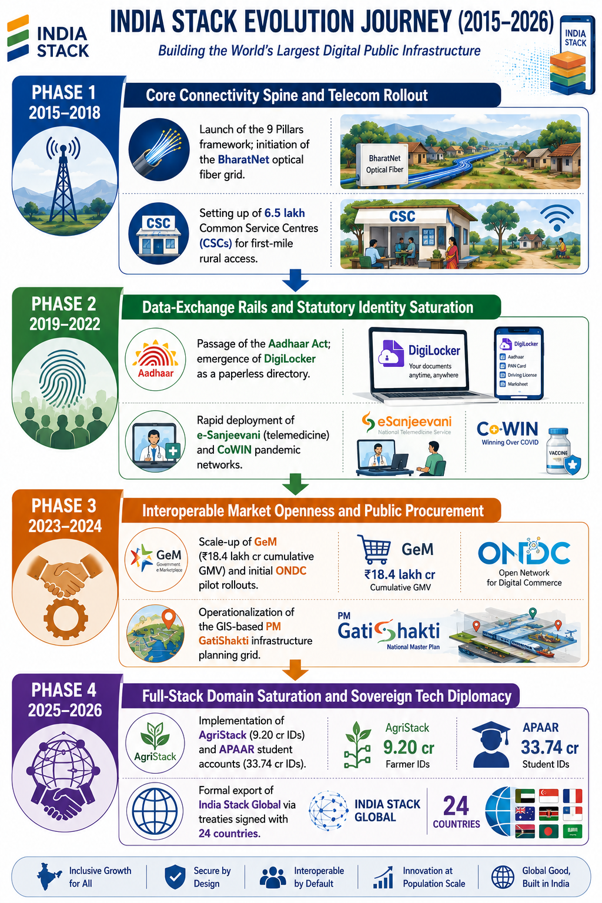
The digital architecture completed a clear four-phase structural evolution over the past eleven years, moving away from fragmented regional software portals to establish an integrated global digital public good:
Empirical Experience of Digital India:
The ground-level outcomes of the Digital India programme highlight a shift in financial inclusion, public health access, tax formalization, and industrial hardware production:
1. The JAM Welfare Rail: The JAM Trinity has formalized welfare transfers, with the Jan Dhan database expanding to 57.78 crore accounts holding ₹2.94 lakh crore in deposits, while Aadhaar enrollments crossed 144 crore. This infrastructure handles over ₹51 lakh crore in cumulative Direct Benefit Transfers (DBT) directly to 176 crore citizen profiles, running 98% of Public Distribution System (PDS) food grain verifications via biometric e-KYC.
2. Real-Time Payment Dominance: Completing its tenth year of operation, the Unified Payments Interface (UPI) processed over 24,162 crore transactions, commanding a 49% share of worldwide real-time digital transaction volume.
3. Healthcare and Public Procurement Saturation: The e-Sanjeevani telemedicine platform has facilitated 48 crore remote consultations across 2.3 lakh onboarded providers, while the Government e-Marketplace (GeM) logged a cumulative Gross Merchandise Value (GMV) of ₹18.4 lakh crore (including ₹5 lakh crore in the current fiscal segment), allowing over 11 lakh small MSMEs to directly fulfill state contracts.
4. The Macro Commercial Base: The digital economy actively contributes between 12–14% of India’s national GDP. Under the electronics manufacturing push, domestic production surged to ₹12 lakh crore, establishing India as the world’s second-largest mobile handset manufacturer, supported by an IT sector generating USD 283 billion in revenue and employing 26 lakh professionals across 2,100+ Global Capability Centres (GCCs).
Challenges
-
- Parliamentary Standing Committee on Communications and IT note that while BharatNet connects 97% of Gram Panchayats, last-mile fiber latency, regional power blackouts, and underutilized fiber networks persist. This infrastructure instability causes authentication errors at rural fair price shops, cutting off vulnerable households from essential rations.
- Analysis from the Indian Express paired with World Bank indicators warn that rapid automation and digitalization pose a structural risk to 69% of traditional low-skilled jobs in India.
- Policy research from the Observer Research Foundation (ORF) points out that India’s tech diplomacy efforts to export the India Stack Global to 24 countries face significant barriers. Cross-border UPI operations are limited by conflicting national central-bank frameworks, currency hedging costs, and strict international data-localization mandates that add friction to transnational peer-to-peer micro-payments.
- A regulatory review by PRS Legislative Research highlights that the deployment of automated data networks like AgriStack (9.20 crore IDs) and APAAR (33.74 crore IDs) occurs in a statutory void regarding automated machine liability.
- As confirmed by the March 2026 Standing Committee Report on AI, the absence of clear laws leaves users exposed to risks from deepfakes, financial fraud, and algorithmic scoring errors without a dedicated legal framework.
Way Forward
-
- Parliament must pass a comprehensive legal framework to replace legacy IT rules, explicitly defining smart-contract liabilities, automated machine error boundaries, and statutory penalties for AI deepfake generation to protect citizen data privacy.
- To support small rural sellers on ONDC, the government should introduce customized, low-interest micro-credit windows via GIFT City, funding localized cold-storage and fulfillment hubs to close the rural logistics gap.
- Integrating LEO Satellite Backups for First-Mile Verification to eliminate regional network drops.
- The RBI should collaborate with partner central banks to set up an automated, low-fee multi-currency settlement mechanism, reducing transaction overheads for cross-border digital payments.
Conclusion:
The transformation of India’s Digital India architecture from a baseline connectivity project into a globally recognized, interoperable DPI powerhouse marks a major milestone in modern public planning by matching foundational identity platforms with open market networks like ONDC, real-time transaction rails like UPI, and data-rich domain stacks, current policy has successfully reduced transaction costs across the domestic economy.
Spread the Word