Topic-1: NAFED’s Digital Ecosystem and Farmer Welfare Initiatives
GS Paper 2: Government policies and interventions for development in various sectors; Mandate of cooperative institutions.
GS Paper 3: E-technology in the aid of farmers; Technology applications in warehousing and agricultural marketing.
Context: Union Home Minister and Minister of Cooperation Shri Amit Shah launched a suite of digital and farmer-centric platforms for the National Agricultural Cooperative Marketing Federation of India Ltd. (NAFED) in New Delhi. The launch aligns with the government’s core vision of “Sahkar Se Samriddhi” (Prosperity through Cooperatives).
The Newly Launched Digital and Welfare Suite
The rollout introduces technology and social security measures to modernize NAFED’s procurement, supply chain, and community support frameworks:
-
- NAFEX.in Auction Portal: A dedicated digital e-auction platform built to streamline the sale and purchase of agricultural produce. By moving auctions online, it removes local middlemen, guarantees competitive bidding transparency, and boosts ease of operations for member cooperative institutions and traders.
- DRISHTI Portal: A real-time inventory management platform engineered specifically to track public buffer stocks of pulses and oilseeds. It tracks stock levels across nationwide warehouses to assist in price stabilization and prevent supply blockages.
- ERP Portal: A centralized Enterprise Resource Planning system designed to digitize NAFED’s internal management, accounting, and workflow systems, ensuring higher administrative accountability.
- NAFED-KALYAN Scholarship: A social welfare scheme that provides financial education grants and scholarships directly to the children of verified active farmers, making higher learning more accessible.
UPSC Prelims Fodder: Fact-Check
| Feature | Details |
| Primary Launch Platform | NAFEX.in (National Electronic Auction Portal of NAFED). |
| Nodal Ministry | Ministry of Cooperation, Government of India. |
| Inventory Tracking Node | DRISHTI Portal (Dedicated to tracking pulses and oilseeds). |
| Social Security Vector | NAFED-KALYAN Scholarship for children of farmers. |
| Core Governing Vision | Guided by the national slogan “Sahkar Se Samriddhi”. |
| About NAFED | Apex cooperative body (est. 1958 under Multi-State Co-operative Societies Act). |
Conclusion:
The launch of NAFEX.in and the DRISHTI inventory portal marks a significant step in digitizing India’s agricultural cooperative trade. By replacing unorganized auction methods with transparent, real-time data tracking, NAFED is improving price discovery for farmers while securing the country’s buffer stocks against market volatility.
Topic-2: Digital Civil Services Management and Human Resource Mapping
GS Paper 2: Role of civil services in a democracy; Government policies and interventions for development in various sectors; Transparency and accountability.
GS Paper 3: E-governance applications; Digitization and optimization of public resources.
Context: Union Minister Dr. Jitendra Singh launched the ‘IAS e-Civil List 2026’ at Kartavya Bhawan, New Delhi. This digital portal acts as a technology-driven talent mapping system to improve cadre management, administrative planning, and data-driven governance across the country.
Key Features and Capabilities of the e-Civil List
The transition from traditional physical directories to an interactive knowledge platform brings major updates to public administration:
-
- Advanced Talent and Domain Mapping: The digital format includes advanced search tools and hyperlinking features. This allows the government to instantly track and filter officers based on their professional background, specializations, academic degrees, and specific domain expertise.
- Comprehensive Data Tracking: The document contains updated service details of all active officers. It logs their respective batch year, allocated state cadre, current posting, pay matrix level, and exact date of superannuation (retirement).
- Macro-Level Manpower Analytics: The system provides critical statistical data for executive planning. It tracks cadre-wise vacancy gaps, identifies the total number of officers retiring over the next five years, and maintains historical data of all officers recruited since 1969.
- Operational Scale (6th e-Edition): Marking the 71st overall edition of the Civil List, this is the 6th consecutive version released as a fully digital e-book, removing the need to print large, resource-heavy physical directories.
Strategic Governance Impact
-
- Evidence-Based Postings: Access to verified officer profiles helps the government make informed placement decisions, ensuring that officers with specialized skills are matched with the developmental needs of specific ministries.
- Flexible Regional Deployments: The platform helps administrators identify personnel with appropriate field experience to handle complex tasks in remote, hilly, or geographically challenging regions.
- Cadre Strength Rebalancing: The database assists the Department of Personnel and Training (DoPT) in reviewing active cadre allocations. As of January 1, 2026, against a total authorized strength of 7,026 positions, India had 5,755 active IAS officers working across 25 distinct state cadres.
UPSC Prelims Fodder: Fact-Check
| Feature | Details |
| Launched Platform | IAS e-Civil List 2026 (71st overall edition | 6th e-book version). |
| Cadre Controlling Authority | Department of Personnel and Training (DoPT), Ministry of Personnel. |
| Total Authorized Strength | 7,026 positions across India (As of 1 January 2026). |
| Total Officers In Position | 5,755 active IAS officers currently deployed. |
| Total Number of Cadres | 25 state/joint cadres managed under the central system. |
| Historical Data Tracking | Contains recruitment records tracking back from 1969 onwards. |
Conclusion:
The launch of the e-Civil List 2026 marks a shift toward modern, data-driven civil service management under the Digital India mission. By replacing static paper directories with an analytical talent-mapping platform, the government is improving transparency and administrative readiness, ensuring optimal deployment of public manpower across diverse regional landscapes.
Topic-3: India’s Leadership in Global Ship Recycling & Circular Economy
GS Paper 2: Government policies and interventions for development in various sectors; Bilateral and global agreements affecting India’s interests.
GS Paper 3: Infrastructure (Ports and Shipping); Conservation, environmental pollution, and degradation (Circular Economy).
Context: According to the latest global report by the United Nations Conference on Trade and Development (UNCTAD), India has emerged as the world’s top ship recycling nation. By securing a global market share of 35.4%, India achieved the ship recycling target set under its Maritime India Vision (MIV) 2030 five years ahead of schedule.
Growth Trajectory and Macro Statistics
-
- The Surge: India’s global ship recycling volume rose by nearly 60%, jumping from 1.86 million Gross Tons (GT) in 2024 to 2.99 million GT.
- Market Share Capture: India’s share of the global recycling market expanded from 30.1% to 35.4%, surpassing all other global competitors.
- Future Forecast: The Baltic and International Maritime Council (BIMCO) projects that over 16,000 vessels will be decommissioned globally over the next ten years. With its current momentum, India is positioned to recycle 500 to 600 vessels annually.
Key Policy Reforms and Green Frameworks
The transition from unorganized, hazardous ship-breaking to standardized, green recycling is driven by major legal and financial reforms:
-
- Hong Kong Convention (HKC) Alignment: India enacted the Recycling of Ships Act, 2019, to implement the guidelines of the Hong Kong International Convention. Backed by financial assistance of ₹53.5 crore, 115 domestic ship recycling yards have been upgraded to meet strict international environmental and safety standards.
- Ship-Breaking Credit Note Scheme: A unique policy linking recycling with domestic manufacturing. Ship owners receive a credit note equal to 40% of a recycled ship’s scrap value. This credit can be used to offset up to 5% of the cost of building a new vessel at any Indian shipyard, boosting the domestic shipbuilding sector.
- Expanding Alang Infrastructure: Located in Gujarat, Alang is the world’s largest ship-breaking facility. The state government has prepared a master plan to nearly double its processing capacity to 9 million Light Displacement Tons (LDT) to meet rising international demand.
- EU Regulatory Integration (EUSRR): The central government is actively working to get Indian recycling yards included in the European Union Ship Recycling Regulation’s approved list, which would unlock access to recycling high-value European commercial fleets.
UPSC Prelims Fodder: Fact-Check
| Feature | Details |
| Global Ranking Node | India ranks 1st globally in ship recycling (UNCTAD Report). |
| Global Market Share | 35.4% of the world’s ship recycling value captured by India. |
| Annual Volume Handled | Increased by ~60% to reach 2.99 million Gross Tons (GT). |
| Statutory Law | Recycling of Ships Act, 2019 (Enforcing HKC compliance). |
| Core Global Treaty | Hong Kong International Convention (HKC) ratified by India in 2019. |
| Primary Industrial Hub | Alang Ship Recycling Yard, managed by the Gujarat Maritime Board. |
Conclusion:
India’s rise to the top position in global ship recycling highlights a successful shift toward sustainable, rule-based maritime operations. By aligning local shipyards with Hong Kong Convention standards and introducing innovative industrial credit schemes.
Topic-4: BRICS Space Economy & Co-Creation Framework
GS Paper 2: Bilateral, regional and global groupings and agreements involving India and/or affecting India’s interests.
GS Paper 3: Science and Technology- developments and their applications and effects in everyday life; Awareness in the fields of Space.
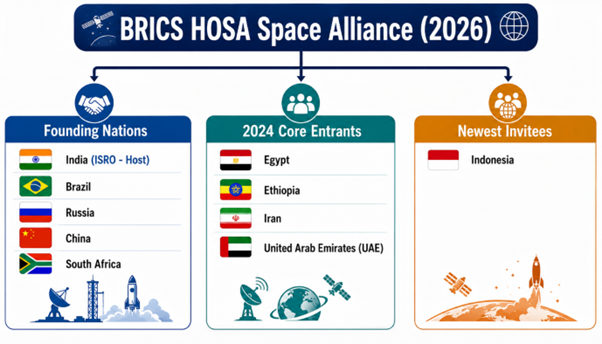
Context: Union Minister Dr. Jitendra Singh pitched for a unified “BRICS Space Economy” during the Valedictory Session of the BRICS Heads of Space Agencies (HOSA) Meeting held in Bengaluru under India’s 2026 BRICS Chairship.
Core Focus Areas of the HOSA Meeting
The two-day convention, hosted by the Indian Space Research Organisation (ISRO), brought together space leaders from the expanded BRICS bloc to review joint operational frameworks:
-
- BRICS Remote Sensing Satellite Constellation (RSSC): The agencies reviewed data-sharing mechanisms under the RSSC. This active constellation allows member nations to share satellite data to address global challenges like climate change, agricultural tracking, and urban planning.
- Space Sustainability & Debris-Free Missions: India called for responsible behavior in outer space. The summit prioritized the creation of international guidelines to handle rapid satellite traffic and minimize orbital debris to keep space safe for future launches.
- The Proposed BRICS Space Council: The delegates discussed setting up an institutional body called the BRICS Space Council. This council will serve as a permanent command structure to coordinate joint space missions, technology transfers, and industrial investments.
- Transitioning from Coordination to Co-Creation: India urged member nations to move past basic consultations and adopt a model of co-development, co-innovation, and co-creation by linking their private space startups and commercial sectors.
The Expanded BRICS Space Footprint
The Bengaluru summit marked one of the first major technical meetings including the newly integrated members of the alliance. The participating space agencies represented a massive combined demographic and technological base:
UPSC Prelims Fodder: Fact-Check
| Feature | Details |
| Summit Event | BRICS Heads of Space Agencies (HOSA) Meeting 2026. |
| Host Institution & Venue | Hosted by ISRO in Bengaluru under India’s 2026 BRICS Chairship. |
| Key Released Document | Indian Space Industry Brochure (Showcasing NewSpace startups). |
| Core Space Framework | BRICS Remote Sensing Satellite Constellation (RSSC). |
| Proposed Institution | BRICS Space Council for permanent institutional cooperation. |
| Key Indian Leaders | Dr. V. Narayanan (Chairman, ISRO); Dr. Pawan Goenka (Chairman, IN-SPACe). |
Conclusion:
India’s push for a “BRICS Space Economy” marks a strategic shift from simple diplomatic data sharing to active industrial co-creation across the Global South. By driving the establishment of a BRICS Space Council and championing debris-free missions, India is positioning its commercial NewSpace startup ecosystem at the center of global, sustainable space governance.
Spread the Word