Introduction:
India’s tourism sector has transitioned from a leisure-driven market into a highly sophisticated, multi-sectoral engine of macroeconomic growth and soft-power diplomacy by integrating national infrastructure projects such as the expansion of highways, modern airports, and semi-high-speed rail networks with experience-based destination management.
Key Takeaways
|
From Leisure Sightseeing to Spiritual Clustering
-
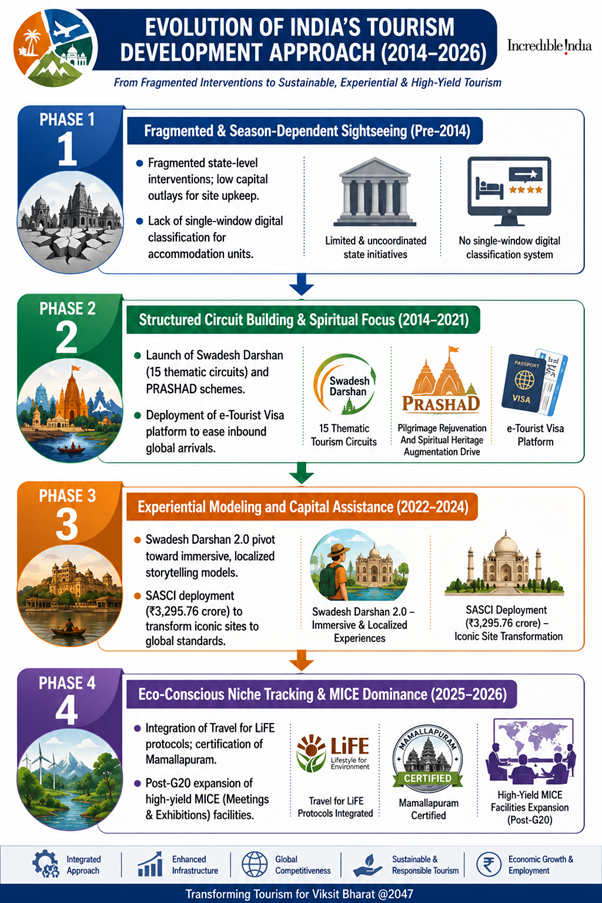
- Historically, India’s tourism ecosystem was constrained by disjointed regional marketing, an infrastructure gap at heritage locations, and long processing timelines for inbound global travelers.
- Between 2014 and 2025, the state drove a significant shift by treating tourism as an integrated infrastructure matrix. This led to the generation of 25 million aggregate international arrivals over the decade.
- By separating macro travel data into clear sub-sectors—such as MICE (Meetings, Incentives, Conferences, and Exhibitions), Spiritual Circuits, and Eco-Conscious Niche Tourism—planning networks successfully decoupled tourism from traditional seasonal peaks.
- This restructuring distributes visitor footprints away from oversaturated historical cities and directs capital down to rural and remote geographies, notably transforming the economic landscape of the Purvodaya and North-Eastern states.
Institutional Interventions
1. Swadesh Darshan 2.0 and PRASHAD Spiritual Networks- The Ministry of Tourism replaced disconnected regional upgrades with data-driven destination re-engineering:
a) The Immersive Hub Framework: Swadesh Darshan 2.0 uses localized storytelling and specialized construction, such as creating floating log cabin hubs around Uttarakhand’s Tehri Lake and setting up immersive Mahabharata thematic developments in Kurukshetra.
b) The Pilgrimage Saturation Grid: The PRASHAD scheme addresses safety and overcrowding risks at historically significant sites by executing ₹1,700 crore in integrated infrastructure upgrades. These projects construct advanced tourist facilities, pedestrian walkways, and security perimeters at high-traffic spiritual locations like Srisailam and Somnath.
2. CapEx Support, Digitization, and Global Certifications- Sustaining global tourism competitiveness relies heavily on targeted state funding and the adoption of open-protocol digital platforms:
a) The SASCI Capital Allocation: Under the Special Assistance to States for Capital Investment (SASCI) framework, the government cleared 40 iconic destination projects across 23 states with an outlay of ₹3,295.76 crore, building world-class infrastructure.
b) Standardized Digital Regulatory Systems: The deployment of the NIDHI and NIDHI Plus platforms has digitized registration and quality audits for accommodation providers and travel agencies, reducing administrative friction across the hospitality sector.
c) Conscious Eco-Tourism Grids: To mitigate the strain of overtourism, the Challenge-Based Destination Development (CBDD) scheme deployed ₹697.94 crore across 38 eco-tourism projects, such as the Panidihing Bird Sanctuary. This aligns with the Travel for LiFE program and supported Mamallapuram in becoming the first South Asian heritage site to secure the Green Destinations Silver global certification.
Challenges
-
- While India recorded 20.6 million international arrivals in 2024, the ratio of high-yield foreign tourist arrivals (FTAs) to general international entries remains uneven. Growth is constrained by a lack of seamless, last-mile luxury connectivity from major airport hubs to interior heritage zones.
- The rapid surge in domestic travel creates waste management challenges that threaten the natural capital of the destinations.
- Observer Research Foundation found that a large portion of the rural tourism workforce remains in the informal economy. Frontline operators, including rural home-stay owners and traditional artisans, face difficulties accessing formal institutional credit to expand their business scale.
- The optimization of interstate tourist circuits is restricted by conflicting state-level luxury taxes, entry permits, and compliance guidelines. This lack of policy alignment adds operational costs for multi-state tour operators.
- Government Audit Portals find that platforms like NIDHI Plus look to standardize the hospitality directory, a technological divide exists among boutique and rural home-stay operators in aspirational districts, limiting their visibility on global online travel portals.
Way Forward
-
- Parliament should draft a model framework to standardize interstate luxury taxes, simplify tourist vehicle permits across state lines, and accord infrastructure status to hotels with lower capital thresholds.
- To counter overtourism, destination management boards should deploy AI-led real-time tracking systems to monitor footfall density, issuing flexible entry allocations for fragile ecological sites.
- Deploying Low-Interest Micro-Credit Windows via GIFT City.
- Utilizing the Common Service Centers (CSCs) framework to provide hands-on tech assistance to rural homestay providers. This simplifies onboarding onto the NIDHI directory and global booking platforms, closing the digital divide.
Conclusion:
India’s structural transition toward an infrastructure-backed, sustainable tourism economy marks a key shift in how the nation leverages its vast cultural and natural wealth. By matching large-scale capital investments under the Swadesh Darshan and SASCI models with digital platforms and eco-certifications, current policy has successfully converted travel volume into local economic security.
Spread the Word