Introduction:
Dams form the backbone of India’s hydro-economic framework, underpinning critical sectors like agricultural irrigation, flood moderation, drinking water logistics, and clean energy grid stability.
However, as the asset portfolio undergoes structural ageing alongside rising monsoon volatility and reservoir sedimentation (averaging a 19% capacity loss over 42 years), dam safety has moved from a standard engineering exercise to a matter of national security. To address this, the Union Government has shifted its strategy from capacity expansion to comprehensive lifecycle optimization, backed by legislative mandates, global financing, and predictive technology.
Structural Profiling:
India’s large dam infrastructure exhibits highly uneven regional distribution and ownership patterns:
-
- Oldest Operational Asset: The Kallanai (Grand Anicut) in Tamil Nadu, functional for nearly 2,000 years, remains a global benchmark for sustainable river engineering.
- Ownership Concentration: Approximately 98.5% (6,448 dams) are owned by State Governments. CPSUs account for 0.7%, private entities own 0.6%, and the Central Government directly oversees 0.2%.
- Geographical Dominance: Maharashtra leads in specified dam count, followed by Madhya Pradesh, Gujarat, Chhattisgarh, Rajasthan, Karnataka, and Odisha.
Dam Rehabilitation and Improvement Project (DRIP)
DRIP represents one of the largest systematically organized dam safety interventions globally.
-
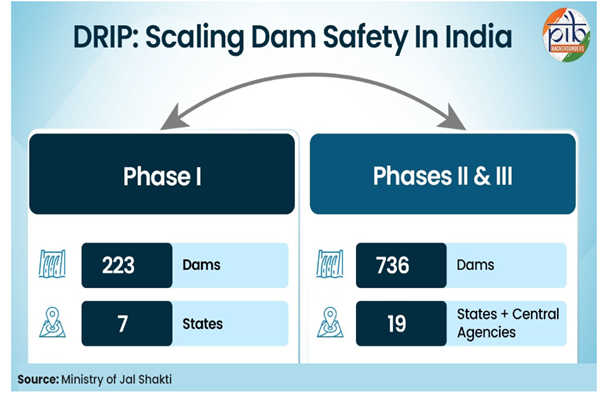
- DRIP Phase I (2012–2021): Funded by the World Bank, this phase completed diagnostic flood reviews and physical repairs for 223 dams across seven states, introducing the foundational data tracking architecture.
- DRIP Phase II & III (Launched October 2021): A 10-year multi-state initiative spanning 736 dams. It incorporates structural retrofitting, institutional strengthening, and revenue-generation measures (e.g., tourism, floating solar) to ensure financial self-sustainability for long-term operations and maintenance (O&M). Major installations under this bracket include the Bhakra, Nagarjuna Sagar, and Gandhi Sagar dams.
Dam Safety Act, 2021
The enactment of the Dam Safety Act, 2021, turned administrative guidelines into legal mandates. The Act applies strictly to specified dams (above 15 meters in height, or 10–15 meters subject to specific technical hazards).
The Act mandates a structured four-tier administrative hierarchy:
1. National Committee on Dam Safety (NCDS): The apex policy-formulating council that sets technical and regulatory benchmarks to prevent catastrophic failures.
2. National Dam Safety Authority (NDSA): The central implementation and regulatory enforcement arm that handles dispute resolution among states and maintains national compliance.
3. State Committees on Dam Safety (SCDS): State-level bodies that assess localized hazards and oversee structural interventions.
4. State Dam Safety Organisations (SDSO): The field-level monitoring units responsible for continuous physical surveillance and reporting.
Statutory Obligations of Dam Owners
Under the Act, public and private dam owners must perform regular structural health evaluations. This includes maintaining hydro-meteorological and seismological stations, setting up early warning systems, compiling technical dossiers, and drafting formal Emergency Action Plans (EAPs).
Technology Integration & Capacity Building
Digital transformations have eliminated traditional, fragmented paper-based reporting:
-
- DHARMA Platform: A centralized, web-based Management Information System (MIS) and mobile app that standardizes asset data mapping.
- The Three-Tier Inspection Classification: Mandated pre- and post-monsoon evaluations categorize dams based on structural integrity:
- Category I (Critical Deficiencies): Structural anomalies requiring immediate containment. Post-monsoon 2025 data flagged 3 dams in this zone.
- Category II (Major Deficiencies): Requires prompt remedial actions (188 dams identified).
- Category III (Minor Deficiencies): Sound structural performance.
- Academic Centers of Excellence (CoEs): Specialized research labs have been established at IIT Roorkee (focusing on Seismic Hazard Mapping and Reservoir Sedimentation) and IISc Bangalore (focusing on Advanced Construction Materials and Risk Assessments), paired with dedicated M.Tech programs to professionalize India’s hydraulic engineering cadre.
Challenges:
-
- Siltation-Induced Hydro-Structural Stress: Real-time CWC data reveals an annual capacity loss of 74% across major reservoirs. Silt accumulation not only lowers gross water availability but increases the hydrostatic pressure on older masonry dams, amplifying failure risks during extreme cloudburst events.
- The Fiscal Gap in State-Level Devolvement: While the Act mandates strict safety enforcement, secondary and agrarian states face fiscal constraints. Allocating funds for continuous sensor deployments, automatic gates, and telemetry networks often competes with immediate welfare spending.
- Legal and Penal Friction over Cross-Border Rivers: Chapter X of the Act prescribes up to two years of imprisonment for non-compliance. However, enforcement often encounters inter-state water sharing friction, where downstream states and upstream owners disagree on flood-discharge forecasting and emergency accountability.
Way Forward
-
- Scaling Telemetry and IoT Edge Sensors: Moving from manual biannual checking to continuous internet-of-things (IoT) structural health monitoring, using piezometers and tilt sensors connected directly to DHARMA.
- Standardizing Downstream EAP Drills: Ensuring that Emergency Action Plans are not merely academic documents but are validated through annual multi-agency mock drills involving local disaster management forces.
- Aggressive Desiltation and Catchment Treatment: Coupling structural repairs under DRIP with catchment area treatment (such as checking check-dams and afforestation) to halt silt flows at the source.
- Operationalizing the National Centre for Earthquake Safety: Leveraging the specialized cell at MNIT Jaipur to update seismic safety parameters for dams located in vulnerable Himalayan zones (Zones IV and V).
Conclusion
India’s transitioning water landscape demands that large engineering assets be managed with predictive precision. By combining multi-billion dollar structural upgrades under DRIP with statutory enforcement via the Dam Safety Act,
Spread the Word