
Introduction:
India’s financial inclusion architecture has completed a paradigm shift, transitioning from expanding basic brick-and-mortar banking access to deploying an intelligent, real-time digital public ecosystem. Armed with vast computational capability, machine learning, and consent-driven data-sharing networks, Artificial Intelligence is reshaping modern banking.
Foundational Rails:
The integration of AI models requires a robust, interoperable, and transaction-dense digital infrastructure:
-
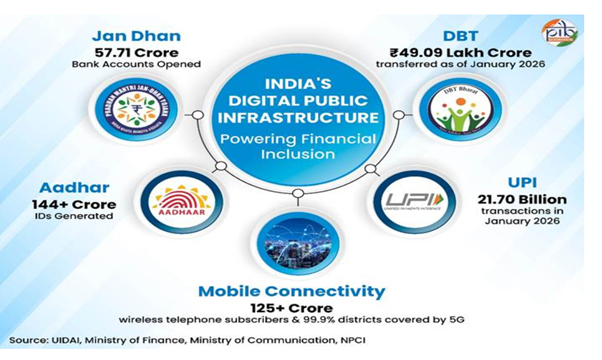
- The JAM Trinity Framework: Integrates universal Jan Dhan accounts (holding ₹3.02 lakh crore in deposits as of April 2026) with secure biometric identification and 5G mobile data coverage to create a verified digital identity footprint.
- Unified Payments Interface (UPI): Operates as the dominant real-time retail rail, processing 2,264.11 crore transactions worth ₹29.53 lakh crore in March 2026 alone.
- Direct Benefit Transfer (DBT): Transferred a cumulative ₹49.09 lakh crore directly into beneficiary accounts by January 2026, saving over ₹4.31 lakh crore by algorithmically purging ghost entries.
Strategic Policy Interventions
The Union Government and the Reserve Bank of India have launched a series of targeted frameworks to guide responsible, secure, and inclusive AI deployment:
1. Language Democratization via “Banking BHASHINI”
Recognizing that linguistic barriers frequently lead to structural exclusion, a formal partnership under the Digital India BHASHINI Division is training specialized Natural Language Processing (NLP) models. Fueled by open-source data from the BhashaDaan initiative, “Banking BHASHINI” embeds contextual financial terminology and regulatory scripts to enable intuitive, voice-based multilingual banking across all 22 scheduled languages.
2. Frictionless Lending under the Unified Lending Interface (ULI)
The newly established ULI platform serves as an API-based data aggregator. Instead of restricting credit evaluation to conventional parameters, ULI enables lenders to pull heterogeneous alternative data points—including satellite crop monitoring, land registry documentation, and GST invoice trails—to perform high-speed underwriting for small-scale borrowers.
3. The Account Aggregator (AA) Architecture
Operating as specialized consent managers, seventeen certified AAs facilitate the safe transfer of consolidated financial information between institutions. As of late 2025, 252.9 million users have securely linked their accounts, enabling predictive AI analytics to review real-time statements without requiring physical paperwork.
4. Algorithmic Risk Safeguards & Inclusive Upgrading
-
- MuleHunter.AI: An advanced anomaly detection engine deployed by the Reserve Bank Innovation Hub (RBIH) that uses machine learning to identify and freeze compromised “mule” bank accounts involved in illegal betting and money laundering.
- RBI Regulatory Sandbox: A controlled live-testing environment that allows fintech entities to evaluate experimental APIs and cybersecurity products under regulatory supervision before full-scale public release.
- Digital ShramSetu: An AI-driven blockchain initiative designed to capture real-time skill verifications, identity validation, and tailored social safety nets for India’s 490 million informal workers.
Challenges:
-
- Algorithmic Bias and Credit Redlining: The Hindu reports that while alternative credit data expands access, uncalibrated machine learning models risk creating localized “credit redlining” or algorithmic bias, where entire zip codes or occupational profiles are auto-rejected based on historical proxies rather than individual merit.
- Data Privacy Boundaries and Concentrated Ownership: PRS Legislative highlights that aggregating massive digital footprints via ULI and Account Aggregators puts premium importance on the strict enforcement of the Digital Personal Data Protection Act. Unsecured storage or unauthorized profile cross-matching by aggressive fintech aggregators poses severe data exploitation risks.
- The “Digital Literacy Deficit” in AI Interfaces: NITI Aayog briefs note that despite voice-based prompts under Banking BHASHINI, elderly and rural demographics remain highly vulnerable to social engineering frauds, deepfakes, and automated phishing, requiring continued human-mediated assistance at the first mile.
Way Forward:
-
- Mandating Ethical AI Auditing Frameworks: Establishing transparent, explainable AI (XAI) standards within the RBI Regulatory Sandbox to ensure that credit-scoring models provide clear reasons for rejection, preventing black-box discrimination.
- FPO and SHG-Targeted Digital Onboarding: Creating specialized credit journeys on the ULI platform tailored specifically for women-led Self-Help Groups and Farmer Producer Organizations to lower aggregate transactional friction.
- Strengthening Cybersecurity at Edge Nodes: Mandating institutional deployment of real-time fraud mitigation tools like MuleHunter.AI across regional rural banks (RRBs) and cooperative networks to protect rural deposits.
- Deploying Hybrid Phygital Architecture: Blending high-tech AI interfaces with physical village Common Service Centres (CSCs) run by local entrepreneurs to ensure safe digital public infrastructure usage.
Conclusion
India’s financial inclusion journey has evolved into a global blueprint, successfully morphing from basic account provisioning to an intelligent, data-driven framework by pairing foundational layers like the JAM trinity with predictive lending infrastructure under ULI and linguistic bridges via Banking BHASHINI.
Spread the Word