
“Dharma is the duty of all, those who govern and those who are governed”.-Kautilya.
Although the terms ‘governance’, ‘good governance’ and ethical governance have entered in the lexicon recently, but their spirit and practice are as old as society. India has a rich cultural heritage ranging from “Satyameva Jayate”, “Ram Rajya” to “Raj Dharma” to refer in modern practices about good governance.
GOVERNANCE
Etymologically, the term ‘governance’ is derived from the Greek word kubernaein, which means “to steer”. While the provided documents focus on the historical application of the term rather than its linguistic roots, they highlight that the concept is as old as human civilization itself.
It means the term ‘governance’ is as old as the ancient society. In traditional sense, it represented an act of governing. It was about exercise of power by the state to maintain order and security.
But as far as its concept is concerned, it is a contemporary development having its origin in 1990s. It was conceptualised and for the first time defined by the world bank through its three reports in 1989, 1992 and 1997.
DEFINING THE TERM GOVERNANCE
| Entity | Definition of Governance |
|---|---|
| World Bank | “The manner in which power is exercised in the management of a country's economic and social resources for development”.(The first definition) |
| United Nations (UN) | “The structures and processes whereby a social organization—from a family to an international institution—steers itself. It also refers to the process of decision-making and decisions implementation”. |
| OECD | “Governance is all about people. It is about building trust”. |
| PM Narendra Modi | Government means rules and governance means delivery. Government is power while governance is empowerment. Where there are files, there is government. Where there is life, that is governance". |
Socrates (470-399 BC): Known as the father of moral philosophy, he defined the root of governance through self-understanding (“Know Thyself”), arguing that an unexamined life is not worth living and that the highest good is found in this attainment.
Kautilya: In his Arthashastra, he defined governance through the lens of the ruler’s behaviour, stating that a leader’s welfare is inseparable from the welfare of the people; what pleases the people should be considered good, rather than what pleases the leader.
THE CONTEXT OF CONCEPTUALISATION OF GOVERNANCE
Since traditionally, governance was about an act of governing, it remained limited to power of state which failed to satisfactorily address the problems of people. The state symbolised command and control approach. There was more government, less governance.
It is in this context during 1990s that the exogenous and endogenous forces conversed to advance the idea of collective governance, governance by networks. The idea has strong urge for:
-
- Government alone cannot govern effectively
- Governance must be together-power with, not power over
- Power-with improves capability of government to govern more effectively
- Governance is not merely about exercise of power, it is more about solving the problems of people.
Take following two examples:
| NTA(National Testing Agency) | UPSC/IIT-JEE/CAT |
|---|---|
| • It doesn’t have ability to conduct examination without leak of NEET paper • It has not yet created a collective governance framework from papers’ setting to supply of papers at test centres | • They have ability to conduct examination without leak of papers • They have created a collective governance framework from papers’ setting to supply of papers at test centres |
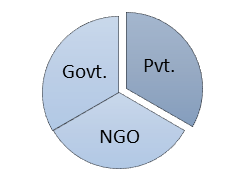
The concept of governance went on bringing the role of the three most important stakeholders to share power and govern collectively: the public, the private and the third sector.
GOOD GOVERNANCE
Like governance, good governance is also as old as society. Indian philosophy gives a rich cultural heritage of good governance which is also popular referred as righteous governance, Raj Dharam, Satyamev Jayate and Ram Rajya.
Ancient Philosophers and Scholars
The ideal of good governance can be traced to the Quran, Bible, Vedas, and Gita. In ancient India, it was known as Raj Dharma, which meant the righteous duty of the ruler to ensure justice and social welfare.
In the Arthashastra, Kautilya stated that a king’s welfare lies in the welfare of his people. He noted that an officer handling money is like someone with honey on their tongue—they will inevitably “taste the sweetness” even if they do not swallow it.
-
- Kautilya (Chanakya): “In the happiness of his people lies king’s happiness, in their welfare his welfare, whatever pleases himself he shall not consider as good, but whatever pleases his people he shall consider as good”.
- Socrates: “Know Thyself”. He argued that self-understanding is the greatest need and the “highest good,” stating that “The unexamined life is not worth human living”.
- Mahabharata (Shanti Parva): “आत्मन प्रतिकूलानि परेषां न समाचरेत” — do not do unto others as you would not be done by.
Modern philosophers and leaders
-
- Mahatma Gandhi: “The corruption of the best is the worst. A single drop of poison can convert a pot of nectar into a lethal draught”.
- Sardar Patel: “A public servant cannot afford to, and must not, take part in politics… no service worth the name can claim to exist if it does not have in view the achievement of the highest standards of integrity”.
- Henry David Thoreau: “That Government is best, which governs not at all”.
- Thomas Hobbes: “Government provides us with protection from the harm that we would otherwise inflict on each other in our quest for gain and glory”.
- John Kenneth Galbraith: “The government is a major part of the problem, it is also central to the remedy”.
The context of conceptualisation of good governance
It is similar to the context and conceptualisation of governance. In fact, both have the same origin, concerns and institutional support. It was first conceptualised and explained by the World Bank in its reports in 1989, 1992 and 1997. The term ‘good governance’ was also coined by the World Bank.
It was conceptualised in the context of poor governance to bring good governance, especially in developing countries. Its objective was to improve the governability of developing countries through participatory and transparent manner so that there was an efficient system of public service delivery.
Contemporary definitions of good governance
| Institution/ Leader | Definition |
|---|---|
| World Bank | Good governance is an essential complement to sound economic policies. Efficient and accountable management by the public sector and a predictable and transparent policy framework are critical to the efficiency of markets and governments". |
| Michael Johnston | Legitimate, accountable, and effective ways of obtaining and using public power and resources in the pursuit of widely accepted social goals". |
| PM Modi | “Good governance is ‘pro-people’ and ‘pro-active,’ focusing on putting citizens at the center of development, rather than just administration. |
| ARC II | “Good governance is the transparent, accountable and efficient management of public affairs, guided by the principles of equity, justice and responsiveness to citizens.” |
Characteristics of good governance
1. Participation: This is considered the core of good governance, requiring that all citizens have the freedom to participate in decision-making and represent their interests.
2. Rule of Law: Governance must not be an arbitrary use of authority; it requires a fair legal framework supported by an independent judiciary and impartial law enforcement.
3. Transparency: This is built on the free flow of information, ensuring it is accessible and understandable to those affected by governance decisions.
4. Responsiveness: Institutions and processes must serve all stakeholders within a reasonable and appropriate timeframe.
5. Equity: A society’s well-being depends on ensuring that all members feel they have a stake in it and are not excluded from the mainstream.
6. Effectiveness and Efficiency: Processes and institutions must produce results that meet societal needs while making the most sustainable use of resources.
7. Accountability: This involves the answerability of politicians, administrators, and the private sector for their activities and the enforcement of laid-down norms.
8. Predictability: This entails presence of clear cut laws and regulations that regulate society and economy.
Good governance in India
Prime Minister Narendra Modi’s vision on good governance reflect a philosophy that prioritizes efficiency, the use of technology, and a citizen-centric approach to administration.
-
- “Minimum Government, Maximum Governance”: This is his most frequently cited quotation, describing a vision for a leaner bureaucracy that empowers citizens rather than controlling them.
- “Where there are files, there is government. Where there is life, that is governance”:This highlights his goal of moving away from traditional red-tape toward impactful service delivery.
- “Reform, Perform, and Transform”: This serves as his roadmap for administrative and systemic change in India.
- “Citizen-centricity is the motto and guiding principle of our administration”: He emphasizes that every government policy must be designed with the end-user in mind.
- “Trust is the cornerstone of good governance”: He advocates for shifting toward trust-based administration, such as moving from mandatory affidavits to self-certification.
- Good governance as “Sabka Saath, Sabka Vikas“: the government has shifted toward E-Governance and Citizen-Centric models.
EXAMPLES OF GOOD GOVERNANCE
| Category | Key Initiatives |
|---|---|
| Participation & Decentralisation | • 73rd & 74th Amendments (1992): Formalized Panchayati Raj (rural) and Municipal (urban) local self-government. • MyGov Platform (2014): A digital space for citizens to contribute ideas and feedback on policy. • Social Audit Laws: Initiated by states like Meghalaya (2017) to allow community-led oversight of public funds. • NITI Aayog (2015): Replaced the Planning Commission to promote cooperative federalism and bottom-up planning. |
| Social Justice | • MNREGA (2005): Guaranteed the right to work for rural households, promoting participatory governance. • Right to Education (RTE) Act (2009): Mandated free and compulsory education for children aged 6–14. • Direct Benefit Transfer (DBT): Links Aadhaar and bank accounts to ensure subsidies reach the marginalized without leakages. • Aspirational Districts Program (2018): Targeted interventions in 112 backward districts to eliminate regional disparities. • Pradhan Mantri Jan Dhan Yojana (2014): Mass financial inclusion drive to bring the unbanked into the formal economy. |
| Efficiency and effectiveness | • Mission Karmayogi (2020): Shifted civil service training from "rule-based" to "role-based" competency. • Digital Public Infrastructure (DPI): India’s DPI, often referred to as the India Stack, is a set of open APIs and digital public goods used to provide social and economic services at a national scale. • PM Gati Shakti: Launched to break departmental silos in infrastructure planning, PM Gati Shakti is a National Master Plan for multi-modal connectivity. • Direct Benefit Transfer (DBT): Ensures that welfare benefits move straight into bank accounts without leakages, significantly improving the effectiveness of social spending and saving over 3.4 lakh crore. |
| Regulation & Facilitation | • Digital India (2015): Comprehensive plan to deliver government services electronically and improve digital infrastructure. • Insolvency and Bankruptcy Code (2016): Streamlined the resolution of bad debts to improve the business environment. • GST Implementation (2017): Unified the indirect tax regime to facilitate a common national market. • Ease of Doing Business (EDB) 2.0: Economic Surrey 2024-25 came up with EDBB 2.0. It focuses on decriminalization through the Jan Vishwas Act, the National Single Window System (NSWS) and trust-Based Governance. |
CRITICISMS OF GOOD GOVERNANCE
1. Many say good governance is more on paper than in practice: A public school collapsed in Jhalawad, Rajasthan, in which 7 students died. Similar incidents of poor governance can be found across the country.
2. Recurring paper leaks in India: In over 77 years, more than 70 paper leaks and the most recent is NEET-UG Exam 2026.
3. Corruption still remains rampant: India’s rank on CPI in 2025 is 91/182, which remains stagnant. The most recent corruption exposure is by CAG in 2025 related to PMKVY in which 95% accounts and Aadhar numbers are fake that resulted into a scam of Rs.14000 crore.
4. Institutional decline: There are allegations of institutional decline of ECI, CBI and ED. Lokpal has given only 7 prosecutions orders since 2019 which is considered very poor record.
5. Regulatory capture: The Indigo fiasco and Hindenburg-SEBI incidents have shown that India has to still work on improving regulatory standards.
6. Gender Gap Index and Democracy Freedom Index: The performance on some indices is far from satisfactory. India ranked 131st out of 148 countries on Gender Gap Index. India is classified as“Partly Free” by Freedom House with a score of 62/100 in 2024.
7. Subba Rao says: In India, only 25 IAS officers are competent, 25% are corrupt and 50% are incompetent.
8. Judicial Delays: The legal system is criticized for being lengthy and costly, with over 5 crore cases pending in the Indian judiciary, leading to a “denial of justice” for many.
BUREAUCRACY AS OBSTACLE TO GROWTH & ENTREPRENEURSHIPIn a landmark ruling on January 6, 2026, a Supreme Court delivered a sharp critique of the Indian bureaucracy, describing its “lethargy” as a primary obstacle to national growth and entrepreneurship. The case: IFGL Refractories Ltd. v. Orissa State Financial Corporation & Ors., where a company was denied sanctioned industrial subsidies for years due to shifting administrative stances. Key Observations of the Court
The Verdict: The Supreme Court directed the authorities to disburse the sanctioned amount of ₹11,14,750, along with 9% interest per annum from the date of the original sanction, within three months. |
Challenges of Good Governance
1. Corruption: According to the UN, corruption is the most important challenge of good governance.
2. Bad politics: There can’t be bad politics and good governance. Electoral mal-practices, nexus and criminalization of politics-46% of MPs have criminal backgrounds, remain serious menace.
3. Soft state: Gunnar Myrdal’s soft-nature of state highlights that how states have weak or selective enforcement of laws.
4. Awareness problem: Low awareness and poor participation of people in the process of democratic governance.
5. Digital Fatigue:Officials are reportedly spending excessive time managing digital dashboards for central reporting (e.g., in waste management) rather than engaging in ground-level delivery.
6. Environmental Emergencies:Escalating ecological crises, such as urban landfill fires and air quality degradation, have exposed the limits of current local waste governance frameworks.
RELEVANCE OF GOVERNANCE AND GOOD GOVERNANCE
The relevance of governance and good governance lies in their ability to transform a state from a mere administrative entity into a vehicle for human welfare, social justice, and sustainable development. While governance provides the framework for decision-making, “Good Governance” ensures those decisions prioritize the dignity and quality of life of every citizen.
-
- “Good governance is the key to a nation’s progress.”— Narendra Modi (Reiterating that transparent and efficient systems are the primary vehicles for national growth).
- “Good governance is perhaps the single most important factor in eradicating poverty and promoting development.”— Kofi Annan
- “The independence of judges is most crucial in achieving good governance under the Constitution”. Supreme Court judge BV Nagarathna
WAY FORWARD
To bridge the gap between policy design and ground-level execution, India must adopt a multi-pronged strategy that balances technological innovation with institutional reform:
-
- Civil Service Transformation: Building on Mission Karmayogi, the bureaucracy must fully transition from a “colonial, rule-based” mindset to a “citizen-centric, role-based” delivery model that prioritizes responsiveness over procedural inertia.
- Humanizing Technology: While Digital Public Infrastructure (DPI) has revolutionized efficiency, governance must ensure “digital inclusion” so that those without high-tech literacy are not excluded from the mainstream.
- Adopting “Good Enough Governance”: Policy makers should prioritize “minimally acceptable” standards that permit poverty reduction and basic service delivery to proceed immediately, rather than waiting for a perfect institutional setup.
- Promoting Organisational Pluralism: Encouraging deeper partnerships between the State, private sector, and civil society (NGOs and SHGs) will create a more resilient and participatory governance ecosystem.
CONCLUSION
While the current “Citizen-First” approach and the mantra of “Minimum Government, Maximum Governance” have laid a strong foundation for a transparent and accountable administration, the “qualitative dimension” of governance remains a work in progress.
Ultimately, Good Governance in India is not merely about efficient management of economic resources; it is about achieving “Humane Governance” that prioritizes human dignity, equality, and the enlargement of choices for every citizen which can ensure that the vision of “Sabka Saath, Sabka Vikas” translates into a tangible reality.
“The best governance is that which serves the last person (Antyodaya), with truth and transparency.”- Mahatma Gandhi.
UNDERSTANDING RELATIONSHIP BETWEEN
1. Government and governance
2. Governance and good governance
3. Good governance and ethical governance
GOVERNMENT AND GOVERNANCE
The transition from “government” to “governance” represents a fundamental shift from a top-down, rigid authority to a collaborative, result-oriented process.
| Feature | Government | Governance |
|---|---|---|
| Definition | A major constituent and instrument of the State through which it accomplishes goals. | The broader process of decision-making and implementation. |
| Scope | Narrower; limited to permanent institutions like the parliament, judiciary, and bureaucracy. | Comprehensive; includes the government, private sector, and civil society. |
| Role | Direct provider, regulator, and controller of goods and services. | Facilitator, enabler, and "steerer" that promotes collaboration. |
| Structure | Hierarchical, relying on formal rules, regulations, and bureaucracy. | Network-based, relying on partnerships and interlinkages between multiple agencies. |
| Focus | Power and authority exercised by the "governors". | Delivery, empowerment, and outcomes for the "governed". |
| Dynamics | Traditionally top-down political setup. | Mutually acceptable decisions arrived at through interaction with society. |
| Citizen Role | Citizens act as mere passive recipients of services. | Citizens act as active stakeholders and participants. |
As noted by Harlan Cleveland, the demand of the modern era is for “less government and more governance”. This shift involves the blurring of boundaries between public and private sectors, with power moving from centralized control toward decentralized, participatory mechanisms.
GOVERNANCE AND GOOD GOVERNANCE
The transition from “governance” to “good governance” represents a shift from a neutral administrative process to a qualitative and value-based approach to ruling.
| Feature | Governance | Good Governance |
|---|---|---|
| Nature | A neutral process of decision-making and implementation. | The qualitative dimension of governance that is effective and responsive. |
| Scope | Includes all processes, mechanisms, and institutions—formal or informal. | Focuses on a framework of transparency, accountability, and the rule of law. |
| Orientation | Focused on the act of "steering" or "piloting" the state. | Focused on human welfare, building capabilities, and enlarging choices. |
| Citizen Role | Involves citizens as stakeholders in a general process. | Empowers citizens through active participation and "citizen-first" services. |
| Core Goal | Management of economic and social resources. | Improving the quality of life and establishing institutional legitimacy. |
| Inclusivity | A broad system that includes government, private sector, and civil society. | Specifically prioritizes equity and inclusiveness for the vulnerable. |
Defining the Transformation
-
- From Process to Principles: While governance is simply the “process” through which policies are implemented, good governance requires that this process be supplemented by a fair legal framework and an independent judiciary.
- The “Good” Element: The term “good” qualifies the governance agenda with characteristics like accountability, predictability, and transparency.
- Result-Orientation: Governance is the mechanism of policy formulation, whereas good governance is a combination of efficiency concerns (from New Public Management) and accountability concerns.
- Humane Dimension: Good governance is often viewed as “Humane Governance,” moving beyond mere economic management to create a safe environment where citizens live with dignity.
In nutshell, governance is a value-neutral term and good governance is a normative and evaluative term. If one is about the process then other is about the quality of the process. In very generic sense for simplicity, the governance determines process and structure (the means) and good governance determines the values and goals (the ends).
ETHICAL GOVERNANCE
Philosophically, Ethical Governance is the movement from the “State as a machine” to the “State as a moral agent.” It suggests that governance is not merely the cold application of rules (lex), but the pursuit of what is inherently right and just (jus).
Virtue Ethics: The Character of the Governor
Aristotelian philosophy suggests that good governance is impossible without virtuous governors.
-
- The Internalization of Values: Unlike Good Governance, which relies on external audits and digital dashboards, Ethical Governance relies on the internalized values of the administrator—integrity, impartiality, and courage.
- From Rule-Based to Role-Based: This is the philosophical core of Mission Karmayogi. It assumes that a civil servant is not a cog in a wheel but a moral actor whose character determines the quality of the state’s interaction with its citizens.
The Teleological Perspective: Governance as ‘Dharma’
In Indian philosophy, ethical governance is rooted in the concept of Raja Dharma.
-
- The Ends of Power: Governance is not an end in itself but a means to achieve Sarvodaya (the upliftment of all).
- Kautilya’s Dictum: “In the happiness of his subjects lies his happiness.” This posits that the ruler has no private interest; their ethical standing is entirely contingent upon the welfare of the collective.
- The Moral Compass: Ethical governance views power as a sacred trust (Trusteeship), a concept later echoed by Mahatma Gandhi, where the state acts as a temporary custodian of resources belonging to the people.
The Deontological Perspective: Duty and Integrity
From a Kantian perspective, ethical governance is defined by Duty.
-
- Categorical Imperative: An ethical administrator acts on the principle that their actions should become a universal law. In this light, “transparency” is not just a policy—it is a moral duty to truth.
- The “Rule of Law” vs. “Rule of Conscience”: Ethical governance recognizes that laws can sometimes be unjust. Therefore, the ethical governor must possess the practical wisdom (Phronesis) to apply the law with empathy and equity, ensuring that the “letter of the law” does not kill the “spirit of justice.”
The Existential Dimension: Protecting Human Dignity
Philosophically, poor governance is a form of “structural violence” that strips individuals of their agency.
-
- Governance as Freedom:As Amartya Sen argues, the relevance of governance lies in Capability Building. Ethical governance is the commitment to removing “unfreedoms” (poverty, illiteracy, discrimination) so that every individual can realize their potential.
- Empathy as a Policy Tool:It requires the state to possess “moral imagination”—the ability to feel the distress of the “last man” (Antyodaya) and respond not because it is efficient, but because it is human.
Philosophically, ethical governance is built on the principles of
-
- Raj Dharam-Kautilya
- Moral virtue-Aristotle
- Moral duty-Kant
- Justice as fairness-Rawls
It tests the moral quality of governance and those who govern. Following are some relevant examples:
| Leader | Primary Ethical Value | Governance Impact |
|---|---|---|
| Mahatma Gandhi | Trusteeship / Non-violence | Shifted focus to the "Last Man" (Antyodaya). |
| Lal Bahadur Shastri | Moral Accountability | Established a culture of resigning over failures. |
| Nelson Mandela | Reconciliation / Equity | Healed a fractured society through forgiveness. |
| APJ Abdul Kalam | Humility / Transparency | Humanized the high offices of the State. |
| Marcus Aurelius | Self-Discipline / Duty | Proved that absolute power requires absolute character. |
Good governance and ethical governance
While Good Governance provides the skeleton (the systems and structures), Ethical Governance provides the soul—the breath of conscience that ensures those systems serve human dignity rather than bureaucratic convenience.
Good Governance primarily focuses on the mechanisms, systems, and outcomes of administration (how well it works), whereas Ethical Governance focuses on the moral values, integrity, and character of the actors involved (how right it is).
| Feature | Good Governance | Ethical Governance |
|---|---|---|
| Primary Focus | Systems, processes, and results. | Values, morals, and integrity. |
| Key Objective | Efficiency, effectiveness, and service delivery. | Honesty, fairness, and adherence to moral standards. |
| Core Components | Rule of law, participation, and responsiveness. | Conscience, empathy, and ethical behaviour. |
| Criteria for Success | Meeting societal needs with optimal resource use. | Doing the "right thing" even when not legally mandated. |
| Perspective | Often technocratic and structural. | Behavioural and normative. |
| Measure | Quantitative (e.g., speed of delivery, transparency levels). | Qualitative (e.g., trust, public faith, character). |
Key Nuances
-
- System vs. Soul: Good Governance ensures that the “files move” through a transparent and accountable system. Ethical Governance ensures that the person moving those files acts with honesty and impartiality.
- Legal vs. Moral: Good Governance is often satisfied by adherence to the Rule of Law. Ethical Governance goes beyond the law, focusing on social inclusion and ethical behaviour even where the law might be silent.
Carl Lewis: “Ethics is knowing the difference between what you have a right to do and what is right to do.”
Let’s understand differences through following examples:
| Example | Ethical governance | Good governance |
|---|---|---|
| Lal Bahadur Shastri’s Rail Resignation | It is ethical as he takes moral responsibility | The railway accident itself reflected a failure in the "Good Governance" of rail safety systems. |
| Liquor shops ban near social-religious sites in Tamil Nadu | Morally high and ethical leadership | But sudden decision affects the business and economic interest of shop owners |
| NEET-UG Exam Scam 2026 | The government has shown strong resolve to punish the perpetrators | The scam is a process failure which is not efficiency and effective to deliver results |
| Adhaar/DBT | Wrongful deletions of over 8 lakh beneficiaries and reports of suicide incidents | Efficient delivery of services |
| SIR in West Bengal | Lacks ethical conformity as several lakhs voters’ name deleted | Outcome-driven approach to update electoral rolls |
The Synthesis
-
- Good Governance without Ethics leads to Technocratic Tyranny: The machine works perfectly, but it has no heart.
- Ethical Governance without Good Governance leads to Ineffectual Idealism: The heart is in the right place, but the machine is broken.
It means even if both are different but they are not necessarily separable. They are deeply interconnected. They must work together and they are complement to each other.
Example: In Puja Khedkar case, after exposure through RTI by Vijay Kumbhar (ethical governance), the government took prompt action and her service was immediately terminated (good governance).
GOVERNANCE, GOOD GOVERNANCE, AND ETHICAL GOVERNANCE
The relationship between Governance, Good Governance, and Ethical Governance is hierarchical and symbiotic. They represent the evolution of a state from a functional machine to a value-driven ecosystem.
The Conceptual Hierarchy
-
- Governance (The Foundation): This is the neutral process of decision-making. It is the “skeleton” or the “hardware”—the mere act of exercising power and managing resources.
- Good Governance (The Standard): This is the qualitative improvement of that process. It ensures the hardware is “effective and efficient.” It focuses on systems (Rule of Law, Transparency, Participation).
- Ethical Governance (The Soul): This is the moral dimension. It ensures the “software” (the intent of the actors) is driven by values like integrity, compassion, and selflessness.
| Layer | Analogy | Key Question |
|---|---|---|
| Governance | The Machine | How do we decide? |
| Good Governance | The Efficiency | How well do we deliver? |
| Ethical Governance | The Conscience | How right is our intent? |
Strategic Links: The “Karmayogi” Model
In the modern Indian context, these three are being integrated through specific reforms:
-
- DPI & Gati Shakti (Good Governance): These provide the digital and physical infrastructure to make the “process” efficient and transparent.
- Mission Karmayogi (Ethical Governance): This focuses on the behavioral competencies of the civil servant, moving them from “rule-based” to “role-based” ethics.
Social Justice (The Goal): The ultimate relevance of this relationship is to ensure that the “last man” (Antyodaya) receives the benefits of the state through a system that is both capable and conscientious.
Conclusion
Governance provides the Power, Good Governance provides the Performance, and Ethical Governance provides the Purpose. A state that lacks any of these three remains incomplete; it either becomes a chaotic entity (poor governance), a technocratic machine (unethical governance), or a well-meaning but failed state (inefficient governance).
Spread the Word