Indian Polity & Governance
QR-Code Enabled Census 2027 Prep:
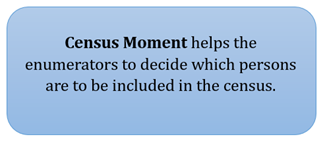
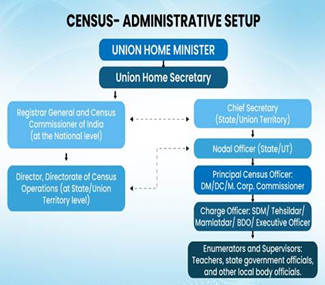
Context: India has officially introduced QR-code-enabled identity cards for enumerators as part of the preparatory phase for Census 2027.
-
- Digital First: This will be India’s first “Digital Census,” with data collected primarily through mobile apps.
- Authentication: QR codes allow citizens to verify the identity of the enumerator instantly.
- Self-Enumeration: The Census will provide a portal for citizens to fill in their data themselves.
- Dynamic Data: Focuses on capturing migration patterns and urbanization trends more accurately.
- NPR Integration: The National Population Register (NPR) update will happen concurrently with the first phase.
- Privacy Protocols: High-level encryption for data stored on the Census mobile application.
- Language Support: The portal and app will support 16 Indian languages.
- Administrative Units: Data will be mapped to the latest administrative boundaries as of 1 January 2026.
- Caste Column: Ongoing debates continue regarding the inclusion of a comprehensive caste-based data column.
- Real-time Processing: Digital entry will allow for much faster data release compared to paper-based censuses.
(TH)
International Relations
BRICS Sherpa Meeting & India-Africa Forum Summit (IAFS-IV):
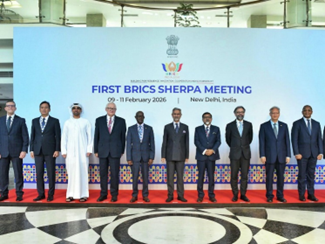
Context: New Delhi is set to host the second BRICS Sherpa meeting starting tomorrow, while preparations for the IAFS-IV in late May were reviewed today.
-
- IAFS-IV Theme: “IA SPIRIT: India-Africa Strategic Partnership for Innovation, Resilience & Inclusive Transformation”.
- Decade-Long Gap: This is the first India-Africa Forum Summit to be held in over 10 years.
- Global South Focus: The BRICS Sherpa meeting aims to bolster partnerships for the “Global South”.
- BRICS Expansion: Discussions will focus on the integration of new members into the BRICS framework.
- IIT Zanzibar: The summit will showcase the success of the first international IIT campus in Africa.
- Strategic Outreach: External Affairs Minister Dr. S. Jaishankar concluded a visit to Trinidad & Tobago today, focusing on Caribbean ties.
- West Asia Conflict: Regional wars are expected to overshadow the upcoming Quad and BRICS Foreign Ministers meetings.
- Energy Security: PM Modi’s upcoming visit to the UAE will focus on long-term LNG and green hydrogen deals.
- Africa Investment: India aims to position itself as an alternative to China in African infrastructure and education.
- Joint Working Groups: A joint release with Singapore today highlighted cooperation in combating transnational crime.
(News on AIR)
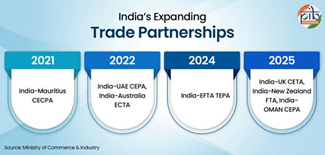
India-Oman Free Trade Agreement (FTA):
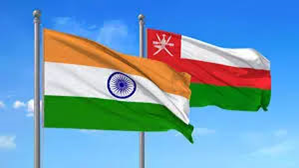
Context: The Ministry of Commerce indicated that the Comprehensive Economic Partnership Agreement (CEPA) with Oman is nearing its “Entry into Force”.
-
- Customs Duty: Anticipates immediate duty-free access for over 80% of Indian exports.
- Energy Security: Oman serves as a critical partner for India’s oil and fertiliser requirements.
- Services Sector: Provides better movement for Indian professionals (Mode 4) into the Gulf region.
- Strategic Location: Oman’s Duqm port is a key strategic interest for Indian maritime security.
- Investment Protection: Includes a robust chapter on bilateral investment protection.
- SME Cooperation: Special provisions to link Indian and Omani MSMEs in the manufacturing sector.
- Digital Trade: One of the first Gulf FTAs to have a dedicated section on cross-border data flows.
- Food Security: Oman views India as a primary source for its food security needs.
- Timeline: Expected to be operational by late May or early June 2026.
- Gulf Cooperation Council (GCC): Seen as a precursor to a wider FTA with the entire GCC bloc.
(Business Standard)
Economy
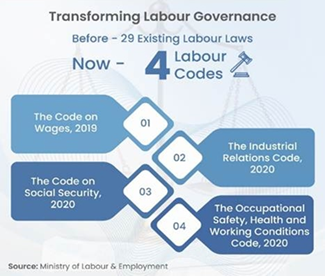
Operationalisation of Four Labour Codes:
Context: The Central Government has fully operationalised the four new Labour Codes today, following the publication of final rules.
-
- Subsumed Laws: They replace over 40 central labour laws into four codes: Wages, Social Security, Industrial Relations, and Occupational Safety.
- Threshold for Retrenchment: The Industrial Relations Code increases the worker threshold for layoffs/closure without government permission from 100 to 300.
- Fixed-Term Employment: Introduces a formal “fixed-term employment” category, providing benefits similar to permanent workers.
- Social Security Fund: Establishes a dedicated social security fund for unorganised, gig, and platform workers.
- Gig Worker Definition: For the first time, “gig workers” and “platform workers” are legally defined in Indian law.
- One Registration: Simplifies compliance by requiring a single registration and single license for businesses.
- Gender Neutrality: Provisions ensure women can work at night (with consent) and in all sectors.
- Web-based Inspection: A new inspection scheme is introduced to reduce the “Inspector Raj” through randomised, web-based inspections.
- Reskilling Fund: Employers must contribute to a ‘worker reskilling fund’ when retrenching workers.
- Trade Union Recognition: Provides a statutory framework for recognising a “negotiating union” at the establishment level.
(TH)
Unified Pension Scheme (UPS) Expansion:
Context: Recent reports from the PFRDA highlight a surge in pension asset growth following the introduction of the Unified Pension Scheme (UPS).
-
- Hybrid Model: Combines features of the National Pension System (contributory) and the Old Pension Scheme (assured).
- Assured Pension: Provides 50% of the average basic pay of the last 12 months as pension.
- Minimum Service: Requires a minimum of 25 years of service for full assured pension.
- Inflation Indexing: Pension is indexed to inflation (Dearness Relief) similar to the old system.
- Family Pension: Provides 60% of the employee’s pension to the spouse in case of death.
- Lump Sum Payment: Employees receive a lump sum at retirement (1/10th of monthly pay for every 6 months of service).
- Minimum Pension: Guaranteed minimum pension of ₹10,000 per month after 10 years of service.
- Contribution Ratio: Government contribution remains at 18.5%, while employee contribution is 10%.
- Investment Freedom: Employees can still choose investment patterns for the non-assured portion of the corpus.
- Fiscal Sustainability: Designed to be more fiscally sustainable for states compared to a full return to OPS.
(BS)
Science & Technology
Launch of India’s First Orbital Data Centre (ODC) Satellite:
Context: Bengaluru-based space startup Pixxel, in partnership with Sarvam AI, announced the upcoming launch of “Pathfinder,” India’s first orbital data centre satellite.
-
- Onboard Processing: The satellite features GPU-based computing to process data directly in orbit rather than sending raw data to Earth.
- Hyperspectral Imaging: It carries Pixxel’s signature hyperspectral sensors for high-resolution environmental monitoring.
- Edge Computing in Space: This is a shift towards “edge computing,” reducing the massive data transmission burden on ground stations.
- Power Source: Leverages near-continuous solar energy available in low Earth orbit (LEO).
- Pathfinder Mission: A 200-kg class satellite designed to run AI models for both training and inference in space.
- Radiation Hardening: Uses specialized shielding to protect GPUs from cosmic radiation damage.
- AI Infrastructure: Sarvam AI provides the Large Language Models (LLMs) and AI infrastructure for the mission.
- Energy Efficiency: Aims to solve the water/energy constraints faced by terrestrial data centres.
- Strategic Sector: India enters a niche group of nations exploring space-based cloud infrastructure.
- Launch Timeline: Full commercial operations are targeted for late 2026/early 2027.
(TH)
Defence
India’s First Indigenous Glide Weapon: TARA:
Context: DRDO and the IAF successfully flight-tested the Tactical Advanced Range Augmentation Weapon (TARA) system.
-
- Nature: It is India’s first indigenously developed glide weapon system.
- Mechanism: Converts conventional unguided bombs into precision-guided munitions using a “wing kit” and GPS/NavIC navigation.
- Developer: Developed by the Research Centre Imarat (RCI), Hyderabad.
- Capability: Enhances range and accuracy, allowing aircraft to release the weapon from a safe distance (Standoff range).
- Technology: Uses low-cost precision guidance and state-of-the-art indigenous avionics.
- Strategic Value: Counterpart to the US’s JDAM kits and Israel’s SPICE system.
- Navigational Support: Likely integrated with GAGAN and NavIC for target accuracy.
- Modular Design: Can be fitted onto various weight classes of bombs currently in the IAF inventory.
- Aatmanirbharta: Supports defense indigenization by involving private defense partners for mass production.
- Test Platform: Typically tested from Su-30 MKI or Tejas platforms for validation of aerodynamics and guidance.

(TH)
History, Art & Culture
Somnath Amrut Mahotsav & PM’s Visit to Gujarat:
Context: Prime Minister Modi arrived in Jamnagar late tonight to participate in the Somnath Amrut Mahotsav.
-
- Historic Milestone: Marks 75 years since the inauguration of the restored Somnath Temple in 1951.
- Consecration Rituals: The PM will participate in Vishesh Maha Puja, Kumbhabhishek, and Dhvajarohan (flag hoisting).
- Commemorative Release: A commemorative stamp and coin will be released to mark the occasion.
- Jyotirlinga Significance: Somnath is the first among the twelve Jyotirlingas of Lord Shiva.
- Sardardham Hostel: In Vadodara, the PM will inaugurate a massive hostel facility for 2,000 students.
- Civilisational Heritage: The temple is celebrated as a symbol of India’s enduring faith and “reconstruction”.
- Ahilyabai Holkar: The historic context includes the 18th-century temple built by Queen Ahilyabai Holkar nearby.
- Post-Independence Restoration: Initiated by Sardar Vallabhbhai Patel and inaugurated by Dr. Rajendra Prasad.
- Tourism Circuit: The event highlights the development of the Somnath-Dwarka religious tourism corridor.
- E-Library Facilities: The new Sardardham complex includes high-tech e-libraries for competitive exam aspirants.

(IE)
Government Schemes
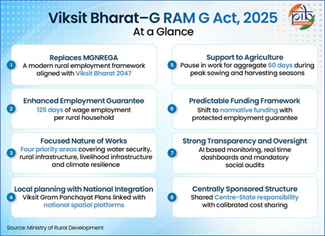
“Viksit Bharat – G RAM G” Act, 2025:
Context: The implementation of the Viksit Bharat -Guarantee for Rozgar and Ajeevika Mission (Gramin) Act, which will replace MGNREGA starting 1 July 2026.
-
- Repeal of MGNREGA: The Mahatma Gandhi National Rural Employment Guarantee Act, 2005, will stand repealed from 1 July 2026.
- Work Guarantee: Increases the statutory guarantee from 100 to 125 days of unskilled manual work per rural household.
- Priority Domains: Focuses on four pillars: water security, rural infrastructure, livelihoods, and disaster preparedness.
- Budgetary Outlay: The Centre has allocated ₹95,692.31 crore for 2026-27, the highest ever for a rural employment scheme.
- Unemployment Allowance: Workers are entitled to an allowance if work is not provided within the prescribed timeframe.
- Transition Period: Current MGNREGA job cards remain valid until new “Gramin Rozgar Guarantee Cards” are issued.
- Weekly Payments: Mandates wage payments on a weekly basis, or within 15 days maximum.
- Direct Benefit Transfer: Payments will continue via DBT into bank/post office accounts.
- Viksit Bharat @2047: Aligns rural employment with the national vision for a developed India by 2047.
- Climate Resilience: New projects under the Act will be specifically audited for their contribution to climate adaptation.
(PIB)
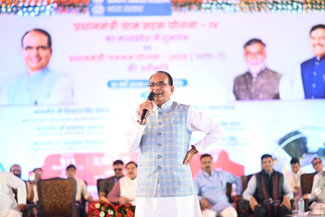
Launch of PMGSY-IV (Silver Jubilee Edition):
Context: During the 25-year celebrations of Pradhan Mantri Gram Sadak Yojana (PMGSY), the government launched its fourth phase.
-
- Objective: Focused on providing all-weather road connectivity to the remaining habitations and upgrading existing rural road networks.
- Ministry: Administered by the Ministry of Rural Development.
- Core Philosophy: “Village roads are the backbone of prosperity,” emphasizing income for women and housing for the poor.
- Targeting: Aims to bridge the last-mile connectivity gap in left-wing extremism-affected areas and tribal belts.
- Funding: Follows a centrally sponsored scheme model (60:40 for general states, 90:10 for NE/Hilly states).
- Integration: Integrated with PM Janman for Particularly Vulnerable Tribal Groups (PVTGs).
- Social Impact: Job cards under MGNREGA are now mandatory for beneficiaries of PMAY 2.0 to ensure convergence of work.
- Digital Monitoring: Utilizes Geo-SADAK for real-time tracking of road construction.
- Sustainability: Promotes use of “Green Technologies” like cold mix technology and waste plastics in road construction.
- Scale: Over 25 years, PMGSY has connected nearly 99% of eligible habitations.
(PIB)
Emergency Credit Line Guarantee Scheme (ECLGS) 5.0:
Context: The Union Cabinet recently approved ECLGS 5.0 to provide credit support amid global supply chain disruptions.
-
- West Asia Context: Specifically designed to help businesses affected by the ongoing geopolitical situation in West Asia.
- Coverage: Provides 100% guarantee coverage for MSMEs and 90% for non-MSMEs and the airline sector.
- Target Flow: Aims for an additional credit flow of ₹2,55,000 crore.
- Airline Support: Specifically carves out ₹5,000 crore for the struggling airline sector.
- Implementation Agency: Managed by the National Credit Guarantee Trustee Company Limited (NCGTC).
- Interest Caps: The scheme likely maintains interest rate caps for MLIs (Member Lending Institutions).
- Extended Tenure: Offers extended repayment periods to ease liquidity stress for manufacturing units.
- Eligibility: Open to borrowers who have not defaulted beyond a specific period (e.g., SMA-0 or SMA-1).
- Collateral-Free: The additional credit provided under the scheme is collateral-free.
- Economic Buffer: Acts as a buffer against rising fuel prices and shipping insurance costs.

(PIB)
Mission for Cotton Productivity:
Context: The Ministry of Agriculture reviewed the progress of the newly approved Mission for Cotton Productivity.
-
- Budget: Allocated ₹5,659.22 crore to enhance indigenous cotton yield.
- Focus Areas: High-density planting system (HDPS) and value-chain development.
- Indigenous Varieties: Promotion of Desi Cotton varieties which are naturally more pest-resistant.
- E-Cotton App: A digital platform to provide farmers with real-time pest alerts and weather data.
- Import Substitution: Aims to reduce India’s dependence on long-staple cotton imports.
- Technology Hubs: Setting up 100 Cotton Technology Hubs across major growing states like Gujarat and Maharashtra.
- Water Efficiency: Focus on drip irrigation and water-saving technologies in arid cotton belts.
- Pink Bollworm: Dedicated research funds for biological control of the Pink Bollworm pest.
- Textile Alignment: Direct linkage with the PM-MITRA textile parks for vertical integration.
- Sustainability: Incentives for “Organic Cotton” certification to capture European markets.
(PIB)
Spread the Word