The Joint Comprehensive Plan of Action (JCPOA), widely known as the “Iran Nuclear Deal,” began as a landmark 2015 diplomatic accord, following the U.S. withdrawal in 2018 and the subsequent expiration of several “sunset clauses” in October 2025, the international community triggered the “snapback” mechanism. This reimposed UN sanctions on Iran, leading to a total breakdown of the 2015 agreement’s legal standing.
The Final Rejection (February 2026)
-
- The “Snapback” of 2025: In September 2025, the “E3” (France, Germany, and the UK) officially triggered the snapback mechanism under UN Security Council Resolution 2231. This move was a response to Iran’s enrichment of uranium to 60% purity and its accumulation of a stockpile sufficient for several nuclear devices.
- Failure of the Geneva Talks: The final attempt to rescue the deal occurred in Geneva on February 26, 2026. President Trump reportedly rejected the resulting Iranian proposal, leading to the launch of Operation Epic Fury just 48 hours later.
- The Result: Six previous UN Security Council resolutions (including Res. 1929, which allows for military action to prevent nuclear proliferation) were legally reinstated.
ORIGINAL JCPOA VS. 2026 REALITY
| Feature | Original JCPOA (2015) | 2026 Reality |
|---|---|---|
| Enrichment Cap | 3.67% (Civilian grade) | 60%+ (Near weapons-grade) |
| Stockpile Limit | 300 kg of UF6 | 450 kg+ of highly enriched uranium |
| Inspections | 24/7 IAEA access | Minimal; IAEA access barred in early 2026 |
| Sanctions Status | Significant relief | Full UN & US Sanctions reinstated |
| Primary Goal | One-year "Breakout Time" | War/Degradation (Breakout time is negligible) |
WHAT IS THE SNAPBACK MECHANISM?
Established under UN Security Council Resolution 2231 (2015), snapback allows any “participant state” to the JCPOA to unilaterally reimpose all pre-2015 UN sanctions on Iran if it is found to be in “significant non-performance.”
-
- Veto-Proof: Unlike standard UN resolutions, the snapback process is designed so that it cannot be blocked by a veto. Once a participant notifies the Council of a breach, the sanctions return automatically after 30 days unless a new resolution is passed to keep them lifted. Any permanent member (like the US or UK) can then veto that new resolution, effectively ensuring the sanctions “snap back.”
| Bloc | Position on Snapback | Legal Argument |
|---|---|---|
| Western Bloc (US, E3) | Active & Binding | The procedure in Res. 2231 was followed; all pre-2015 sanctions are now law. |
| Eastern Bloc (Russia, China) | Null & Void | Since the US left the deal in 2018, the whole framework (including snapback) collapsed and expired in Oct 2025. |
| India | Functional Adherence | While neutral in rhetoric, India has co-sponsored resolutions (Res. 2817) that acknowledge the "new reality" of regional instability. |
CONSEQUENCES OF THE 2026 SNAPBACK
-
- Re-establishment of the 1737 Committee: The UN Sanctions Committee on Iran has been revived to monitor asset freezes and arms embargos.
- Maritime Interdictions: Under the restored Resolution 1803, member states now have the legal right to inspect Iranian cargo ships suspected of carrying prohibited materials.
- Justification for Force: Critics argue that by “snapping back” Resolution 1929, the E3 provided the “legal cover” used for Operation Epic Fury in February 2026, as that resolution allowed for “all necessary measures” to stop Iran’s nuclear program.
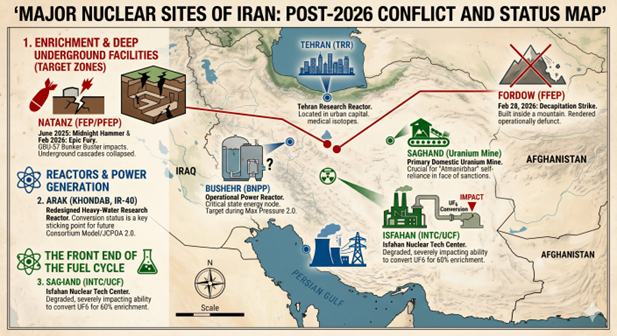
IRAN’S NUCLEAR SITES1. Enrichment & Deep Underground Facilities (Target Zones)
2. Reactors & Power Generation
3. The Front End of the Fuel Cycle
|
CONCLUSION: THE “WAY FORWARD” FOR JCPOA 2.0?
The 2015 model of “sanctions relief for enrichment caps” is considered dead by most jurists. The proposed “New Delhi Protocols” (2027) suggest a new framework:
-
- The “Consortium Model”: No enrichment on Iranian soil. Instead, fuel for Iran’s civilian reactors would be enriched by a regional consortium (including India and the GCC) and delivered to Iran under UN seal.
- Ballistic Inclusion: Unlike the original JCPOA, any new deal would legally mandate limits on Iran’s ballistic missile range (the “True Promise” launchers).
Current Status: As of March 15, 2026, the JCPOA is a “historical artifact.” Diplomacy has been replaced by a “Kinetic Inspection” model—where force is used to dismantle what the law could no longer contain.
Spread the Word