
The Report of the 16th Finance Commission headed by Dr. Arvind Panagariya was tabled in Parliament on February 1, 2026 for the five-year period between 2026-27 and 2030-31.
THE KEY RECOMMENDATIONS:
-
- Share of states in central taxes: 41%(Includes all central taxes except for cesses, surcharges, and the cost of tax collection)
- Grants: total grants worth ₹9.47 lakh crore for the five-year period.
- Local Bodies: Allocated ₹8 lakh crore (₹4.4L cr for Rural, ₹3.6L cr for Urban).
-
-
- Grants are split: 80% Basic (Untied/Tied) and 20% Performance-based.
- Entry Conditions: Local bodies must have audited accounts and functional State Finance Commissions to receive funds.
- Disaster Management: ₹2.04 lakh crore for state disaster relief. The cost-sharing ratio remains 90:10 for Himalayan/NE states and 75:25 for others.
- Discontinued Grants: Revenue deficit grants, sector-specific grants, and state-specific grants (which were part of the 15th FC) have been discontinued.
-
-
- Fiscal Deficit Targets:
- Centre: Target to reach 3.5% of GDP by 2030–31.
- States: Annual limit set at 3% of GSDP.
- Off-Budget Borrowings: The Commission recommended a strict ban on off-budget borrowings; all such liabilities must now be included in the official debt and deficit calculations.
- Subsidy Reform: States are encouraged to rationalise subsidies, particularly “unconditional cash transfers,” and establish clear exclusion criteria for beneficiaries.
- Fiscal Deficit Targets:
-
- Power Sector: States are urged to privatize DISCOMs (Electricity Distribution Companies). A “Special Purpose Vehicle” (SPV) may be used to warehouse existing debt to make them attractive to private investors.
- State Public Sector Enterprises (SPSEs): Recommended the closure of 308 inactive SPSEs. Any enterprise losing money for 3 out of 4 years must be reviewed for closure or privatization.
- Transparency: The Union government is asked to disclose CAG-certified data on net tax proceeds annually to ensure states have clarity on the actual size of the divisible pool.
FORMULA
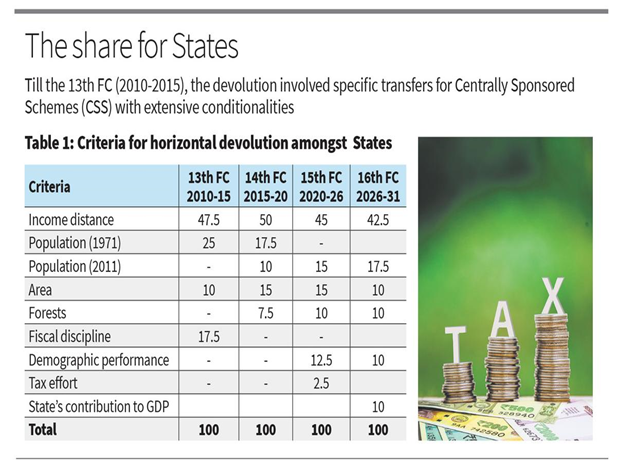
| Criteria | 15th FC (2021-26) | 16th FC (2026-31) | Change Analysis |
|---|---|---|---|
| Income Distance | 45% | 42.5% | Reduced to allow for new efficiency parameters. |
| Population (2011) | 15% | 17.5% | Increased weightage for demographic needs. |
| Contribution to GDP | — | 10% | New feature; rewards states for economic productivity. |
| Demographic Performance | 12.5% | 10% | Redefined to population growth between 1971–2011. |
| Area | 15% | 10% | Reduced weightage. |
| Forest | 10% | 10% | Now includes open forests and growth in cover. |
| Tax and Fiscal Efforts | 2.5% | - | - |
Grants-in-aid
The 16th FC has recommended grants worth Rs 9.47 lakh crore over the five-year period. These comprise grants for: (i) urban and rural local bodies, and (ii) disaster management. The 16th FC has discontinued the following grants recommended by the 15th FC: (i) revenue deficit grants, (ii) sector-specific grants, and (iii) state-specific grants.
| Grants | Amount |
|---|---|
| Local governments | 7,91,493 |
| Rural local bodies | 4,35,236 |
| Basic Grant | 3,48,188 |
| Performance Grant | 87,048 |
| Urban local bodies | 3,56,257 |
| Basic Grant | 2,32,125 |
| Performance Grant | 58,032 |
| Special Infrastructure Component | 56,100 |
| Urbanisation Premium | 10,000 |
| Disaster management | 1,55,916 |
| Total | 9,47,409 |
Grants for local bodies: The 16th FC has recommended grants worth Rs 4.4 lakh crore and Rs 3.6 lakh crore for rural and urban local bodies, respectively. These grants are divided into basic (80%) and performance-based (20%) components. Special Infrastructure Grants and Urbanisation Premium Grants have also been recommended for urban local bodies.
All local body grants conditioned to: All local body grants will be made available upon fulfilment of three entry-level criteria:
1. constitution of the local bodies as per the Constitution
2. publication of provisional and audited accounts of the local bodies in the public domain, and
3. timely constitution of the State Finance Commission.
Basic grants: 50% of the basic grant will be untied and the rest 50% will be tied to: (i) sanitation and solid waste management, and/or (ii) water management.
Special infrastructure grants: This component will be tied to the development of a comprehensive wastewater management system in cities with population between 10-40 lakh as per the 2011 census. Grants worth Rs 56,100 crore have been recommended over five years.
Urbanisation premium grant: These will be released to states as a one-time grant for: (i) merger of peri-urban villages into adjoining urban local body areas and (ii) formulation of a Rural to Urban Transition Policy. Rs 10,000 crore have been recommended under the urbanisation premium component.
Disaster management grants: The Commission has recommended disaster management corpus of Rs 2,04,401 crore for State Disaster Relief and Management Funds (SDRF and SDMF). The cost-sharing pattern between the centre and states is recommended to be: (i) 90:10 for north-eastern and Himalayan states, and (ii) 75:25 for all other states. Centre’s share in total will be Rs 1,55,916 crore.
Fiscal Roadmap
The Commission has recommended that the Centre should bring down fiscal deficit to 3.5% of GDP by 2030-31. It recommended the annual fiscal deficit limit for states to be 3% of GSDP. It also recommended strictly discontinuing the practice of off-budget borrowings for states and bringing all such borrowings onto their budgets. The definition of fiscal deficit and debt should be expanded to uniformly include all off‑budget borrowings.
The Commission has projected the combined debt of the central and state governments to decline from 77.3% in 2026-27 to 73.1% of the GDP in 2030-31.
Power-sector reforms
The Commission recommended that states should actively pursue privatisation of electricity distribution companies (DISCOMs). To shield the private investor from debt burden after discom takeover, a special purpose vehicle may be created to warehouse the debt. Pre-payment or eventual repayment of this debt may be allowed using the funds from the Special Assistance Scheme for Capital Investment. It also recommended that states should be allowed to utilise this assistance only after the privatisation process is complete.
Subsidy Expenditure
The Commission recommended states to review and rationalise their subsidy expenditure. It noted that schemes providing unconditional cash transfers tend to have large and untargeted beneficiaries. It recommended setting clear exclusion criteria and a rigorous review process to ensure effective targeting. In addition, it recommended discontinuing financing of subsidies through off budget borrowings.
The Commission also noted a lack of standardisation in defining and accounting of subsidies and transfers across states. It observed that subsidies and transfers across states are being misclassified as assistance, grants, or other expenditure. It recommended adoption of a uniform approach for accounting and disclosure of subsidies and transfers.
Public Sector Enterprise Reforms
The Commission recommended a review and closure of 308 inactive State Public Sector Enterprises (SPSEs). It recommended formulation of a state-level PSEs disinvestment policy to target inactive and underperforming SPSEs.
State or union PSEs, which incur losses for three out of four consecutive years, should be placed for the respective Cabinet’s consideration. The Cabinet may decide closure, privatisation, or continuation depending on the strategic importance of the enterprise.
Individual State Shares: 15th FC vs. 16th FC
| State | 15th FC Share (%) | 16th FC Share (%) | Change |
|---|---|---|---|
| Andhra Pradesh | 4.05 | 4.22 | +0.17 |
| Arunachal Pradesh | 1.76 | 1.35 | -0.41 |
| Assam | 3.13 | 3.26 | +0.13 |
| Bihar | 10.06 | 9.95 | -0.11 |
| Chhattisgarh | 3.41 | 3.30 | -0.11 |
| Goa | 0.39 | 0.37 | -0.02 |
| Gujarat | 3.48 | 3.76 | +0.28 |
| Haryana | 1.09 | 1.36 | +0.27 |
| Himachal Pradesh | 0.83 | 0.91 | +0.08 |
| Jharkhand | 3.31 | 3.36 | +0.05 |
| Karnataka | 3.65 | 4.13 | +0.48 |
| Kerala | 1.93 | 2.38 | +0.45 |
| Madhya Pradesh | 7.85 | 7.35 | -0.50 |
| Maharashtra | 6.32 | 6.44 | +0.12 |
| Manipur | 0.72 | 0.63 | -0.09 |
| Meghalaya | 0.77 | 0.63 | -0.14 |
| Mizoram | 0.50 | 0.56 | +0.06 |
| Nagaland | 0.57 | 0.48 | -0.09 |
| Odisha | 4.53 | 4.42 | -0.11 |
| Punjab | 1.81 | 2.00 | +0.19 |
| Rajasthan | 6.03 | 5.93 | -0.10 |
| Sikkim | 0.39 | 0.34 | -0.05 |
| Tamil Nadu | 4.08 | 4.10 | +0.02 |
| Telangana | 2.10 | 2.17 | +0.07 |
| Tripura | 0.71 | 0.64 | -0.07 |
| Uttar Pradesh | 17.94 | 17.62 | -0.32 |
| Uttarakhand | 1.12 | 1.14 | +0.02 |
| West Bengal | 7.52 | 7.22 | -0.30 |
Key Trends in the 16th FC Devolution
-
- Highest Recipient: Uttar Pradesh remains the state with the highest share at 62%, although its share decreased slightly from 17.94%.
- Significant Gainers: Karnataka (+0.48), Kerala (+0.45), and Gujarat (+0.28) saw notable increases in their shares.
- Notable Decreases: Madhya Pradesh (-0.50), Arunachal Pradesh (-0.41), and Uttar Pradesh (-0.32) experienced the largest drops in percentage terms.
- Vertical Stability: Despite these individual state adjustments, the total vertical devolution (share of all states combined) remains at 41% of the divisible pool.
What were States’ demands?
Firstly, as regards vertical devolution, 18 States had demanded that the States’ share be increased from the current 41% to 50%. Few other States had demanded an increase of 45% to 48%. Many States had demanded the inclusion of cess and surcharge in the divisible pool as well as fixing a cap on cess and surcharge that could be levied by the Centre.
What did the 16th FC recommend?
It recommended retaining the States’ share in vertical devolution at its current level of 41% considering three main reasons
1. The States’ share in total tax revenues of the country
2. Much of the spending of the Union in CSS is anyway ultimately routed to the States
3. The Union government needs increased funds for defence and infrastructure.
Two principles for horizontal devolution:
-
- First, changes to each State’s share in the portion of divisible pool should be gradual.
- Second, due recognition should be given to efficiency and especially the States’ contributions to growth.
Accordingly, a new criterion of State’s contribution to GDP has been added. The weightage to this new criterion as well as other criteria has been assigned in such a way that it spells a directional change without causing a drastic shift in States’ shares.
Considering all the above factors, the share of southern and western States has marginally increased while the share of big north and central States has marginally decreased.
The Centre should progressively reduce raising revenues through cess and surcharge. The States should make their subsidies efficient and targeted, actively pursue reforms in the power sector, and rein in the levels of their fiscal deficit and debt. The Centre and States should undertake various public sector enterprise reforms.
THE FORMULA CALCULATIONS
Per Capita GSDP Distance (Income Distance): The 16th FC has defined income distance as the difference between the per capita GSDP of a state and the average of the per capita GSDP of the top three large states with the highest per capita GSDP. Per capita GSDP has been computed as the average over the period 2018-19 and 2023-24, excluding the pandemic year of 2020-21. States with a lower per capita GSDP will receive a higher share on this parameter, to maintain equity among states.
The Income Distance (or Per Capita GSDP Distance) is the most significant parameter used by the Finance Commission to ensure fiscal equity across India. It is designed to provide more financial support to states that have lower economic output per person compared to the wealthiest states.
Here is a breakdown of how the 16th Finance Commission (FC) calculates and applies this parameter:
1. The Benchmark (The “Distance”)
The Commission determines the “Income Distance” by identifying the top three large states with the highest per capita Gross State Domestic Product (GSDP).
-
- It calculates the average per capita GSDP of these three leader states.
- The “distance” for any other state is the gap between its own per capita GSDP and that top-three average.
2. The Data Period
To ensure the data is stable and not skewed by temporary economic shocks, the Commission used a multi-year average:
-
- Timeframe: The average covers the period from 2018-19 to 2023-24.
- Pandemic Exclusion: The year 2020-21 was explicitly excluded from the calculation because the COVID-19 pandemic caused abnormal economic fluctuations that would have distorted the long-term picture.
3. The Principle of Equity
The primary goal of this parameter is progressive redistribution:
-
- Inverse Relationship: States with a lower per capita GSDP (meaning they are relatively poorer) have a larger “distance” from the benchmark.
- Higher Funding: A larger distance translates to a higher share in the devolution of central taxes.
- Why it matters: This ensures that less-developed states have more resources to provide essential public services—like healthcare and education—equalizing the quality of life across the country regardless of a state’s internal revenue-generating capacity.
4. Weightage in the Formula
The 16th FC assigned a weight of 42.5% to Income Distance. While this remains the highest-weighted factor in the distribution formula, it is a slight decrease from the 45% weight used by the 15th FC.
Population: On this parameter, the share in devolution is determined based on the share in the population as per the 2011 Census.
Demographic Performance: The 15th FC had introduced this parameter to award states for controlling population on the basis of Total Fertility Rate (TFR). The 16th FC has redefined this to account for population growth between 1971 and 2011 instead of relying on change in TFR. States with lower population growth will have a higher share under this parameter.
Forest: The 16th FC has assigned weightage to both the share of a state in the overall forest area, and its share in the increase in overall forest area between 2015 and 2023. Further, it has also considered open forests in arriving at the total forest area. In contrast, the 15th FC had considered only dense and moderately dense forests, and defined the parameter only in terms of share in the overall forest area.
Contribution to GDP: The 16th FC has introduced this parameter to account for the contribution to national GDP. This replaces the tax and fiscal efforts parameter used by the 15th FC which rewarded states with a higher tax collection efficiency. Contribution to GDP by a state is calculated as the squared root of its GSDP to the sum of squared root of GSDP of all states. GSDP of each state has been measured as the average nominal GSDP between 2018-19 and 2023-24 (excluding the pandemic year of 2020-21).
The Contribution to GDP parameter is a significant addition to the 16th Finance Commission’s (FC) devolution formula, designed to reward states for their economic productivity and contribution to the national economy. This parameter effectively replaces the “Tax and Fiscal Efforts” metric used by the 15th FC.
Here is a detailed breakdown of the formula and methodology used:
1. The Mathematical Formula
To ensure that larger states do not disproportionately dominate this parameter while still rewarding higher output, the Commission uses a square root transformation. The share of a state is calculated as:
State’s Share=∑(GSDP of all States)GSDP of the State
2. Methodology and Data Selection
-
- Averaging Period: The Commission used the average nominal GSDP over the period from 2018-19 to 2023-24.
- Pandemic Exclusion: To avoid data distortions caused by the economic shock of COVID-19, the year 2020-21 was excluded from this average.
- Nominal Terms: The calculation is based on nominal GSDP rather than real GSDP to reflect current economic value.
3. Strategic Intent
-
- Replacing Tax Effort: While the 15th FC focused on tax collection efficiency (Tax and Fiscal Efforts), the 16th FC shifted toward broader economic contribution.
- Incentivizing Growth: By assigning a 10% weight to this parameter, the Commission provides a direct fiscal incentive for states to implement policies that drive economic growth and increase their Gross State Domestic Product.