Introduction
The Sagarmala Programme launched in March 2015, aims to reduce logistics costs and promote port-led development by integrating road, rail, and inland water networks.
The Five Pillars of Sagarmala
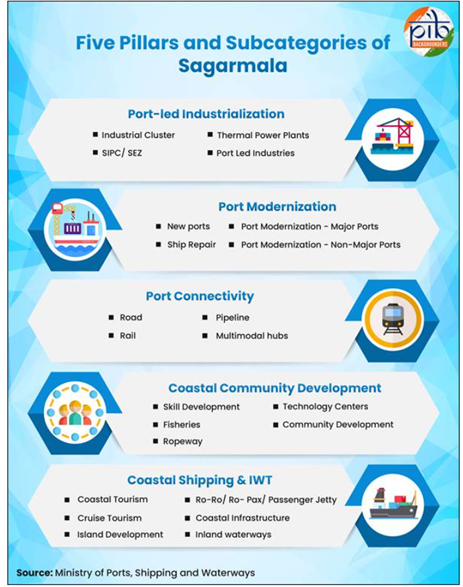
India’s maritime sector is the backbone of its trade, with a 11,099 km coastline and 14,500 km of navigable waterways. Maritime routes handle approximately 95% of India’s trade by volume and 70% by value. The program is structured around five strategic pillars to create a holistic maritime ecosystem:
1. Port Modernization: Upgrading existing ports and building new “Greenfield” ports.
2. Port Connectivity: Strengthening hinterland links via multimodal transport networks.
3. Port-Led Industrialization: Developing industrial clusters near ports to reduce logistics overheads.
4. Coastal Community Development: Skill development, fisheries support, and sustainable tourism for coastal residents.
5. Coastal Shipping & Inland Waterways: Shifting cargo from congested road/rail to more sustainable water routes.
Institutional Framework
The program is managed through a coordinated multi-tier structure:
-
- National Sagarmala Apex Committee (NSAC): Provides overall policy guidance.
- Maritime States Development Council (MSDC): Facilitates Centre-State coordination.
- Sagarmala Finance Corporation Limited (SMFCL): India’s first NBFC dedicated to the maritime sector, offering tailored financial solutions with loan sanctions of ₹4,300 crore as of Dec 2025.
Navigating Success
-
- Operational Efficiency: Average vessel turnaround time dropped from 96 hours (2014) to 49.5 hours (2025).
- Global Standing: 9 Indian ports now rank among the world’s top 100.
- Inland Waterways: Cargo movement through inland waterways grew by 700%, reaching 145.50 MTPA in FY 2024-25.
- Passenger Connectivity: 17 Ro-Pax and ferry projects have been completed, benefiting over 35 lakh passengers. For example, The Ghogha–Hazira Ro-Pax reduced travel time from 10 hours (road) to 4 hours (sea).
Challenges
-
- Last-Mile Connectivity: The Hindu reports that while port capacity has increased, bottlenecks in “last-mile” rail and road connectivity to non-major ports continue to hinder overall logistics speed.
- Environmental Impact: ORF notes that rapid port expansion and dredging often lead to coastal erosion and habitat loss, requiring more stringent Environmental Impact Assessments (EIA).
- Financing Gaps: PRS Legislative highlights that attracting private investment for long-gestation “Port-Led Industrialization” projects remains a challenge due to perceived regulatory risks and land acquisition delays.
Way Forward
-
- Comprehensive Modernization: Aligning with Maritime Amrit Kaal Vision 2047 to position India as a global maritime hub.
- Innovation & R&D: Fostering digital innovation and research to make port operations “smarter” and more sustainable.
- Logistics Cost Reduction: Targeting a significant reduction in India’s logistics costs to make exports globally competitive.
- Island Development: Holistic development of island territories to boost strategic presence and tourism.
Conclusion
Sagarmala 2.0 will be the next step in ensuring India becomes a top-tier global maritime power by 2047 by combining infrastructure growth with digital finance through SMFCL and social welfare for coastal communities, India is building a resilient blue economy.
Spread the Word