Introduction:
India’s rise as a global health leader is driven by a vision of Universal Health Coverage (UHC) and the goal of becoming a “Viksit Bharat” (Developed India) by 2047. Through massive infrastructure expansion, digital integration, and its role as the “Pharmacy of the World,” India is restructuring global healthcare delivery.
Universal Health Coverage: The Ayushman Bharat Umbrella
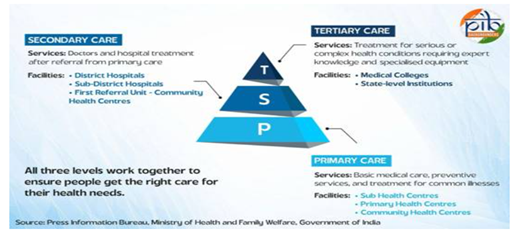
Ayushman Bharat is the government’s flagship strategy to ensure quality care reaches the most vulnerable populations across primary, secondary, and tertiary levels.
-
- AB-PMJAY: The world’s largest public health assurance scheme, providing ₹5 lakh ($5,000) annually for secondary and tertiary care. It covers the bottom 40% of the population and all seniors over 70, saving families over ₹1.25 lakh crore in 2024-25.
- Ayushman Arogya Mandirs (AAMs): A network of 184,235 primary centers providing essential care close to home. AAMs conducted 426.6 million teleconsultations last year, bridging the urban-rural divide.
- PM-ABHIM: A ₹32,928.82 crore mission focused on strengthening grassroots infrastructure, including critical care blocks and integrated district labs.
- Digital Mission (ABDM): The backbone of a paperless ecosystem with over 863 million Ayushman Bharat Health Accounts (ABHA) created as of February 2026.
Pharmacy of the World
India’s pharmaceutical prowess ensures a global supply of affordable, life-saving medicines and vaccines.
-
- Generic Leadership: India is the largest supplier of generic medicines, meeting 20% of global supply and over 70% of global anti-retroviral needs.
- Vaccine Powerhouse: Supplies 55–60% of UNICEF’s vaccines. In 2026, India launched a nationwide HPV Vaccination Programme to prevent cervical cancer, targeting 11.5 million adolescent girls.
- Biotechnology Growth: The bioeconomy has seen a 13-fold increase in a decade, projected to reach $300 billion by 2030.
- Biopharma SHAKTI: Launched in Budget 2026-27 to create an end-to-end ecosystem for biologics, including a network of 1,000+ clinical trial sites.
Technology & Innovation
India is operationalizing cutting-edge tech to solve “last-mile” delivery challenges.
| Innovation | Impact & Reach |
|---|---|
| i-DRONE | Delivers vaccines/supplies to mountainous regions and transports TB/blood samples in high-altitude areas. |
| Tele MANAS | 24x7 digital mental health service; handled over 3.28 million calls in 20 languages. |
| SAHI Strategy | Launched in 2026, the Strategy for AI in Healthcare for India guides ethical AI use in diagnostics and patient management. |
| AI Diagnostics | MadhuNetrAI graded retinal photos for 7,100 diabetic patients; Adverse Outcome Prediction tool led to a 27% decline in TB treatment failures. |
Affordability
-
- Affordable Medicines: The PMBJP operates 17,990 Janaushadhi Kendras, selling medicines at 50-90% lower than market prices.
- Medical Education: MBBS seats have increased by 130% (to 118,190) and PG seats by 138% (to 74,306) over the last 11 years.
- Medical Tourism: Tourists grew from 112,000 in 2009 to 600,000 in 2024, supported by new integrated medical hubs.
Challenges
-
- While seats have doubled, The Hindu reports a persistent rural-urban imbalance, with 70% of specialists remaining in urban areas.
- ORF notes that while ABHA IDs have scaled, the “digital health locker” adoption remains low in regions with poor internet connectivity.
- Despite screening millions for hypertension and diabetes at AAMs, The Indian Express highlights a rising “silent epidemic” of NCDs among the youth.
The Way Forward
-
- It requires mandatory rural service incentives and scaling the AAM specialist outreach.
- Integration of i-DRONE data with offline-first digital records is essential.
- SAHI-driven predictive analytics must prioritize early school-level screenings.
Conclusion:
India’s shift from endemic disease management to being a global health tech leader demonstrates the power of strategic public-private collaboration.
Spread the Word