Introduction:
India is rapidly emerging as a global AI powerhouse, with 89% of new startups in 2024 being AI-powered and 87% of enterprises actively deploying AI solutions. The domestic AI market is projected to grow at a CAGR of 25%-35% through 2027. To sustain this momentum, industry bodies like NASSCOM estimate that India’s AI talent pool must expand from approximately 650,000 in 2024 to over 1.25 million by 2027.
National Policy Framework: NEP 2020
The National Education Policy (NEP) 2020 recognizes AI’s potential to drive economic growth and personalize learning.
-
- Multidisciplinary Approach: NEP emphasizes learning AI, computer science, and data science across all levels.
- IndiaAI Mission: Launched in March 2024 with a budget of ₹10,371.92 crore, it fosters innovation across government, startups, and academia.
- Democratization: The strategy ensures AI tools reach remote and tribal areas to bridge the digital divide.
AI in School Education
The Ministry of Education has integrated AI into curricula via CBSE and NCERT under the National Curriculum Framework (NCF) 2023.
| Platform/Initiative | Target Audience | Key Features |
|---|---|---|
| CBSE Module | Class VI onwards | 15-hour AI skill module; optional subject for IX-XII. |
| DIKSHA | Students & Teachers | AI-based keyword search and read-aloud for visually impaired. |
| SOAR Initiative | Classes 6–12 | 15-hour student modules and 45-hour "AI for Educators" module. |
| NCERT | Grades 1-2 | Used AI/ML to translate textbooks into 22 Indian languages. |
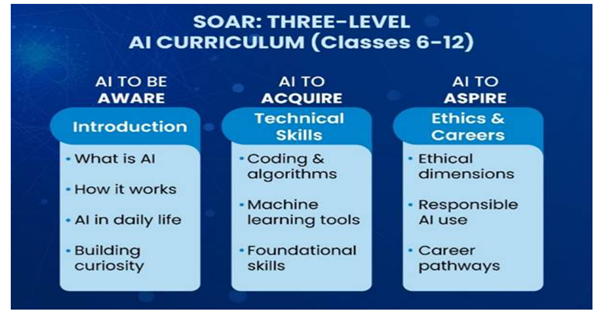
AI in Higher Education
Higher education bodies are restructuring courses to include advanced technologies like 3D machining and Deep Learning.
-
- UGC & AICTE: AI components are now mandatory in all IT-related courses; scholarships like PRAGATI support women in engineering.
- Perplexity AI Partnership: Provides support to 40 million students across 14,000 institutions for AI-led research.
- Srijan (Center for GenAI): Established at IIT Jodhpur in partnership with Meta to advance open-source AI.
- YuvAi Initiative: Targets 100,000 students (18-30 years) to develop solutions for healthcare, agriculture, and smart cities.
Inclusive AI
India is leveraging AI to bridge gaps for children with Specific Learning Disabilities (SLDs).
-
- Readabled: An online dyslexia training application for phonetic awareness.
- ScreenPlay: A game-based tool to identify autism risks in children aged 3-6.
- Voice Fusion AI (Prototype): Assistive support for SLDs in multiple Indian languages.
- Special Educator AI (Idea): A system designed to address the shortage of human special educators.
AI Projects
Government-funded R&D focuses on the ethical “Safe & Trusted AI” pillar.
| Project Focus | Implementing Institute | Description |
|---|---|---|
| Machine Unlearning | IIT Jodhpur | Removing specific data from Generative Foundation Models. |
| Bias Mitigation | NIT Raipur / IIT Roorkee | Frameworks to mitigate dataset bias in healthcare and ML pipelines. |
| Explainable AI | DIAT Pune | Enabling privacy-preserving AI for security sectors. |
| ParakhAI | Civic Data Labs | Open-source toolkit for participatory algorithmic auditing. |
National Skilling Initiatives
To equip the workforce, foundational and advanced AI training is being scaled nationwide.
-
- PMKVY 4.0: 36,584 trained in AI (45% women); includes the AI Career for Women initiative.
- SkillSaksham: A partnership with Microsoft targeting 10,000+ candidates in 200 ITIs.
- FutureSkills PRIME: A NASSCOM partnership with 16.29 lakh+ enrolled in 500+ digital fluency courses.
- YUVA AI For All: A free, self-paced 4-hour foundational course targeting 1 crore citizens
Challenges
-
- The Inference Gap: The Hindu warns of an “inference gap” where the capital and infrastructure (GPUs) reside abroad, making domestic deployment expensive and potentially creating a new digital divide.
- Cognitive Offloading: Recent studies highlight concerns over “cognitive offloading,” where excessive reliance on AI for homework and grading may diminish critical thinking and problem-solving skills in students.
- Algorithmic Bias: The New Indian Express and ORF note that AI can amplify existing societal biases (gender, caste, socio-economic) if trained on non-diverse datasets, necessitating strict Responsible AI guardrails.
- Teacher Displacement Anxiety: While officials pitch AI as a “bridge,” there is persistent anxiety among educators regarding AI displacing human interaction and traditional pedagogical roles.
Way Forward
-
- Sovereign AI Infrastructure: Expanding domestic data center capacity and developing indigenous LLMs through projects like Bhashini and Sarvam AI to ensure cultural and linguistic relevance.
- Digital Temperance: Implementing policies that encourage students to “wrestle unaided” with foundational concepts to build meta-cognitive resilience before using AI assistants.
- Teacher as Facilitator: Reorienting teacher training toward AI-assisted pedagogy where AI handles routine grading, allowing teachers to focus on holistic and empathetic student development.
- Regulatory Frameworks: Aligning AI deployment with the Digital Personal Data Protection Act, 2023 to safeguard vast amounts of student data.
India’s AI education strategy is a decisive pivot from rote learning to personalized, experiential education. By institutionalizing initiatives like Bodhan AI and the Bharat EduAI Stack, the government aims to empower both students and teachers.
Conclusion:
However, the long-term success of this “pedagogical revolution” depends on balancing technological adoption with ethical governance and ensuring that algorithmic assistance does not replace cerebral persistence.
Spread the Word