Economy
LPG & Natural Gas Supply Disruption:
Context
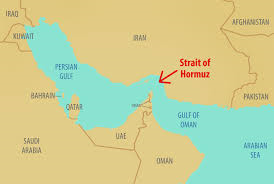
India faced disruptions in LPG and LNG supply due to geopolitical tensions affecting the Strait of Hormuz, prompting government intervention.
-
- Around 20–21 million barrels of oil per day pass through the Strait of Hormuz.
- Nearly 20% of global LNG trade passes through this chokepoint.
- India imports a large portion of LPG from Persian Gulf countries.
- The government invoked the Essential Commodities Act, 1955 to prioritise gas allocation.
- Priority sectors include household LPG and transport fuel.
- Strategic petroleum reserves exist in India, but no strategic LPG reserves exist.
- Major LPG distributors include Indian Oil, BPCL and HPCL.
- LNG imports are crucial for power, fertiliser and city gas distribution.
- Strait of Hormuz connects the Persian Gulf with the Gulf of Oman.
-
- Iran controls much of the northern coastline of the strait.
(TH)
Relaxation of FDI Rules for Neighbouring Countries:
Context
The Cabinet approved changes to rules related to FDI from countries sharing land borders with India, relaxing earlier restrictions introduced in 2020.
-
- The earlier rules were introduced under Press Note 3 (2020).
- These rules required government approval for investments from neighbouring countries.
- New guidelines allow automatic route when beneficial ownership is below 10%.
- Majority ownership must remain with Indian residents or Indian-controlled entities.
- The move aims to promote high-tech manufacturing investment.
- Sectors include electronics, semiconductors and capital goods manufacturing.
- Approval timelines are expected to be around 60 days.
- India has seen recent net FDI outflows in some quarters due to global uncertainty.
(PIB+TH)
Electric Mobility Push in India:
Context
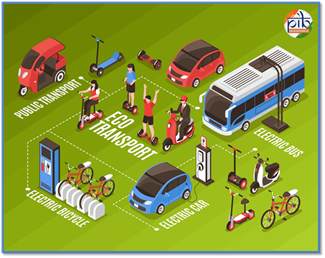
Government highlighted the rapid growth in electric vehicle adoption and deployment of electric buses under national mobility schemes.
-
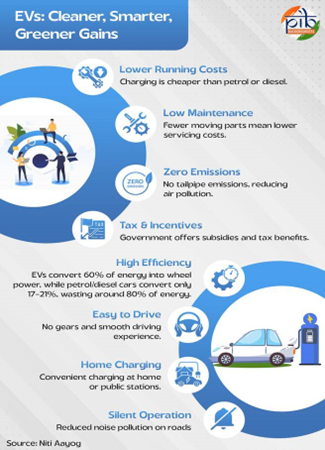
- EV registrations increased significantly between 2019-20 and 2024-25.
- The PM e-Bus Sewa Scheme promotes electric buses in cities.
- A ₹500-crore Payment Security Mechanism Fund ensures timely payments to operators.
- Over 6,000 electric buses have been tendered.
- 19 States and UTs submitted financial guarantees to RBI.
- EV adoption helps reduce urban air pollution and oil imports.
- India promotes EV manufacturing through Production Linked Incentive (PLI) schemes.
- Lithium-ion batteries dominate EV technology.
- EV policy aligns with India’s climate commitments under the Paris Agreement.
-
- EV ecosystem includes charging infrastructure and battery recycling.
(PIB)
Geography, Mapping, Ecology & Environment and DM
Rare Earth Supply Chains:
Context
Countries including India are exploring strategies to diversify rare earth element supply chains.
-
- Rare earth elements include 17 elements, mainly the lanthanide series.
- They are crucial for magnets, electric vehicles, wind turbines and electronics.
- Despite the name, rare earth elements are not always rare in crustal abundance.
- Their extraction and processing are environmentally intensive.
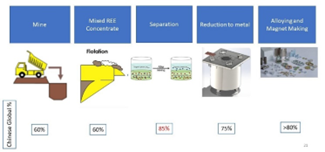
- China dominates global rare earth processing capacity.
- Rare earth magnets are critical for high-efficiency motors.
- India possesses reserves of monazite sands along coastal regions.
- Monazite contains thorium and rare earth elements.
- Processing rare earths requires complex chemical separation.
- Supply chain diversification is seen as a strategic technology priority.
(ET)
Global Methane Emissions Monitoring:
Context
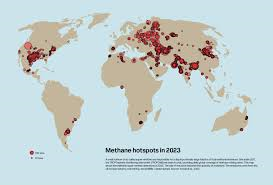
Global discussions continued on reducing methane emissions, especially from fossil fuel production and agriculture.
-
- Methane (CH₄) is the second most important anthropogenic greenhouse gas after CO₂.
- It has a much higher global warming potential than CO₂ over a 20-year period.
- Major sources include livestock, rice cultivation, landfills, and fossil fuel extraction.
- Methane remains in the atmosphere for about 12 years.
- Reducing methane emissions can produce rapid climate benefits.
- The Global Methane Pledge aims to reduce methane emissions by 30% by 2030.
- Satellite monitoring is increasingly used to detect methane leaks.
- Wetlands are the largest natural source of methane.
- Methane oxidation in the atmosphere forms carbon dioxide and water.
- Reducing methane emissions also improves air quality.
(ET)
Urban Heat Island Concerns in Indian Cities:
Context
Reports highlighted rising urban heat island intensity in major Indian cities.
-
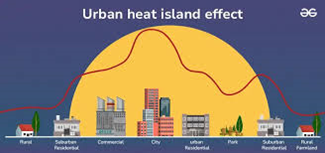
- Urban Heat Island (UHI) refers to higher temperatures in urban areas compared to rural surroundings.
- Causes include concrete surfaces, reduced vegetation, and waste heat from vehicles and industries.
- Asphalt and concrete have high heat absorption and low albedo.
- UHI effects are stronger at night due to slower heat release.
- Urban vegetation reduces temperature through evapotranspiration.
- Green roofs and cool roofs are used as mitigation strategies.
- Climate change can amplify UHI effects.
- UHI can increase electricity demand for cooling.
- It also worsens air pollution and heat stress mortality.
- Urban planning measures include reflective surfaces and urban forests.
(IE)
Deep-Sea Mining and Polymetallic Nodules:
Context
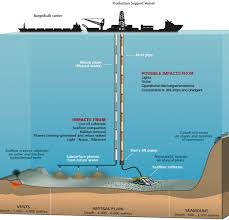
India renewed discussions on exploration of polymetallic nodules in the Central Indian Ocean Basin as part of deep-sea mining initiatives.
-
- Polymetallic nodules contain nickel, cobalt, copper and manganese.
- They occur mainly on the abyssal plains of deep oceans at depths of 4,000–6,000 m.
- India has an exploration contract from the International Seabed Authority.
- The allocated exploration area lies in the Central Indian Ocean Basin (CIOB).
- The ISA regulates mineral resources in areas beyond national jurisdiction under UNCLOS.
- Deep-sea mining is controversial due to potential benthic ecosystem damage.
- Nodules grow extremely slowly — a few millimetres per million years.
- India’s deep ocean exploration efforts are part of the Deep Ocean Mission.
- The mission includes development of a manned submersible vehicle.
- Polymetallic nodules are considered important for energy transition technologies.
(TH)
First National Checklist of Fireflies:
Context
Researchers released India’s first comprehensive firefly species checklist.
-
- Fireflies belong to the beetle family Lampyridae.
- They produce light through bioluminescence.
- The light is generated by a chemical reaction involving luciferin and luciferase.
- Bioluminescence is used mainly for communication and mating signals.
- Fireflies are indicators of healthy ecosystems.
- Their populations are declining globally due to light pollution and habitat loss.
- They are commonly found in forests, wetlands and grasslands.
- Bioluminescence occurs in several marine organisms as well.

(TH)
Science & Technology
Proton Accelerator Facility in India:
Context
India plans to establish a proton accelerator facility in Visakhapatnam for advanced research.
1. Particle accelerators accelerate charged particles using electromagnetic fields.
2. Proton accelerators are used in nuclear physics and materials science.
3. They also support medical applications such as proton therapy for cancer.
4. Accelerators help simulate conditions inside stars and atomic nuclei.
5. Major global accelerator facilities include CERN (Europe).
6. Particle beams can be used to produce radioisotopes for medicine.
7. Accelerator research contributes to fundamental physics discoveries.
8. India participates in several international accelerator projects.

(TH)
Spread the Word