Indian Society & Social Justice
National Migration Survey by NSO:
-
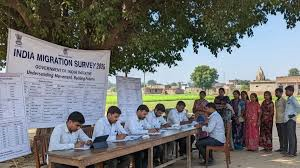
- Context: The National Statistics Office (NSO) announced a nationwide survey on internal migration to be conducted between July 2026 and June 2027 to generate updated data on internal migration trends across India.
-
- NSO survey covers rural–urban and inter-state migration.
- It focuses on employment characteristics and remittance flows.
- Includes seasonal and circular migration, historically underreported.
- Most recent data is from Periodic Labour Force Survey (PLFS) 2020–21.
- Overall migration rate in PLFS was 28.9%, with higher female migration due to marriage.
- Data will support urban planning, labour policy, social security design.
- Will inform housing, employment, education, and healthcare coverage policies.
- Helps refine estimates of informal sector workforce and economic mobility.
- Timely data assists governance responses to urbanisation challenges.
- This large-scale survey is critical for evidence-based policymaking.
(PIB)
Ek Bharat Shreshtha Bharat – Expansion of Eklavya Model Residential Schools:
-
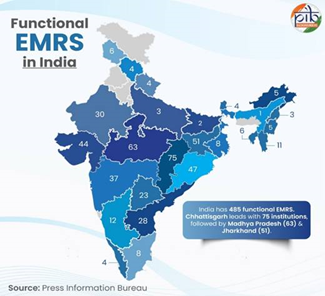
- Context: Expansion of Eklavya Model Residential Schools (EMRS) for tribal education in under-served regions like Odisha and nationwide.
-
- EMRS provide quality education for tribal students.
- Expansion covers underserved tribal blocks in Odisha and elsewhere.
- Aims to reduce educational inequality.
- Residential model enhances access and retention.
- Focus on holistic and multidisciplinary curriculum.
- Supports socio-economic upward mobility.
- Linked to National Education Policy goals.
- Encourages local cultural context in education.
- Promotes sports and vocational training.
- Enhances tribal participation in competitive exams.
(PIB)
Economy
Yantra India Limited Gets ‘Miniratna Category-I’ Status:
-
- Context: The Government of India approved the grant of Miniratna Category-I status to Yantra India Limited, a defence PSU, reflecting improved performance, profitability, and autonomy.
-
- Miniratna Category-I status confers enhanced financial and operational autonomy.
- It is awarded to Public Sector Undertakings (PSUs) with consistent performance & profitability.
- YIL is a defence manufacturing PSU under the Ministry of Defence.
- The designation allows expenditure & investment decisions up to specified limits without Cabinet approval.
- PSUs are categorised Navratna → Miniratna → Maharatna based on performance and thresholds.
- Status reflects Atmanirbhar Bharat goals in defence production.
- Enhanced autonomy helps quicker decision-making, fostering innovation.
- Criteria include profitable track record and net worth thresholds.
- It signals trust in PSU governance and accountability mechanisms.
(PIB)
Advancement of Semiconductor Ecosystem – Semicon India & IT Sector Growth:
-
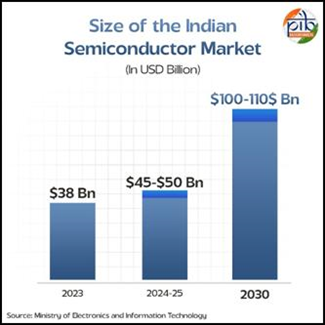
- Context: Semicon India Programme with approval of 10 projects and expansion of the IT sector to USD 283 billion, showcasing India’s tech competitiveness.
-
- Semicon India Programme advances complete chip ecosystem.
- Includes design, fabrication, assembly, testing, packaging and modules.
- Aligns with Atmanirbhar Bharat / Make in India vision.
- IT sector revenue at USD 283 billion reflects India’s global role.
- Chips critical for AI, telecommunications, EVs and defence tech.
- Projects approved likely generate investment and jobs.
- Ecosystem development addresses global semiconductor supply chain gaps.
- Supports India’s digital economy and export push.
- Strategic autonomy in technology reduces import dependency.
- Complements Budget emphasis on 7 strategic and frontier sectors.
(PIB)
Geography, Mapping, Ecology & Environment
Karuna Abhiyan Bird Rescue in Gujarat:
-
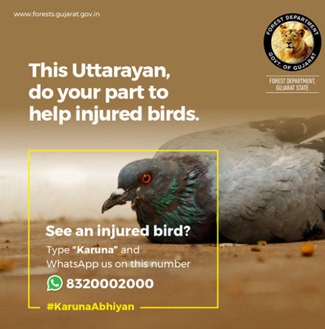
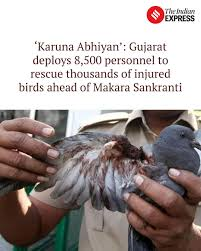
- Context: In Gujarat, the Karuna Abhiyan (Compassion Campaign) for injured birds saw over 18 lakh birds rescued over ten years, emphasising wildlife protection during the kite festival (Uttarayan).
-
- Karuna Abhiyan launched in 2017 to care for injured birds during Uttarayan kite flying.
- Gujarat Forest Department coordinates rescue operations across all 33 districts.
- Birds injured mainly by manja (kite strings).
- Over 1.18 lakh birds treated in last decade.
- Recovery rate of ~90 % due to better medical care.
- Major hospitals and vets contribute to treatment and rehabilitation.
- Pigeons, black kites, crows and sparrowhawks were common beneficiaries.
- Reflects community-government synergy in wildlife protection.
- Highlights conflict between cultural practices and animal welfare.
- Relevant for Animal Welfare Board of India norms and bird conservation policy.
(IE)
Important data/facts
Polity and Governance
Over 2.5 Crore Aadhaar Deactivations to Curb Identity Fraud:
-
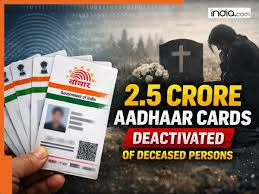
- Context: Over 2.5 crore Aadhaar numbers of deceased persons were deactivated to reduce identity misuse and fraud.
-
- Aadhaar is India’s unique biometric identity system.
- Deactivations reduce risk of identity fraud in financial/benefit systems.
- Process involves integration with death registries.
- Enhances public service delivery integrity.
- Prevents fraud in banking, subsidies, welfare schemes.
- Demonstrates data governance and updating administrative databases.
- Aligns with Digital India and e-governance priorities.
- Check and balance on ghost beneficiaries.
- Strengthens authentication ecosystems.
- Impacts financial inclusion metrics.
(PIB)
Miscellaneous
World Cancer Day 2026:
-
- Context: World Cancer Day is observed annually on 4 February to raise awareness about cancer prevention, early detection, treatment, and care.
- It also calls for stronger health systems, global cooperation, and policy prioritisation to reduce the cancer burden.
- The theme for this cycle (2025-27) is “United by Unique.”
- World Cancer Day is observed globally on 4 February every year.
- It was established in 2000 at the World Summit Against Cancer for the New Millennium in Paris.
- The day is led by the Union for International Cancer Control (UICC).
- The 2025-27 theme “United by Unique” emphasises personalised, patient-centred care and equity in cancer control.
- Cancer is one of the leading causes of death globally, with a rising incidence in India.
- Early detection and prevention are considered key strategies for reducing mortality.
- Four in ten cancer cases are estimated to be preventable through lifestyle and screening measures.
- National guidelines (e.g., for lung cancer care) and screening initiatives support early diagnosis and standardised treatment.
- World Cancer Day also highlights health equity, addressing disparities in care access and affordability.
- Tobacco control, immunisation (HPV, hepatitis), diet, and environmental risk reduction remain policy priorities.

(HT)
Spread the Word